Young Lady in 1866
Édouard Manet · 1866
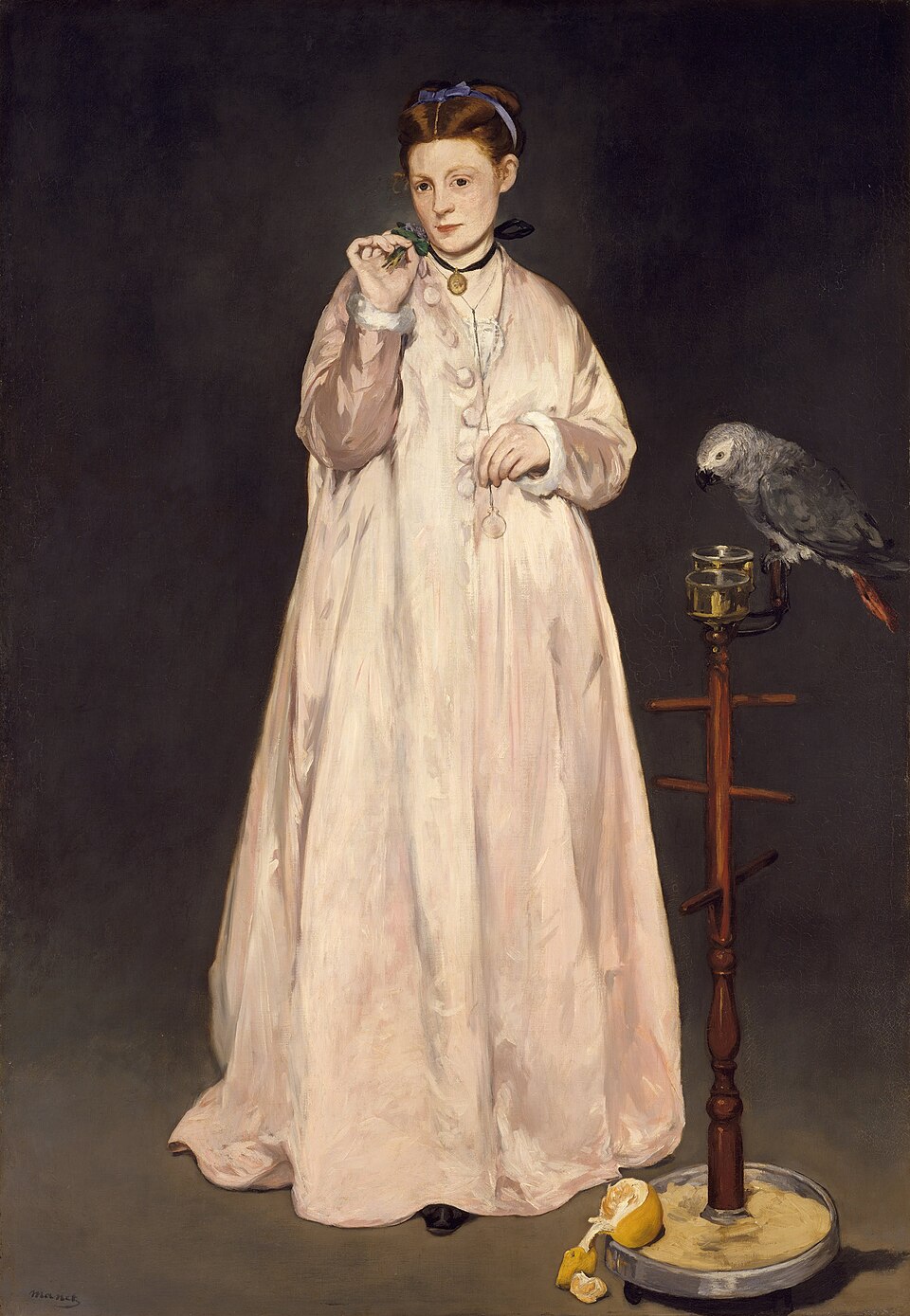
Victorine Meurent stands in a long pink peignoir, a few violets in her hand, beside an African grey parrot on its perch. Manet called her simply a young lady of 1866; the public called her the Lady with a Parrot.
The story behind the painting
Édouard Manet painted this large canvas, nearly two metres tall, in 1866. His model was his favourite sitter, Victorine Meurent. He first showed it in May 1867 at his own exhibition on the Avenue de l'Alma in Paris, as number 15, titled Jeune dame en 1866. It went on to the Paris Salon of 1868. There, its realism and its parrot reminded viewers of Gustave Courbet's Woman with a Parrot, a nude that had caused a scandal at the 1866 Salon, and Manet's painting was criticised in turn. It had been shown as Lady in Pink, then as A Young Lady, but the public nickname stuck: Lady with a Parrot.
What to look for
Victorine stands full length, wearing a long pink peignoir, a loose dressing gown that falls in soft folds to the floor. In one hand she holds a small bouquet of violets. Beside her, an African grey parrot sits on its tall perch, and around her neck hangs a pendant. Notice how plainly Manet sets her against the background, letting the soft pink of the gown and her red hair carry the picture. There is no story being acted out, no mythological disguise. A young woman, a pet bird and a few flowers are enough, and that directness is what struck viewers in 1868.
Meaning and intent
The title itself is a statement. By calling the picture Young Lady in 1866, Manet presents not a goddess or a heroine but a woman of his own day, fixed to a particular year. The obvious comparison with Courbet's nude, painted the same year with the same bird, sharpened the point: Manet's young lady is fully dressed, at home and calm, yet critics still found the painting too frank. The sources do not record Manet explaining his intentions, so the meaning rests in what he chose to show, an ordinary modern moment treated at the grand scale usually reserved for important subjects.
Legacy
Manet sold the painting in 1872 to the dealer Durand-Ruel, and it passed through the hands of Ernest Hoschedé, the friend of Claude Monet, before crossing to New York. There Erwin Davis acquired it, and on 21 March 1889 he gave it to the Metropolitan Museum of Art, together with Manet's Boy Carrying a Sword and Jules Bastien-Lepage's Joan of Arc. With Boy Carrying a Sword, it became one of the first two works by Manet to enter any gallery collection. Today it hangs in the same museum as Courbet's Woman with a Parrot, so visitors can still compare the two paintings that were once set against each other.
Schon gewusst?
- The model is Victorine Meurent, Manet's favourite sitter.
- It was first shown in May 1867 at Manet's own exhibition on the Avenue de l'Alma.
- It and Boy Carrying a Sword were the first works by Manet to enter a gallery collection.
- Erwin Davis gave it to the Metropolitan Museum of Art in 1889.
Über den Künstler
Édouard Manet (1832-1883)
Porträt · Metropolitan Museum of Art · Kleid · Stehen · rothaarig · Victorine Meurent · Scheitel
Mehr von Édouard Manet
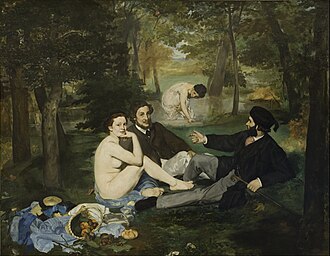 Das Frühstück im Grünen - Édouard Manet (1863)
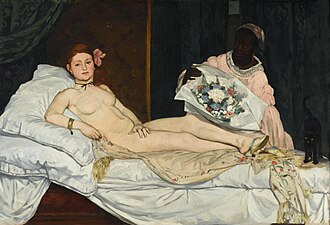 Olympia - Édouard Manet (1863)
%20(33539037428).jpg) Bar in den Folies-Bergère - Édouard Manet (1882)
Bar in den Folies-Bergère - Édouard Manet (1882)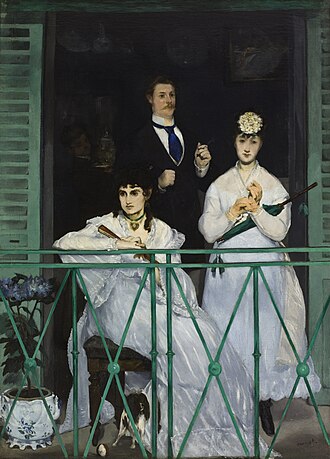 Der Balkon - Édouard Manet (1868)
.jpg) Musik im Tuileriengarten - Édouard Manet (1862)
Musik im Tuileriengarten - Édouard Manet (1862).jpg) Der Pfeifer - Édouard Manet (1866)
Der Pfeifer - Édouard Manet (1866) Die Eisenbahn - Édouard Manet (1873)
 Berthe Morisot mit Veilchenstrauß - Édouard Manet (1872)
Werke verwandter Künstler
 Impression, Sonnenaufgang - Claude Monet (1872)
 Seerosen - Claude Monet (1906)
 Tanz im Moulin de la Galette - Pierre-Auguste Renoir (1876)
 Das Frühstück der Ruderer - Pierre-Auguste Renoir (1881)
 Der Absinth - Edgar Degas (1875)
 Die Bellelli Familie - Edgar Degas (1858)
 Die Sternennacht - Vincent van Gogh (1889)
.jpg) Caféterrasse am Abend - Vincent van Gogh (1888)
Caféterrasse am Abend - Vincent van Gogh (1888) Die letzte Fahrt der Temeraire - J. M. W. Turner (1839)
 Rain, Steam and Speed - The Great Western Railway - J. M. W. Turner (1844)
 Woher kommen wir? Wer sind wir? Wohin gehen wir? - Paul Gauguin (1897-1898)
%201889.jpg) Der gelbe Christus - Paul Gauguin (1889)
Der gelbe Christus - Paul Gauguin (1889)