Women Going to the Woods
Alfred Sisley · 1866
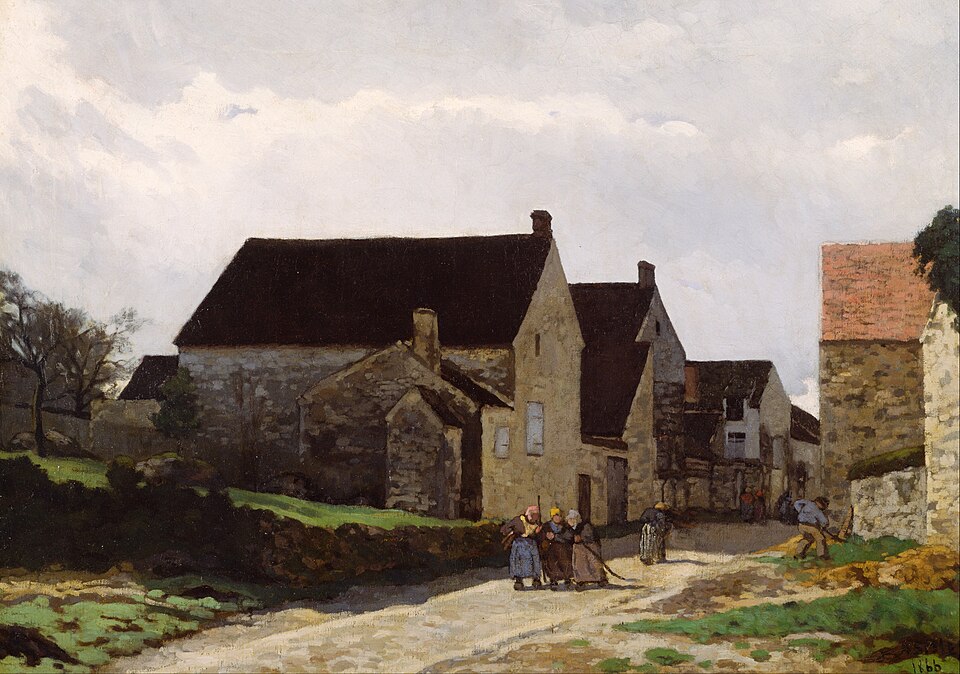
A village street tilts away between sunlit walls and heavy roofs, and women wrapped against the cold set off for the forest. Sisley painted it at Marlotte in 1866, years before anyone spoke of Impressionism.
The story behind the painting
In February 1866 Sisley, Renoir and Renoir's friend Jules Le Cœur crossed the forest of Fontainebleau on foot, by way of Milly and Courances, to reach Marlotte on the southern edge of the forest near the Loing, where Le Cœur had bought a house the year before. Monet and Bazille were working nearby at Chailly-en-Bière. Renoir painted Sisley and Le Cœur at the inn of Mother Anthony that same year. Sisley had known the village since the early 1860s and began two canvases of it there.
What to look for
The picture, also called Village Street in Marlotte, Women Going to the Woods, is built on the diagonal of the village street, which tips as its perspective meets strongly marked walls, houses and roofs. The buildings are shaped by broad contrasts of light and shade, recalling Corot's oil sketches from nature, a method also used by Monet and Pissarro in those years. The women in the street are bundled up against the cold, a detail that shows Sisley's interest in the seasons. The canvas measures about 65 by 92 cm.
Meaning and intent
Figures in a landscape traditionally added a picturesque touch of rural life. Here they seem more than decoration. The women are probably heading into the forest to gather wood, the wood a man is cutting in the second canvas Sisley sent to the same Salon. The French Wikipedia suggests that Sisley may have followed Constable, for whom a working landscape should be inhabited by working people who belong to its purpose. The village, the cold and the labour form one quiet whole.
Legacy
The two Marlotte canvases, modest in size beside his Chestnut Avenue at La Celle-Saint-Cloud of 1865, were finished in April 1866 and shown at the Salon that May. Works by Pissarro of the Marne also hung at that Salon. The painting is described as pre-Impressionist. It was later acquired by Shōjirō Ishibashi and passed through the Bridgestone Gallery to the Bridgestone Museum of Art in Tokyo, known today as the Artizon Museum, where it remains.
Schon gewusst?
- Painted at Marlotte in 1866.
- Shown at the Paris Salon of May 1866.
- Also called Village Street in Marlotte.
- Now in the Artizon Museum, Tokyo.
Über den Künstler
Alfred Sisley (1839-1899)
Mehr von Alfred Sisley
 Der Kanal von Loing - Alfred Sisley (1892)
 The Watering Pond at Marly with Hoarfrost - Alfred Sisley (1876)
 Aquädukt von Marly - Alfred Sisley (1874)
 Schnee in Louveciennes - Alfred Sisley (1875)
 Maschinenhaus der Pumpe in Marly - Alfred Sisley (1873)
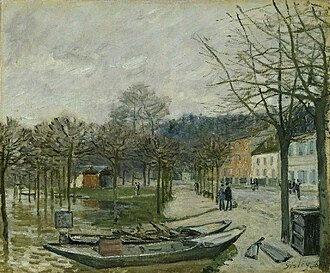 The Flood at Port Marly - Alfred Sisley (1876)
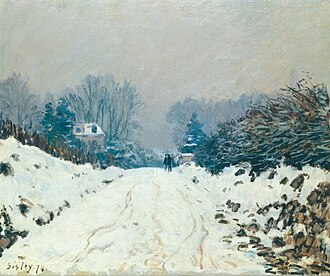 Schneelandschaft in Louveciennes - Alfred Sisley (1874)
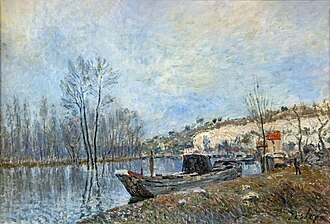 Die Ufer des Loing in Richtung Moret - Alfred Sisley (1883)
Werke verwandter Künstler
 Impression, Sonnenaufgang - Claude Monet (1872)
 Seerosen - Claude Monet (1906)
 Das Frühstück im Grünen - Édouard Manet (1863)
 Olympia - Édouard Manet (1863)
 Tanz im Moulin de la Galette - Pierre-Auguste Renoir (1876)
 Das Frühstück der Ruderer - Pierre-Auguste Renoir (1881)
 Wiege - Berthe Morisot (1872)
 Sommertag - Berthe Morisot (1879)
 Der Absinth - Edgar Degas (1875)
 Die Bellelli Familie - Edgar Degas (1858)
 Straße in Paris an einem regnerischen Tag - Gustave Caillebotte (1877)
 Die Parkettschleifer - Gustave Caillebotte (1875)