Maschinenhaus der Pumpe in Marly
Alfred Sisley · 1873
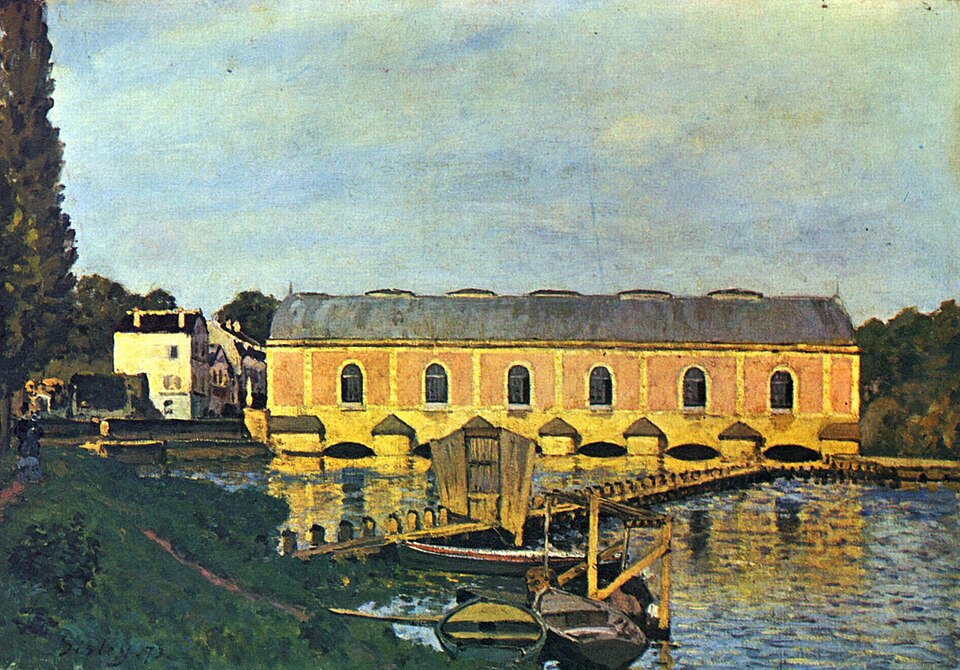
A brick pumping house sits on the Seine, its reflection trembling in the ripples. Sisley painted the Machine de Marly at Bougival in 1873, and a critic of the time called it the absolute realisation of what the new school wanted from landscape.
The story behind the painting
The Machine de Marly was the pumping station on the Seine between Port-Marly and the île de la Loge. Under Napoleon III it was replaced between 1855 and 1859, and the building Sisley painted was destroyed in 1968. Sisley set up downstream on the left bank at Bougival, where a paved path descends to the river just before a little lane under ash and chestnut trees. From there he painted the brick shed that covered the machine. It was one of many views he made of this stretch of river, and the canvas measures 46 by 65 cm.
What to look for
Look first at the water. Sisley painted the reflection of the building breaking up in the small lapping waves of the Seine, so that the solid brick house dissolves into moving colour below. The pumping house stands as the subject, but the river, the air and the light around it carry the picture. This is the quality that struck the critic Ernest Chesneau. He wrote that he knew of no painting, past or present, that gave so completely, so perfectly, the physical sensation of the atmosphere, of the open air, and that this was something entirely new in painting.
Meaning and intent
François Daulte suggested that this was one of the six canvases Sisley showed at the first Impressionist exhibition in 1874, five in the catalogue and one outside it. Nothing proves it was number 163, La Seine à Port-Marly, but the critics praised the picture. Sisley returned to the spot again and again: the ferry to the île de la Loge in flood and in calm, the Barrage de la Machine de Marly of 1873 and of 1876, and, during the flood of 1876, another Machine de Marly now in Boston. Camille Pissarro painted the same view in 1871 as Barrage sur la Seine à Bougival.
Legacy
The painting passed through the Galerie Bernheim-Jeune and the collector Levesque in Paris before entering the Statens Museum for Kunst in Copenhagen in 1914. It is on long-term loan to the Ny Carlsberg Glyptotek in the same city. In Bougival a reproduction has been placed along a Pays des Impressionnistes walking route on the quai Rennequin Sualem, near where it was painted, and a full-size reproduction of the Barrage de la Machine de Marly has stood by the river since the 1990s. The house on the île de la Loge that Sisley often painted still stands today.
Schon gewusst?
- Painted at Bougival in 1873, 46 by 65 cm.
- Possibly shown at the first Impressionist exhibition in 1874.
- Owned by the Statens Museum for Kunst since 1914, on loan to the Ny Carlsberg Glyptotek.
- The building Sisley painted was destroyed in 1968.
Über den Künstler
Alfred Sisley (1839-1899)
Landschaftsmalerei · Impressionismus · Baum · Himmel · Seine · Barke · Ufer · optische Reflexion · Ny Carlsberg Glyptotek · Statens Museum for Kunst
Mehr von Alfred Sisley
 Der Kanal von Loing - Alfred Sisley (1892)
 The Watering Pond at Marly with Hoarfrost - Alfred Sisley (1876)
 Aquädukt von Marly - Alfred Sisley (1874)
 Schnee in Louveciennes - Alfred Sisley (1875)
 The Flood at Port Marly - Alfred Sisley (1876)
 Schneelandschaft in Louveciennes - Alfred Sisley (1874)
 Die Ufer des Loing in Richtung Moret - Alfred Sisley (1883)
 The Seine at Bougival - Alfred Sisley (1873)
Werke verwandter Künstler
 Impression, Sonnenaufgang - Claude Monet (1872)
 Seerosen - Claude Monet (1906)
 Das Frühstück im Grünen - Édouard Manet (1863)
 Olympia - Édouard Manet (1863)
 Tanz im Moulin de la Galette - Pierre-Auguste Renoir (1876)
 Das Frühstück der Ruderer - Pierre-Auguste Renoir (1881)
 Wiege - Berthe Morisot (1872)
 Sommertag - Berthe Morisot (1879)
 Der Absinth - Edgar Degas (1875)
 Die Bellelli Familie - Edgar Degas (1858)
 Straße in Paris an einem regnerischen Tag - Gustave Caillebotte (1877)
 Die Parkettschleifer - Gustave Caillebotte (1875)