Frau bei der Toilette
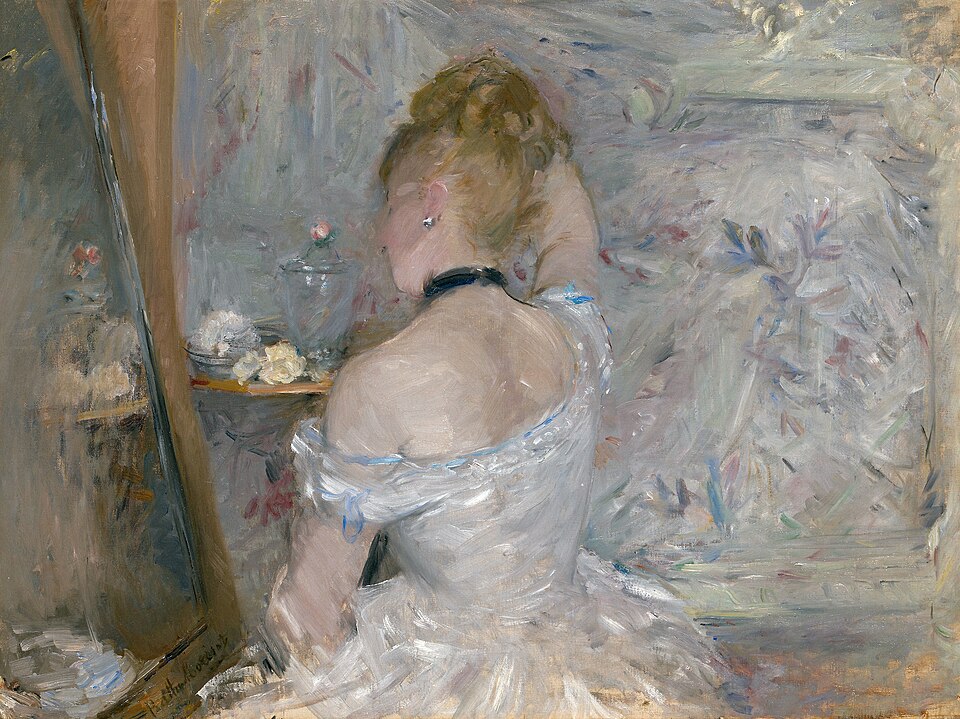
A woman stands at her mirror with her back to us, wrapped in silver, white and a breath of blue. Berthe Morisot painted a private moment, and critics who called similar scenes by men improper called hers charming.
The story behind the painting
Berthe Morisot painted Woman at her Toilette, also known as Lady at her Toilet, between 1875 and 1880; Wikidata gives no single year. It is one of seven toilette paintings in which she showed women dressing, making up and arranging their hair, scenes she could witness herself as a bourgeois woman. Female artists had limited access to models, so Morisot often asked her women friends to pose. As a wife and mother she also had to balance her ambitions with domestic duties, and the critic Theodore Duret felt her gender and class lowered her reputation.
What to look for
The canvas, about 60 by 80 cm, shows a woman before a mirror in her bathroom, turned away from the viewer. The palette is silvery grey and white with subtle hints of blue. Morisot took inspiration from the sketches of Jean-Honore Fragonard, and the Rococo shows in the pastel, dreamlike colours, the loose brushwork and the blurred edges. Kathleen Adler suggests the sketchy freedom may reflect Morisot's stable position, which spared her from depending only on dealers. Many critics read the silvery blue as proof of her attention to natural light.
Meaning and intent
Historians disagree on what the scene means. Kathleen Adler and Tamar Garb see it in line with its era's idea of womanhood, the toilette as the place where women turned themselves into objects of male pleasure. Anne Higonnet sees instead a moment of female creativity, where a woman produces her self-image, and argues Morisot turned eroticism into an empty spectacle by refusing the viewer what he expects. Her women are absorbed in themselves and turn us away. Cindy Kang adds that the gestural brushwork shifts the focus to the sitter's state of mind.
Legacy
The painting was shown at the fifth Impressionist exhibition in 1880, beside works by Cezanne, Renoir and Pissarro, and it became one of Morisot's most critically successful pictures. Joris-Karl Huysmans called her the chronicler of the boudoir. While bathing scenes by Manet and Degas were linked in the press with prostitution, Morisot's were called charming, chaste and elegant. Ernest Hoschede, a patron of Manet and Morisot, bought it in January 1876 from the dealer Paul Durand-Ruel, and in June 1878 Mary Cassatt acquired it from his collection. It is now in the Art Institute of Chicago.
Schon gewusst?
- Painted between 1875 and 1880.
- Shown at the fifth Impressionist exhibition in 1880.
- Once owned by the painter Mary Cassatt.
- Now in the Art Institute of Chicago.
Über den Künstler
Berthe Morisot (1841-1895)
Frau · Genreszene · Art Institute of Chicago
Mehr von Berthe Morisot
 Wiege - Berthe Morisot (1872)
 Sommertag - Berthe Morisot (1879)
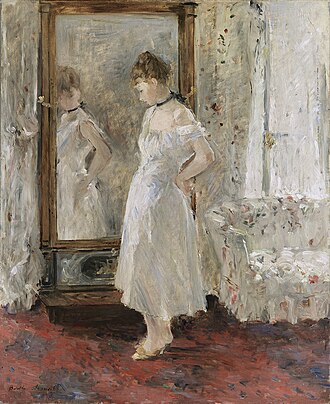 The Psyche mirror - Berthe Morisot (1876)
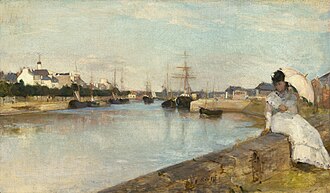 Der Hafen von Lorient - Berthe Morisot (1869)
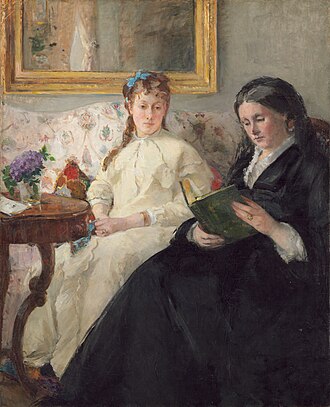 Mutter und Schwester der Künstlerin - Berthe Morisot
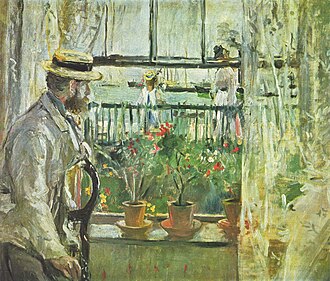 Eugène Manet auf der Isle of Wight - Berthe Morisot (1875)
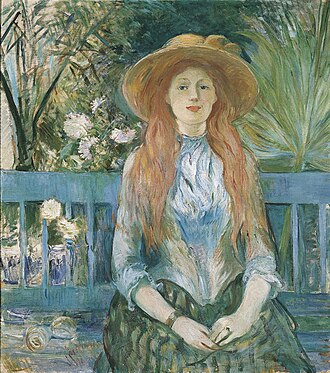 Junges Mädchen in einem Park - Berthe Morisot (1893)
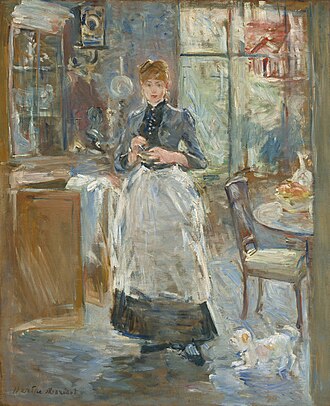 Im Dining Room - Berthe Morisot (1886)
Werke verwandter Künstler
 Impression, Sonnenaufgang - Claude Monet (1872)
 Seerosen - Claude Monet (1906)
 Das Frühstück im Grünen - Édouard Manet (1863)
 Olympia - Édouard Manet (1863)
 Tanz im Moulin de la Galette - Pierre-Auguste Renoir (1876)
 Das Frühstück der Ruderer - Pierre-Auguste Renoir (1881)
 Der Absinth - Edgar Degas (1875)
 Die Bellelli Familie - Edgar Degas (1858)
 Der Kanal von Loing - Alfred Sisley (1892)
 The Watering Pond at Marly with Hoarfrost - Alfred Sisley (1876)
 Straße in Paris an einem regnerischen Tag - Gustave Caillebotte (1877)
 Die Parkettschleifer - Gustave Caillebotte (1875)