Im Dining Room
Berthe Morisot · 1886
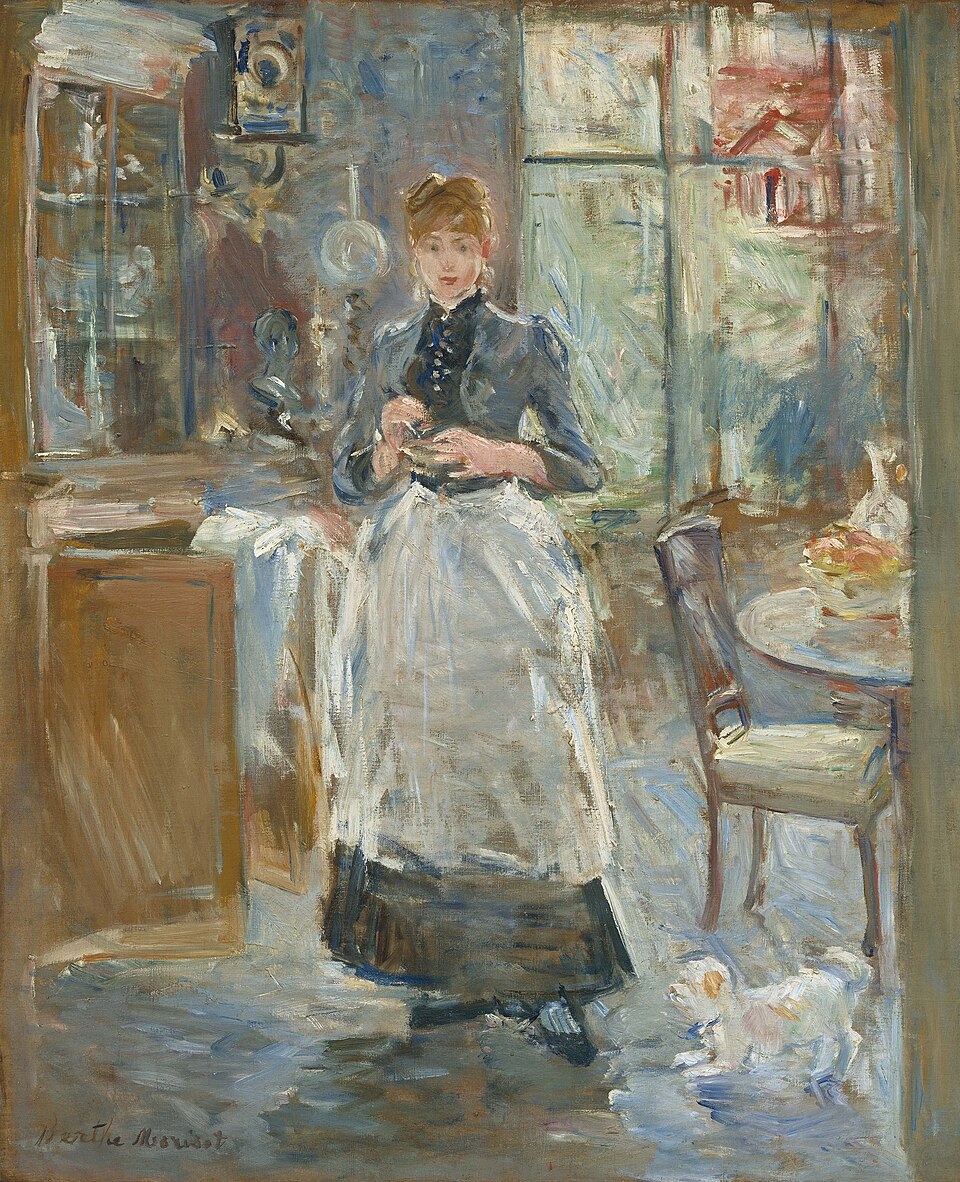
A young woman in a white apron stands in a dining room, looks straight at us and seems to welcome us in, while a small dog barks at her feet. Berthe Morisot painted it in 1886 with brushstrokes so wild that some critics called it unfinished.
The story behind the painting
Berthe Morisot was highly regarded among the Impressionists. Where her mostly male colleagues sought modern city life in streets, cafes, parks and bridges, she, like Mary Cassatt, often chose indoor domestic subjects and used acquaintances and relatives as models, a choice that suited a woman's role in society at the time, however progressive she was. She painted In the Dining Room in 1886 and showed it that year at the eighth and last major Impressionist exhibition.
What to look for
At the centre stands a young woman in an ankle-length black skirt, a short grey-blue jacket and a white apron that marks her, apparently, as a maid. Her hands are busy with something we cannot quite make out. On the left is a cluttered cabinet of glass and porcelain; on the right a table with fruit like a small still life, and a little dog crouches barking at the bottom right. The wall glows in blue, pink, purple and brown, the window in strips of white, green, yellow and grey, with red roofs beyond. Hasty strokes run in every direction and blur several places.
Meaning and intent
The streaky handling gives the picture movement, unrest and complexity, yet the domestic theme brings a certain calm. The woman looks at the viewer relaxed, barely posing. Her role as a servant is not stressed, almost the opposite: she seems friendly, charming and warm, as if welcoming us. Morisot also makes us curious about who she really is, consciously using the wild, bristly style of her later period to raise the emotional charge of a simple everyday moment.
Legacy
At the 1886 exhibition critics mainly remarked on her wild, streaky method, never before so emphatic in her work. Some called the picture unfinished, while the critic Jules-Antoine Castagnary wrote that Morisot had an extraordinary artistic feeling. In the early twentieth century the painting belonged to the French collector Eugène Blot, and later to American collectors, including the banker Chester Dale, from whose estate it came to the National Gallery of Art in Washington, D.C., in 1963.
Schon gewusst?
- Painted in 1886 and shown at the last Impressionist exhibition.
- Some critics called it unfinished; Castagnary praised it.
- Painted in the wild, streaky style of Morisot's later years.
- In the National Gallery of Art, Washington, since 1963.
Über den Künstler
Berthe Morisot (1841-1895)
Genreszene · National Gallery of Art
Mehr von Berthe Morisot
 Wiege - Berthe Morisot (1872)
 Sommertag - Berthe Morisot (1879)
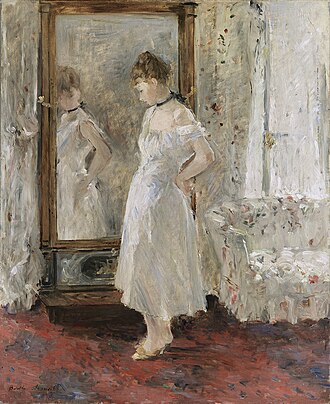 The Psyche mirror - Berthe Morisot (1876)
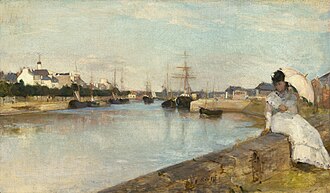 Der Hafen von Lorient - Berthe Morisot (1869)
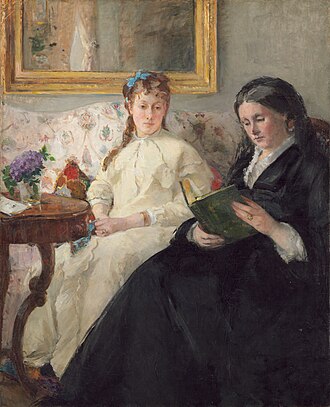 Mutter und Schwester der Künstlerin - Berthe Morisot
 Eugène Manet auf der Isle of Wight - Berthe Morisot (1875)
 Junges Mädchen in einem Park - Berthe Morisot (1893)
 Bergère nue couchée - Berthe Morisot (1891)
Werke verwandter Künstler
 Impression, Sonnenaufgang - Claude Monet (1872)
 Seerosen - Claude Monet (1906)
 Das Frühstück im Grünen - Édouard Manet (1863)
 Olympia - Édouard Manet (1863)
 Tanz im Moulin de la Galette - Pierre-Auguste Renoir (1876)
 Das Frühstück der Ruderer - Pierre-Auguste Renoir (1881)
 Der Absinth - Edgar Degas (1875)
 Die Bellelli Familie - Edgar Degas (1858)
 Der Kanal von Loing - Alfred Sisley (1892)
 The Watering Pond at Marly with Hoarfrost - Alfred Sisley (1876)
 Straße in Paris an einem regnerischen Tag - Gustave Caillebotte (1877)
 Die Parkettschleifer - Gustave Caillebotte (1875)