Winterlandschaft mit Eisläufern und Vogelfalle
Pieter Bruegel the Elder · 1565
%20-%20Winterlandschap%20met%20schaatsers%20en%20vogelknip%2C%201565.jpg)
Villagers skate and play on a frozen river while, on the near bank, birds peck at scattered bait under a propped-up door. One tug of the rope and it falls. No Bruegel was copied more often than this quiet winter scene.
The story behind the painting
Bruegel signed and dated this small panel at the lower right in 1565, during a short period when he painted five snowy landscapes and so established the winter landscape as a genre in Western art. The same year produced The Hunters in the Snow. The group has often been linked to a sharp drop in winter temperatures in northern Europe, especially the very hard winter of 1564 to 1565. The village is said to be based on Sint-Anna-Pede near Brussels, whose church also appears in The Blind Leading the Blind. The panel, about 37 by 56 cm, is now in the Oldmasters Museum in Brussels.
What to look for
People skate, play curling and walk on the frozen river and the far bank. On the near bank at the right there are no people, only birds. The three birds in the nearest trees, being closer to us, are at least as large as the humans on the ice. Below them an old door is propped up on a stick, and a rope runs from it to one of the houses; birds crowd around the bait scattered underneath. Look also for the hole in the ice. The painting was done quickly, largely wet-in-wet, and some reddish tones may have been reworked by a later hand.
Meaning and intent
The bird trap was not in the underdrawing and no space was left for it, so Bruegel painted it over the snow at a late stage, as if the idea came to him while working. Art historians have tried many times to find a moral or allegorical meaning: the birds feeding unaware beside the trap, the skaters on thin ice. None of these readings has won wide acceptance. That openness is part of the picture's hold. Two worlds sit side by side, the busy human one on the ice and the still, waiting one of the birds, and Bruegel does not tell us what to think.
Legacy
No painting by Bruegel was copied more. In 2000 the art historian Klaus Ertz documented 127 copies, 45 of them by Bruegel's son Pieter Brueghel the Younger, whose dated copies run from 1601 to 1626; others are doubtful or rejected. Each copy shifts details, such as the curling game, the trap or the hole in the ice, and two even add the Rest on the Flight into Egypt. With so many copies, the Brussels original was only rediscovered in 1925 and doubted for years, until a 2012 re-investigation confirmed it. It was bequeathed to the museum in 1973 by Mrs Delporte-Livrauw and Dr Franz Delporte.
Schon gewusst?
- Signed and dated 1565, about 37 x 56 cm.
- One of five snowy landscapes that founded the winter landscape genre.
- Klaus Ertz documented 127 early copies in 2000.
- Bequeathed to the Oldmasters Museum, Brussels, in 1973.
Über den Künstler
Pieter Bruegel the Elder (1525-1569)
Genreszene · Landschaftsmalerei · Himmel · Schnee · Königliche Museen der Schönen Künste · Winter · Eis
Mehr von Pieter Bruegel the Elder
%20-%20Google%20Art%20Project.jpg) Die Jäger im Schnee - Pieter Bruegel the Elder (1565)
Die Jäger im Schnee - Pieter Bruegel the Elder (1565)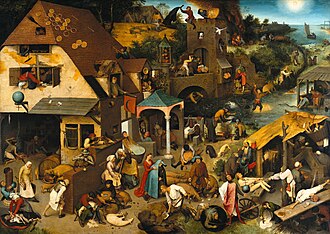 Die niederländischen Sprichwörter - Pieter Bruegel the Elder (1551)
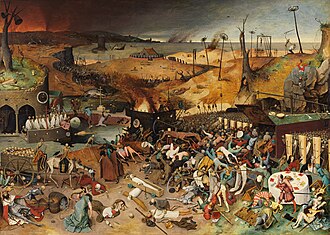 Der Triumph des Todes - Pieter Bruegel the Elder (1560s)
%20-%20Blind%20leading%20the%20blind%20Google%20Art%20Project.jpeg) Der Blindensturz - Pieter Bruegel the Elder (1568)
Der Blindensturz - Pieter Bruegel the Elder (1568)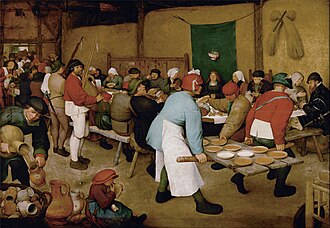 Die Bauernhochzeit - Pieter Bruegel the Elder (1560s)
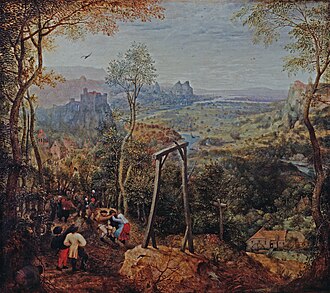 Die Elster auf dem Galgen - Pieter Bruegel the Elder (1568)
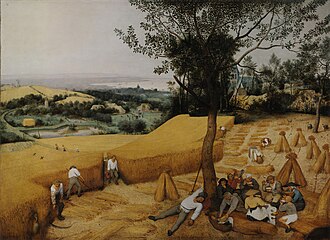 Die Kornernte - Pieter Bruegel the Elder (1565)
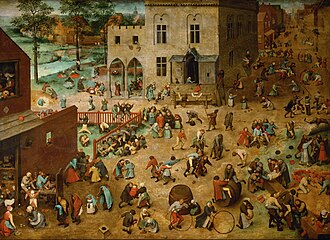 Die Kinderspiele - Pieter Bruegel the Elder (1560)
Werke verwandter Künstler
 Der Garten der Lüste - Hieronymus Bosch
 Das Narrenschiff - Hieronymus Bosch (1500s)
 Die Gesandten - Hans Holbein the Younger (1533)
 Der Leichnam Christi im Grabe - Hans Holbein the Younger (1520s)