Der Wein zum Fest des heiligen Martin
Pieter Bruegel the Elder · 1560s
%20(restaurada).jpg)
A crowd of peasants presses around a huge barrel, scrambling for the first wine of the season, while Saint Martin quietly cuts his cloak for a beggar at the edge. Bruegel's largest painting was only recognised as his in 2010.
The story behind the painting
The Wine of Saint Martin's Day is the largest known painting by Pieter Bruegel the Elder, about 148 by 270.5 cm. It shows the festival of 11 November, when the first wine of the season was drunk. The picture is not dated; it has been placed in the 1560s on grounds of style. Its early history is uncertain. It matches the description of a painting in the collection of the Gonzaga dukes of Mantua in the early seventeenth century, but that may have been a related painting now in Vienna. The first record that surely concerns this work is an early eighteenth-century inventory of the ninth Duke of Medinaceli.
What to look for
At first the eye goes to the throng of figures crowding toward the wine, a whole village on the move. Then look for what they ignore: a roadside cross, which the peasants seem not to notice, and a group alluding to the legend of Saint Martin of Tours dividing his cloak to share it with a beggar. Bruegel places this important theme at the side of the picture, as he does in Landscape with the Fall of Icarus, where ordinary life fills the centre. The painting is made in glue-size on linen, a fragile technique called Tüchlein, so its colours are matte and delicate.
Meaning and intent
Although it is not a religious painting as such, it carries Christian references set against the scramble for drink. The cross by the road and the saint's act of charity sit quietly beside the crowd's appetite, leaving the viewer to notice the contrast. Bruegel often painted peasant life with this double view, lively and observant, but with the deeper meaning pushed to the margins where only an attentive eye will find it. The sources do not record what Bruegel himself intended, so the meaning grows from what he chose to show and where he chose to place it.
Legacy
By the early twenty-first century the canvas was in poor condition, not surprising for such a fragile medium; Bruegel's The Blind Leading the Blind, made the same way, has survived better. Its owners brought it to the Museo del Prado in Madrid for restoration, and in 2010 X-ray study of the surface revealed fragments of Bruegel's signature, confirming his authorship. The Prado then acquired the painting, and after restoration put it on public display. It is one of only a few surviving works by Bruegel in glue-size on linen, and a rare chance to see his art at its largest scale.
Schon gewusst?
- Bruegel's largest known painting, about 148 x 270.5 cm.
- Painted in glue-size on linen (Tüchlein), dated to the 1560s by style.
- Identified as a Bruegel at the Prado in 2010 through traces of his signature.
- Shows the 11 November festival of the new wine.
Über den Künstler
Pieter Bruegel the Elder (1525-1569)
Genreszene · Museo del Prado · Wein
Mehr von Pieter Bruegel the Elder
%20-%20Google%20Art%20Project.jpg) Die Jäger im Schnee - Pieter Bruegel the Elder (1565)
Die Jäger im Schnee - Pieter Bruegel the Elder (1565) Die niederländischen Sprichwörter - Pieter Bruegel the Elder (1551)
 Der Triumph des Todes - Pieter Bruegel the Elder (1560s)
%20-%20Blind%20leading%20the%20blind%20Google%20Art%20Project.jpeg) Der Blindensturz - Pieter Bruegel the Elder (1568)
Der Blindensturz - Pieter Bruegel the Elder (1568) Die Bauernhochzeit - Pieter Bruegel the Elder (1560s)
 Die Elster auf dem Galgen - Pieter Bruegel the Elder (1568)
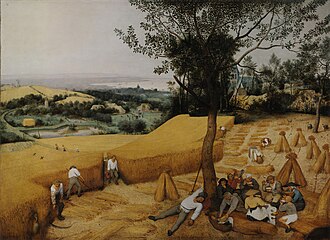 Die Kornernte - Pieter Bruegel the Elder (1565)
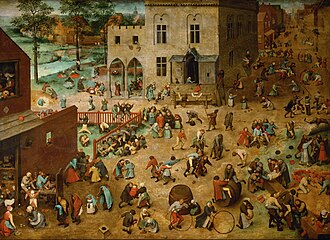 Die Kinderspiele - Pieter Bruegel the Elder (1560)
Werke verwandter Künstler
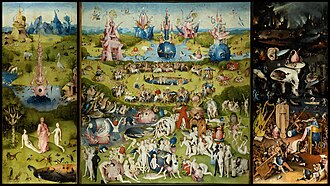 Der Garten der Lüste - Hieronymus Bosch
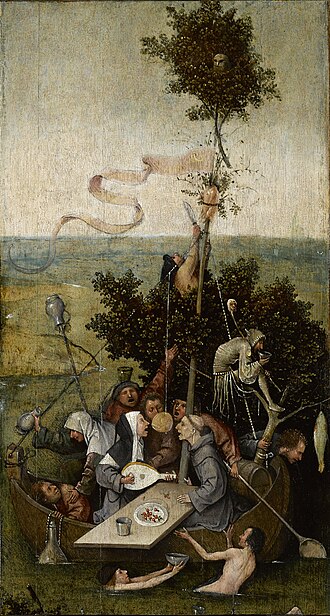 Das Narrenschiff - Hieronymus Bosch (1500s)
 Die Gesandten - Hans Holbein the Younger (1533)
 Der Leichnam Christi im Grabe - Hans Holbein the Younger (1520s)