Distel
Édouard Manet · 1858
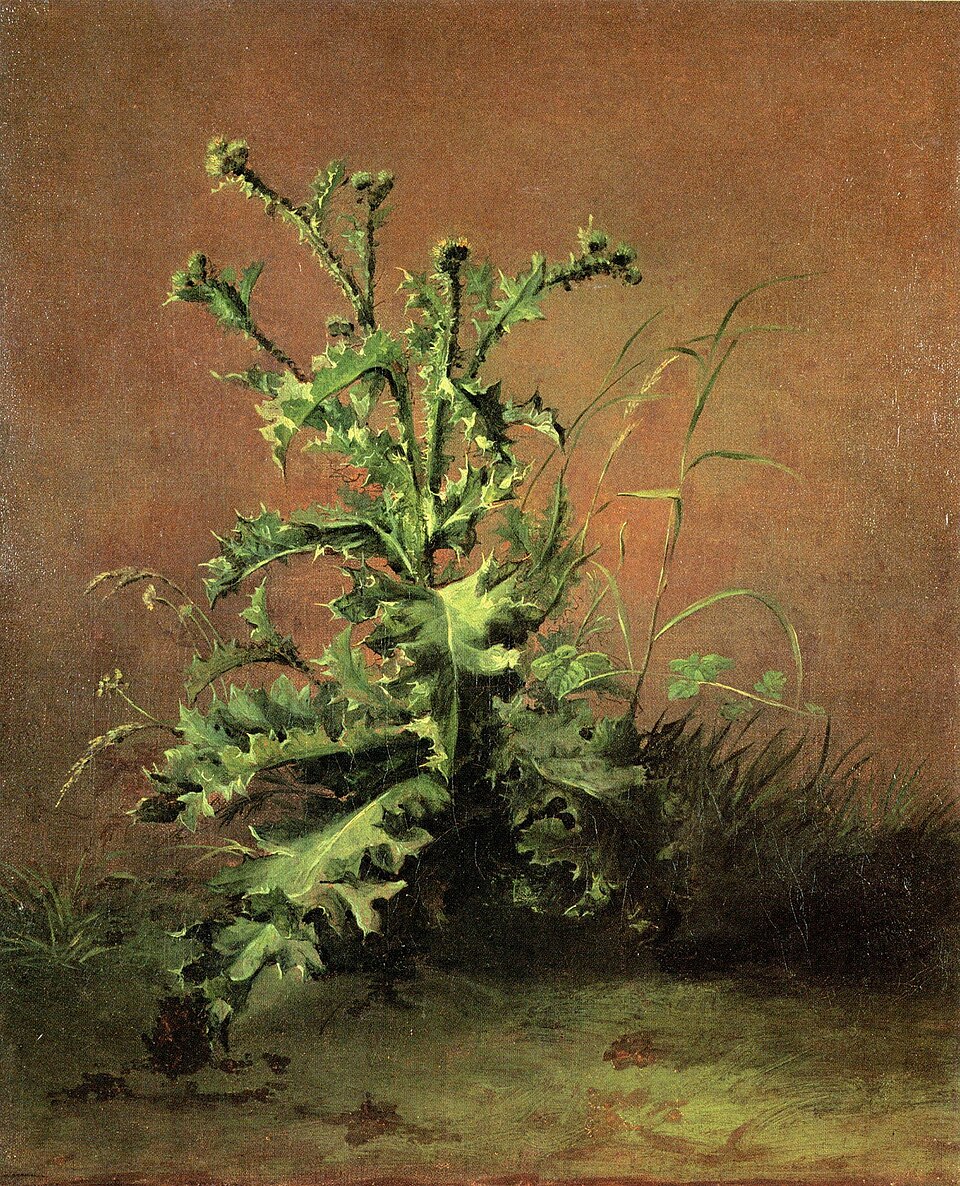
A single thistle, almost life-size, seen close to the ground against a reddish-brown background. Manet's wife wrote on the back that he painted it in 1880, yet many historians believe it came twenty years earlier.
The story behind the painting
The picture is neither signed nor dated, and historians have reached very different dates. The Von der Heydt Museum in Wuppertal, which owns it, has at times given 1880, probably because of an inscription on the back by Suzanne Manet, the painter's wife, certifying that her husband painted this thistle at Bellevue in 1880. Manet did stay at Bellevue, near Meudon, for a cure in summer 1880, already seriously ill with paralysis in his leg caused by syphilis, and the thistle's link with pain might have drawn him to the subject. But in 1931 his biographer Adolphe Tabarant called the inscription wrong and suggested about 1866, and the 1932 catalogue by Paul Jamot and Georges Wildenstein put it at 1858 to 1860.
What to look for
Manet joins still life and landscape here. In the centre a thistle rises from the earth, its wavy green leaves with thorny tips painted in great detail and reaching in every direction. Lighter greens on the top of the leaves suggest light from above. At the upper shoots sit the flower heads with small reddish petals. On both sides, delicate grasses run to the edges of the canvas as a counterweight to the dominant plant. The foreground in greens and browns is an undefined surface, perhaps grassy ground, and the background is almost a single red-brown tone. The canvas measures 65 by 54 cm, so the thistle appears at about life-size.
Meaning and intent
Juliet Wilson-Bareau describes an almost photographic close-up near the ground, probably painted from nature, as if the plant were pushing out of the canvas into the viewer's space. Christiane Lange praises its atmospheric liveliness, a naturalism reached through light and shadow and fine gradations of grey. Wilson-Bareau also explains the dating conflict: Suzanne may have written the note many years after Manet's death, perhaps when Théodore Duret bought the picture in 1899, and her memory may have been inexact. The cautious, conventional handling and reduced colours resemble Manet's early work under his teacher Thomas Couture, unlike the freer Watering Can painted at Bellevue in 1880. Thistles also appear as foreground motifs in his works of 1859 to 1863.
Legacy
After Manet's death in 1883, his godson Léon Leenhoff listed the studio pictures, and the thistle received number 288. It was not in the 1884 estate auction, and it is unclear where it went next. In 1899 it came up at the Hôtel Drouot from an anonymous seller and was bought by Duret, then passed through dealers including Justin Thannhauser before the banker Eduard von der Heydt gave it to the Wuppertal museum in 1957. At its 2017 to 2018 Manet exhibition the museum dated it 1858, the year Wikidata gives. In 2026 the artist Nicole Bianchet made woodblock prints after it for the Berlin show D'après Manet.
Schon gewusst?
- Unsigned and undated; proposed dates range from 1858 to 1880.
- A note by Suzanne Manet on the back says Bellevue, 1880.
- Given to the Von der Heydt Museum, Wuppertal, in 1957.
- Shown as 1858 at the museum's 2017-2018 Manet exhibition.
Über den Künstler
Édouard Manet (1832-1883)
Mehr von Édouard Manet
 Das Frühstück im Grünen - Édouard Manet (1863)
 Olympia - Édouard Manet (1863)
 Bar in den Folies-Bergère - Édouard Manet (1882)
 Der Balkon - Édouard Manet (1868)
 Musik im Tuileriengarten - Édouard Manet (1862)
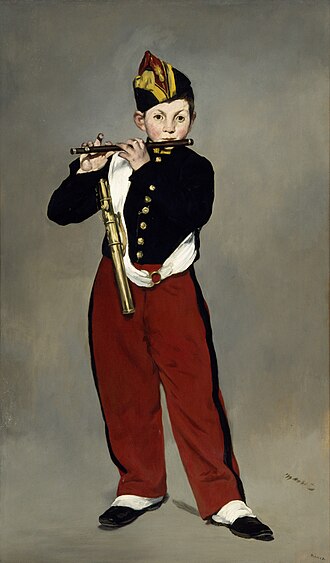 Der Pfeifer - Édouard Manet (1866)
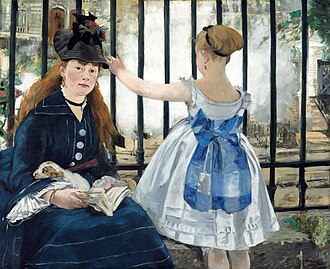 Die Eisenbahn - Édouard Manet (1873)
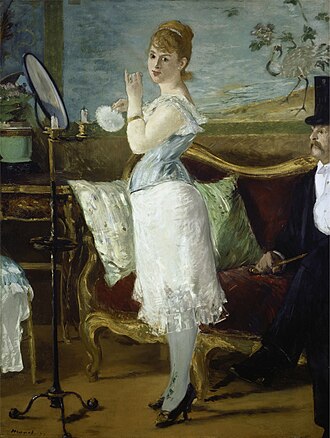 Nana - Édouard Manet (1877)
Werke verwandter Künstler
 Impression, Sonnenaufgang - Claude Monet (1872)
 Seerosen - Claude Monet (1906)
 Tanz im Moulin de la Galette - Pierre-Auguste Renoir (1876)
 Das Frühstück der Ruderer - Pierre-Auguste Renoir (1881)
 Wiege - Berthe Morisot (1872)
 Sommertag - Berthe Morisot (1879)
 Der Absinth - Edgar Degas (1875)
 Die Bellelli Familie - Edgar Degas (1858)
 Der Kanal von Loing - Alfred Sisley (1892)
 The Watering Pond at Marly with Hoarfrost - Alfred Sisley (1876)
 Straße in Paris an einem regnerischen Tag - Gustave Caillebotte (1877)
 Die Parkettschleifer - Gustave Caillebotte (1875)