Der bethlehemitische Kindermord
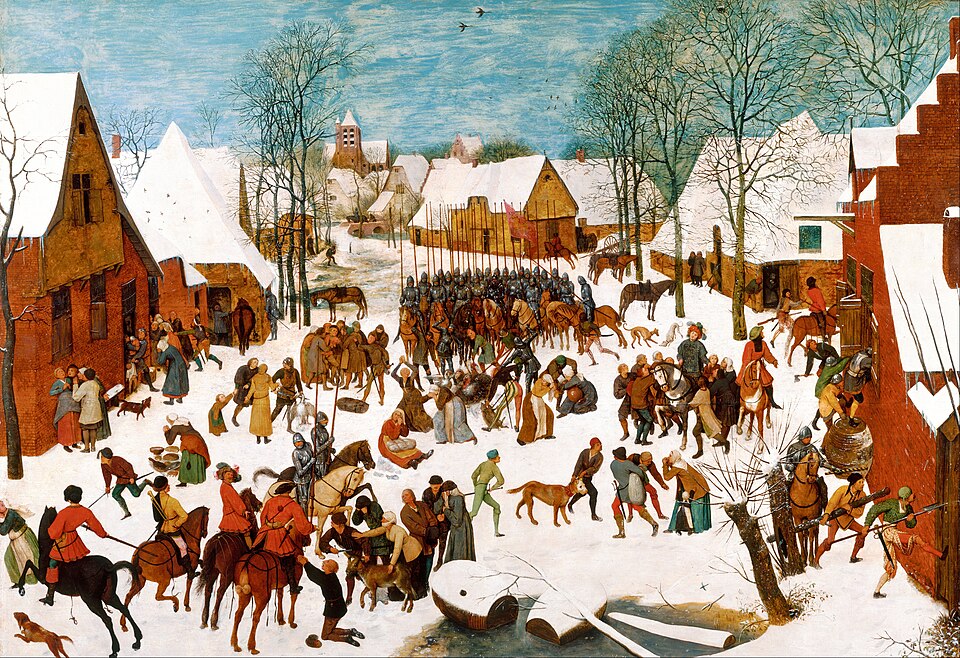
Soldiers ride into a snowy Flemish village and break down doors. Yet in this version the victims are gone: an emperor had the murdered children painted over as meats, cheeses, a calf and a boar, turning a massacre into a scene of plunder.
The story behind the painting
The Gospel of Matthew tells how King Herod, hearing from the Magi of Jesus's birth, ordered every child under two in Bethlehem to be killed. Pieter Bruegel the Elder moved the story to a sixteenth-century village in the Southern Netherlands, attacked by Spanish soldiers and German mercenaries, possibly a comment on the occupying troops before the Dutch Revolt. The hard winter of 1564 to 1565 may have inspired the snow, the icicles and the frozen pond, as it inspired The Hunters in the Snow. This panel, signed BRVEGEL, is dated between 1565 and 1567 and is now thought to be the only version by the Elder.
What to look for
Like Netherlandish Proverbs, the picture is made of many small scenes. A horseman guards a bridge by the church; a man tries to hide a child; a soldier drags an infant out of a house; four villagers mourn. In the centre, soldiers in black armour lunge with spears in front of a mass of mounted lancers, and one may carry the five gold crosses of Jerusalem, a title the Habsburgs claimed. At the right, soldiers batter the door of an inn with an axe and a log, one kicking loose an icicle above his head. In this version, look closely at the odd bundles, jugs and animals: each one hides a child.
Meaning and intent
Emperor Rudolf II acquired the panel and had it in Prague by about 1600. He disliked the scene, in which babies were slaughtered by soldiers wearing his own double-headed eagle, so the dead and dying children were painted over with food, animals and sacks of goods. A herald originally wore a Habsburg eagle tabard, and the inn sign showed the Star of Bethlehem. One mounted figure may represent the Duke of Alba, the harsh commander of the Spanish army in the Netherlands, a resemblance clearer in the later copies by Pieter Brueghel the Younger.
Legacy
The overpainting came to light during conservation in 1998, when Lorne Campbell identified this panel as Bruegel's original. It was probably looted from Prague Castle by a Swedish army in 1648, belonged to Queen Christina by 1652, and entered the British Royal Collection when Charles II acquired it at Breda in 1660. It has hung at Hampton Court and, from 2017 to late 2024, at Windsor Castle. Wikipedia gives its size as 102 by 155 cm, while Wikidata gives 109.2 by 158.1 cm. Many copies by Brueghel the Younger, in Vienna, Brussels and Bucharest, still show the children as Bruegel first painted them.
Schon gewusst?
- Dated between 1565 and 1567, signed BRVEGEL.
- Rudolf II had the murdered children painted over.
- The overpainting was revealed in conservation in 1998.
- In the British Royal Collection since 1660.
Über den Künstler
Pieter Bruegel the Elder (1525-1569)
religiöse Kunst · Landschaftsmalerei · Himmel · Haus · Laubbaum · Schnee · Royal Collection · Winter · Eis
Mehr von Pieter Bruegel the Elder
%20-%20Google%20Art%20Project.jpg) Die Jäger im Schnee - Pieter Bruegel the Elder (1565)
Die Jäger im Schnee - Pieter Bruegel the Elder (1565)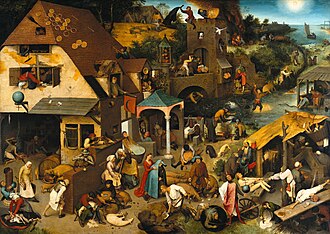 Die niederländischen Sprichwörter - Pieter Bruegel the Elder (1551)
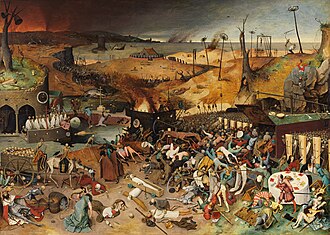 Der Triumph des Todes - Pieter Bruegel the Elder (1560s)
%20-%20Blind%20leading%20the%20blind%20Google%20Art%20Project.jpeg) Der Blindensturz - Pieter Bruegel the Elder (1568)
Der Blindensturz - Pieter Bruegel the Elder (1568)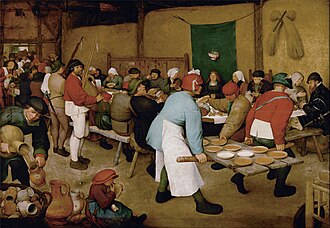 Die Bauernhochzeit - Pieter Bruegel the Elder (1560s)
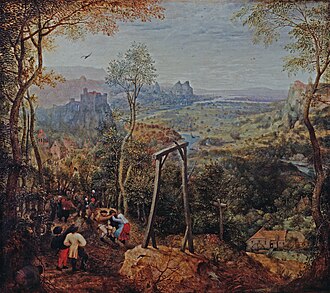 Die Elster auf dem Galgen - Pieter Bruegel the Elder (1568)
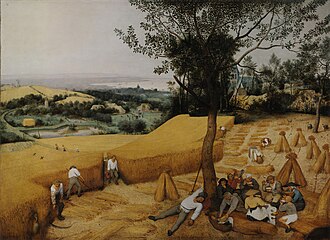 Die Kornernte - Pieter Bruegel the Elder (1565)
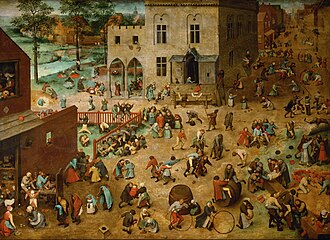 Die Kinderspiele - Pieter Bruegel the Elder (1560)
Werke verwandter Künstler
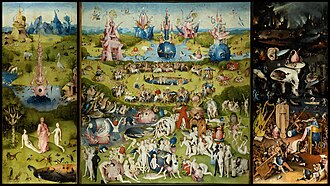 Der Garten der Lüste - Hieronymus Bosch
 Das Narrenschiff - Hieronymus Bosch (1500s)
 Die Gesandten - Hans Holbein the Younger (1533)
 Der Leichnam Christi im Grabe - Hans Holbein the Younger (1520s)