Der bestrafte Wüstling
Pieter Bruegel the Elder · 1557
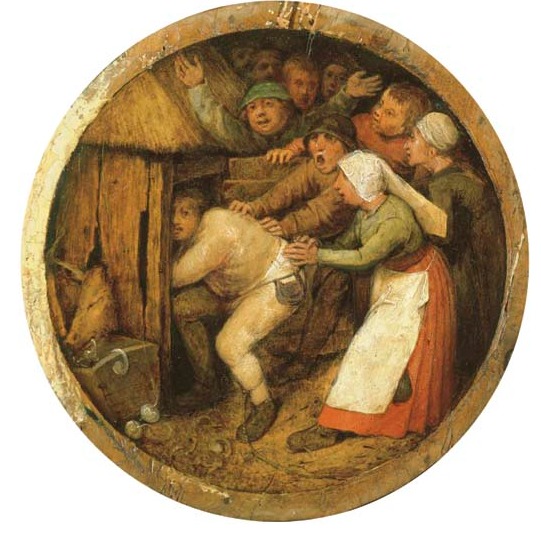
A crowd of men and women shove a stout drunkard into a thatched pigsty while a pig pokes its head out to eat. For centuries Bruegel's round little panel was known only from an engraving, until infrared light found his signature beneath the paint.
The story behind the painting
Pieter Bruegel the Elder painted this work in 1557. For a long time the composition was known only through an engraving made in 1568 by Jan Wierix, marked with his monogram, the date and the words P. Brueghel inuet, and through copies from the circle of Pieter Brueghel the Younger, one of them, made after 1616, now in the museum in Bamberg. The 1606 inventory of the painter Gillis van Coninxloo lists a picture of the pig pushed into the sty, but does not name Bruegel. In 1967 Piero Bianconi's catalogue listed the original as lost.
What to look for
The painting is oil on a round panel, a tondo, made of walnut rather than the oak Bruegel usually used, perhaps because some woodturners' guilds banned oak. Several men and women push a corpulent man into a small thatched building. It is clearly a pigsty: a pig sticks its head through a gap to eat from its trough. In the trough lie turnips, root vegetables then thought to be aphrodisiac. The work probably belongs to the Flemish tradition of painted plates, and, like Bruegel's Twelve Flemish Proverbs in the Museum Mayer van den Bergh, was likely part of a series.
Meaning and intent
The subject is not drawn directly from a known Flemish proverb, but its moral message is plain and fits the imagery of the time, which often compared the degradation of debauchery to the condition of the pig, held to be shameful. The turnips add another hint of debauchery. With a few figures, a sty and a hungry animal, Bruegel turns a rough joke into a lesson: the man who lives like a pig ends up among them. The small round format, close to a plate, made the warning something to look at up close.
Legacy
For the 19th and 20th centuries the panel belonged to the Van der Renne de Daelenbroeck family at the castle of Daelenbroeck in Herkenbosch. In 1975 an heir deposited it at the Museum Mayer van den Bergh, where Josef de Coo published it and cautiously proposed Bruegel. In 1998 Roger van Schoute and Hélène Verougstraete used infrared reflectography and found a fragmentary signature, BRVEG, and the date MDLVII, with changes in the underdrawing that proved authenticity; they confirmed it in 2000. Most specialists now accept it, though Roger Marijnissen stayed cautious. It was shown at the National Gallery in London, in Rotterdam and in Vienna's 2018 retrospective.
Schon gewusst?
- Painted by Bruegel in 1557 on a round walnut panel.
- Known for centuries only through Jan Wierix's 1568 engraving.
- Infrared study in 1998 revealed a signature fragment and the date MDLVII.
- Now in a private collection.
Über den Künstler
Pieter Bruegel the Elder (1525-1569)
Mehr von Pieter Bruegel the Elder
 Die Jäger im Schnee - Pieter Bruegel the Elder (1565)
 Die niederländischen Sprichwörter - Pieter Bruegel the Elder (1551)
 Der Triumph des Todes - Pieter Bruegel the Elder (1560s)
 Der Blindensturz - Pieter Bruegel the Elder (1568)
 Die Bauernhochzeit - Pieter Bruegel the Elder (1560s)
 Die Elster auf dem Galgen - Pieter Bruegel the Elder (1568)
 Die Kornernte - Pieter Bruegel the Elder (1565)
 Die Kinderspiele - Pieter Bruegel the Elder (1560)
Werke verwandter Künstler
 Die Gesandten - Hans Holbein the Younger (1533)
 Der Leichnam Christi im Grabe - Hans Holbein the Younger (1520s)
 Der Garten der Lüste - Hieronymus Bosch
 Das Narrenschiff - Hieronymus Bosch (1500s)
 Arnolfini-Porträt - Jan van Eyck (1434)
 Genter Altar - Jan van Eyck (1432)