Tanzklasse
Edgar Degas · 1870s
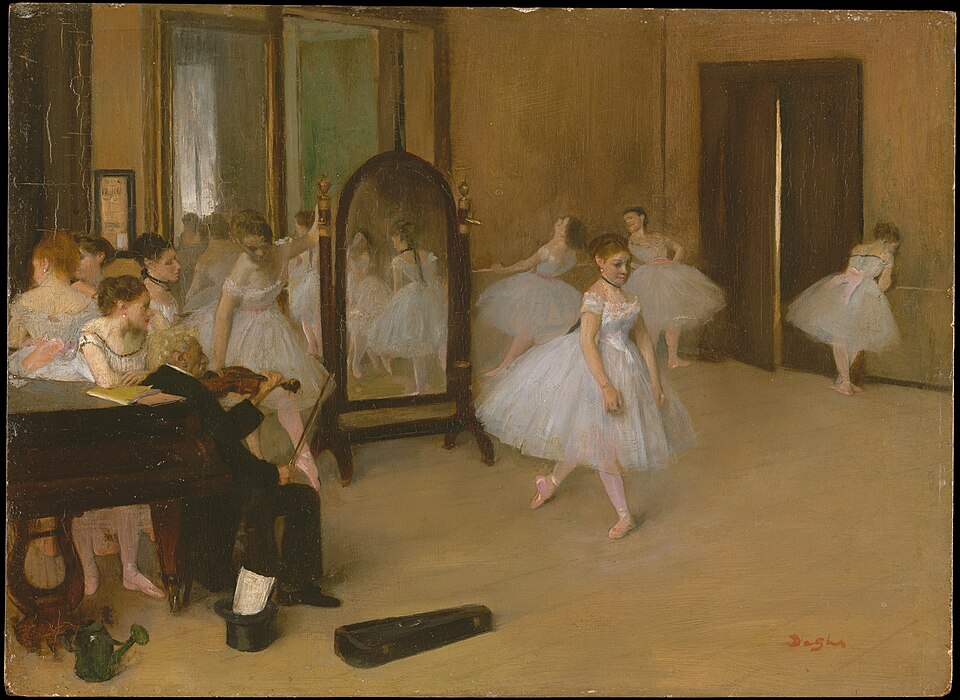
A small wooden panel, a mirror, a barre, bare floorboards and a dancer named Joséphine Gaujelin. This is where Degas's long love affair with the ballet classroom began, still a little stiff and shy.
The story behind the painting
The Dancing Class is one of Degas's earliest classroom scenes, painted when he was still unfamiliar with the rehearsal room. Rather than working on the spot, he relied on preparatory studies. The dancer in the centre is Joséphine Gaujelin, or Gozelin. The work is also called Dance Class or Rehearsal Room, and is dated around 1870, or to 1871, 1872 or 1871 to 1872; Wikidata gives the 1870s. It is considered foundational to his ballet series.
What to look for
The oil on wood is tiny, about 19.7 by 27 cm. Look for the motifs that would become central to Degas's ballet pictures: the barre, the mirrors and the bare floorboards, all inside a strongly built architectural setting that steers the eye. The dancers look stiff and self-conscious, perhaps because of the painter's unfamiliar presence. A male musician is also in the room. Compare them with the relaxed, fluid dancers of his later, more intimate works.
Meaning and intent
Scholars link the spatial arrangement to the influence of Velázquez. Eunice Lipton reads Degas's dancers as touching on class, sex and work, bringing a middle-class audience into spaces they could not see themselves. Carol Armstrong notes that Degas balances the dancer as an object of desire with the dancer as a subject of social documentation. In later works he left men out. Scholars also treat the work as part of Degas's commitment to documenting modern life in Paris.
Legacy
When it was first shown in 1874, responses were mixed. The critic Marc de Montifaud praised it as a fine, profound study and stressed its erotic charge, while others found the angular figures incoherent. Today it is seen as the template for Degas's later classroom scenes, and it belongs to the Metropolitan Museum of Art. Mari Kálmán Meller notes that it shares with the later ballet scenes a highly articulated architectural setting, the frame that would hold so many of his dancers.
Schon gewusst?
- One of Degas's earliest ballet classroom scenes.
- The central dancer is Joséphine Gaujelin.
- First exhibited in 1874.
- In the Metropolitan Museum of Art, New York.
Über den Künstler
Edgar Degas (1834-1917)
Frau · Genreszene · Metropolitan Museum of Art · Chignon · Dekolleté
Mehr von Edgar Degas
 Der Absinth - Edgar Degas (1875)
 Die Bellelli Familie - Edgar Degas (1858)
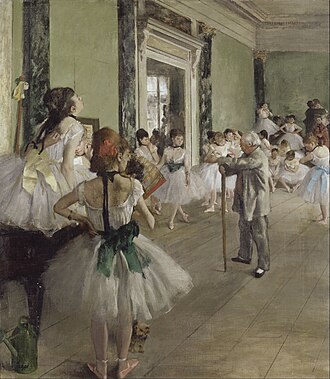 Die Tanzklasse - Edgar Degas (1871)
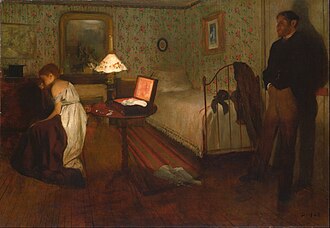 Intérieur - Edgar Degas (1868)
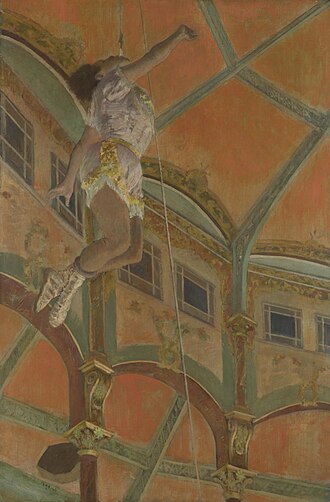 Miss La La at the Cirque Fernando - Edgar Degas (1879)
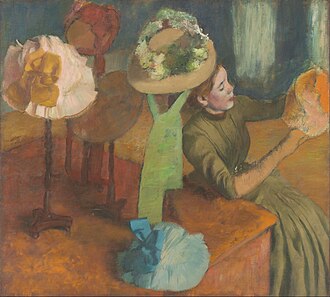 Das Modewarengeschäft - Edgar Degas
 Das Wannenbad - Edgar Degas (1886)
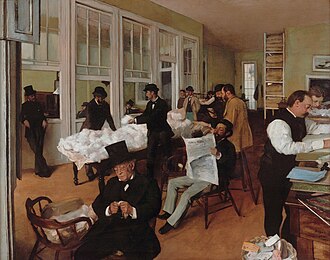 Das Baumwollkontor in New Orleans - Edgar Degas (1873)
Werke verwandter Künstler
 Impression, Sonnenaufgang - Claude Monet (1872)
 Seerosen - Claude Monet (1906)
 Das Frühstück im Grünen - Édouard Manet (1863)
 Olympia - Édouard Manet (1863)
 Tanz im Moulin de la Galette - Pierre-Auguste Renoir (1876)
 Das Frühstück der Ruderer - Pierre-Auguste Renoir (1881)
 Wiege - Berthe Morisot (1872)
 Sommertag - Berthe Morisot (1879)
 Der Kanal von Loing - Alfred Sisley (1892)
 The Watering Pond at Marly with Hoarfrost - Alfred Sisley (1876)
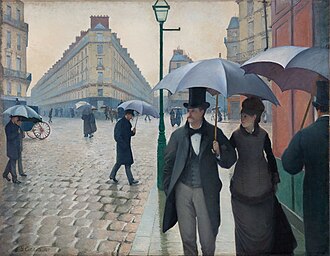 Straße in Paris an einem regnerischen Tag - Gustave Caillebotte (1877)
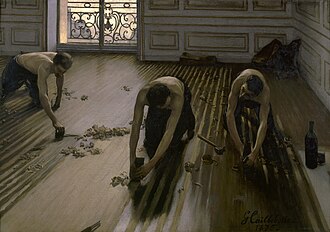 Die Parkettschleifer - Gustave Caillebotte (1875)