The Beaked
Jean-François Millet · 1860
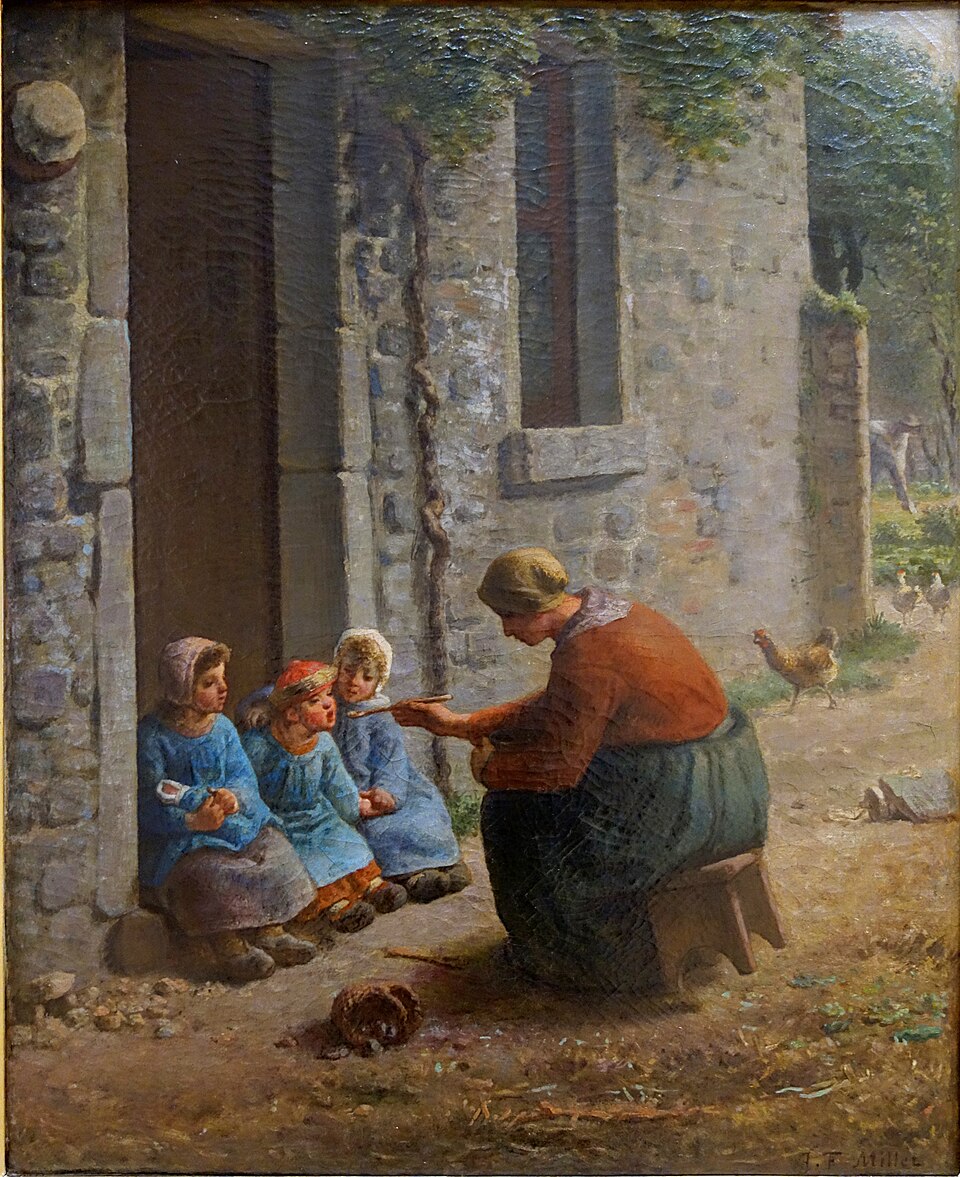
Three children sit on a doorstep, mouths open like fledglings, while their mother spoons soup to each in turn. Millet wanted us to think of a brood of birds being fed.
The story behind the painting
The Beakful, in French La Becquée, also called Woman Feeding Her Children, is an oil on canvas painted by Jean-François Millet in 1860. It was the culmination of a long process that began with sketches and preparatory drawings in 1848-1849, some of which are also in the Palais des Beaux-Arts in Lille. A painted sketch of the subject from 1848 has its own dramatic story: it is held at the Ahmed Zabana National Museum in Oran, Algeria, was stolen in 1985, found in France in 2001 and returned to the Algerian authorities in 2014. Millet sketched his models on the spot, but went back to his studio to paint.
What to look for
A mother squats on a stool in front of her farmhouse door, giving soup to her three children seated on the threshold. Watch her spoon move from child to child, and notice how their eyes and hands are drawn together by her. Three chickens peck nearby. Then let your eye travel to the right and into the background, where the father digs in the garden. He is barely visible, yet the composition steers the viewer towards him, and he holds a central place in the story the painting tells. The harmony of the colours and the light that bathes the scene help bind mother, children and father into one family.
Meaning and intent
Millet explained his intention in a letter to the critic Théophile Thoré-Burger, who saw the canvas at the Martinet Gallery: he wanted to imagine a brood of birds being fed by their mother, adding that man works to feed these beings. Hence the French title, La Becquée, the beakful a bird brings to its young. Comparing the early drawings with the finished picture shows how his intentions matured. Each parent has a nourishing role: the massive, protective mother feeding, the discreet, hardworking father tilling the soil. Together they express family harmony, a quiet dignity found in the most ordinary daily act.
Legacy
The painting reached the museum through an unusual act of generosity. In 1871 it belonged to Madame Maracci, a wealthy patron who wished to give Lille a painting by Auguste-Joseph Herlin, then assistant to the curator of the city's painting museum. Herlin, embarrassed, dissuaded her and persuaded her to donate a work by another artist instead, and so Millet's painting entered the Palais des Beaux-Arts de Lille, where it remains. Alongside the preparatory drawings kept there, it lets visitors follow a work from its first studies in 1848 to the finished canvas of 1860, a dozen years of patient thought about a simple scene.
Schon gewusst?
- Painted in 1860; held at the Palais des Beaux-Arts de Lille.
- Preparatory drawings date back to 1848-1849.
- Millet wrote that he wanted to imagine a brood of birds fed by their mother.
- A painted sketch from 1848, stolen in Oran in 1985, was returned to Algeria in 2014.
Frau · Haus · Korb · Laubbaum · Familie
Mehr von Jean-François Millet
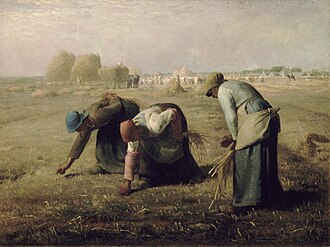 Die Ährenleserinnen - Jean-François Millet (1857)
Werke verwandter Künstler
 Die Sternennacht - Vincent van Gogh (1889)
.jpg) Caféterrasse am Abend - Vincent van Gogh (1888)
Caféterrasse am Abend - Vincent van Gogh (1888) Impression, Sonnenaufgang - Claude Monet (1872)
 Seerosen - Claude Monet (1906)
 Das Frühstück im Grünen - Édouard Manet (1863)
 Olympia - Édouard Manet (1863)