Angelusgebet
Jean-François Millet · 1858
.jpg)
At dusk in a potato field, a man and a woman bow their heads as a distant church bell rings. Millet painted a memory of his grandmother, and the quiet picture went on to stir patriotic fervour, bidding wars, a new artists' law and Salvador Dalí's wildest theories.
The story behind the painting
Millet painted The Angelus between 1857 and 1859; Wikidata gives 1858. It was commissioned by the American collector Thomas Gold Appleton, who never came to collect it. Millet then added a church steeple on the horizon and changed the title from Prayer for the Potato Crop to The Angelus, the Catholic prayer said at dawn, noon and dusk when the church bell rings. He explained that the idea came from memory: his grandmother, hearing the bell while the family worked in the fields, always made them stop to say the Angelus for the poor departed. The scene is the potato harvest at Barbizon, with the steeple of Chailly-en-Bière in the distance.
What to look for
Two peasants, a man and a woman, stand in an open field at the end of the day, heads bowed. At their feet is a small basket of potatoes, and around them a potato fork, sacks and a wheelbarrow. The church steeple sits far off on the horizon, and the light of dusk falls across the land. The canvas is modest, about 55.5 by 66 cm. Their relationship is left open: interpreters have seen them as co-workers, a husband and wife, or, as the statesman Léon Gambetta read it, a farmer and his maidservant. An 1889 sale catalogue called them simply a young peasant and his companion.
Meaning and intent
At first the painting was read politically, with Millet seen as a socialist siding with workers. It became one of the most widely reproduced religious images of the 19th century, hung in thousands of French homes. Yet Millet painted from nostalgia rather than strong religious feeling. Karine Huguenaud writes that there is no religious message: Millet simply portrayed a ritual moment of meditation as dusk rolls in. The Belgian minister Jules Van Praët, who owned it, joked that everyone thought they could hear the church bell, and in the end the constant ringing became tiresome. After the Franco-Prussian War and the Commune, the French found in Millet a unifying national image.
Legacy
When the Louvre tried to buy the painting in 1889, it sparked patriotic fervour and a bidding war, which the American Art Association won. A Paris collector, Alfred Chauchard, brought it back the next year and left it to the French State; it entered the Louvre in 1910 and moved to the Musée d'Orsay in 1986. In 1932 it was attacked by a vandal. The gap between the huge resale sums for Millet's works and the poverty of his family helped lead to the droit de suite, a French law paying artists or heirs on resales. Salvador Dalí, haunted by it since school, asked the Louvre to X-ray it and saw a child's coffin; few accept that reading.
Schon gewusst?
- Painted between 1857 and 1859; Wikidata gives 1858.
- Originally titled Prayer for the Potato Crop.
- Inspired by Millet's memory of his grandmother praying at the bell.
- Its resale history helped inspire France's droit de suite law.
Frau · Mann · Gemäldeabteilung des Louvre · Musée d’Orsay · Stehen · Paar · Acker · ländlicher Raum
Mehr von Jean-François Millet
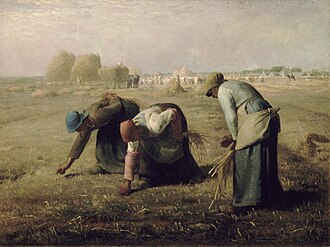 Die Ährenleserinnen - Jean-François Millet (1857)
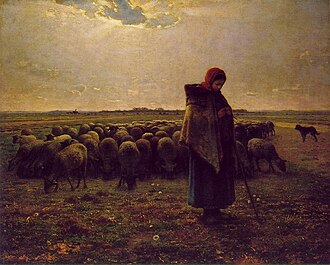 Hirtin - Jean-François Millet (1863)
.jpg) The Winnower - Jean-François Millet (1848)
The Winnower - Jean-François Millet (1848)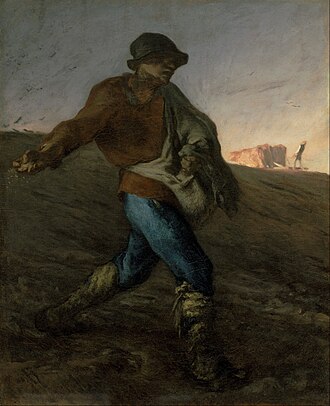 Sämann - Jean-François Millet (1850)
.jpg) Mann mit Hacke - Jean-François Millet (1860s)
Mann mit Hacke - Jean-François Millet (1860s)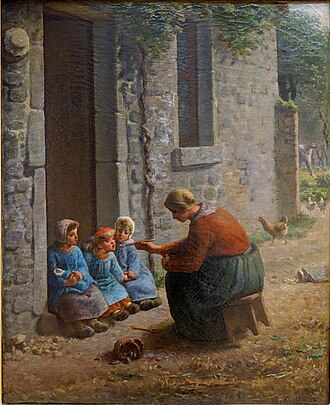 The Beaked - Jean-François Millet (1860)
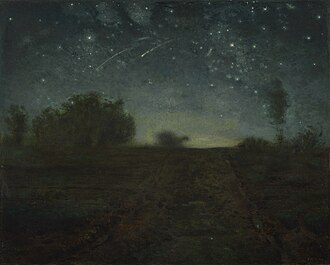 Starry Night - Jean-François Millet (1850s)
Werke verwandter Künstler
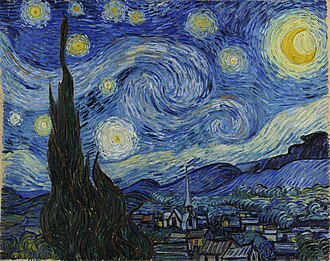 Die Sternennacht - Vincent van Gogh (1889)
.jpg) Caféterrasse am Abend - Vincent van Gogh (1888)
Caféterrasse am Abend - Vincent van Gogh (1888)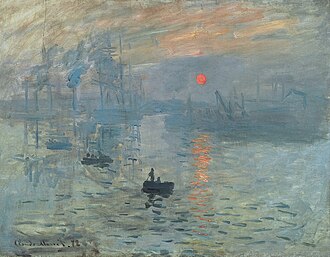 Impression, Sonnenaufgang - Claude Monet (1872)
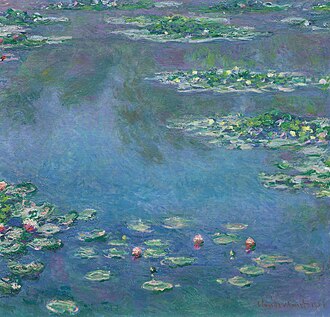 Seerosen - Claude Monet (1906)