Festmahl der Offiziere der St-Hadrians-Schützengilde von Haarlem
Frans Hals · 1627
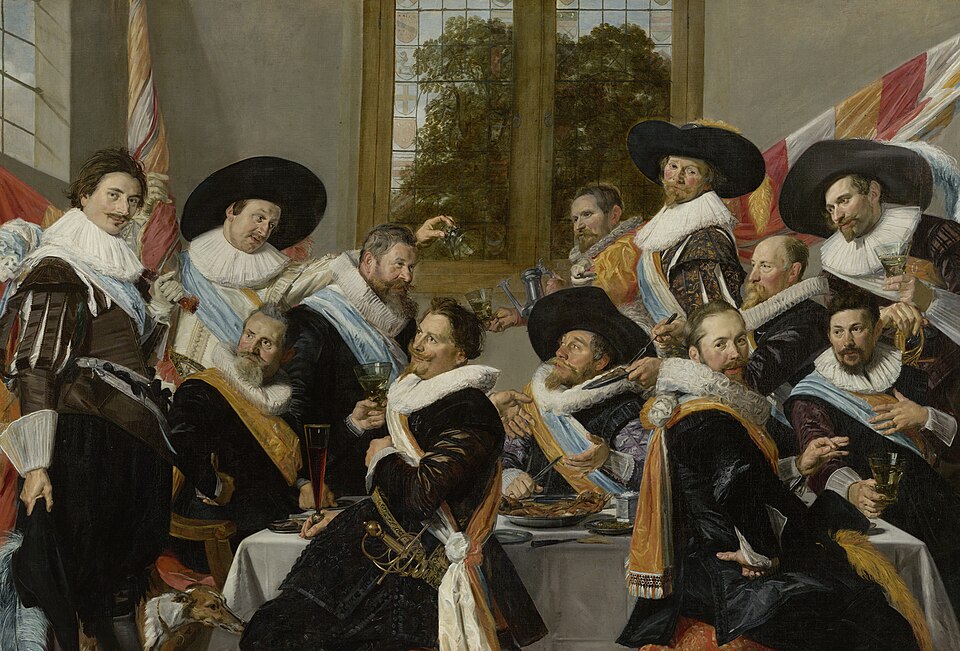
Twelve men of Haarlem's civic guard toast the end of three years of service. Frans Hals dressed them all in orange, white and blue, and slipped a greyhound in as a quiet joke.
The story behind the painting
In 1627 Frans Hals painted this schutterstuk, a militia group portrait, for the St Adrian civic guard of Haarlem, and it was long known as The Banquet of the Officers of the St Adrian Militia Company in 1627. Haarlem then had three civic guard districts. Officers were chosen by the town council to serve for three years, and this group had just finished its term and celebrated the end of service with a portrait. At the head of the table, on the left, sits Colonel Willem Claesz Voogt in an orange sash, looking towards the ensign Adriaen Matham.
What to look for
In most such portraits each sash takes the colour of its guard district, but here every officer wears the colours of the Dutch flag, orange, white and blue. Small differences mark the flag bearers. Adriaen Matham, on the left, holds a hat with a blue feather and wears mostly blue in his sash. Beside him the ensign Loth Schout wears a white jacket. Standing by the window on the right, the ensign Pieter Ramp has a jacket with finely cut sleeves of orange brocade and an orange feather in his hat. Captain Gilles de Wildt holds a knife, a servant stands with a pitcher, and a lieutenant offers a dish.
Meaning and intent
The source names all twelve men, from Ensign Matham on the left to Lieutenant Matthys Haeswindius seated at the foot of the table, so the picture works almost like a roll call of rank and office. The dog in the lower left is a greyhound, in Dutch a hazewind. That word may be meant to point to the link between the ensign Adriaen Matham and his lieutenant Haeswindius, whose name it echoes, seated on the other side of the table. A shared colour scheme binds the officers together, while each sleeve, feather and gesture keeps them individual.
Legacy
The painting once hung with other militia portraits in the main hall of the old Doelen building on the Gasthuisstraat, today the Haarlem Public Library. The hall is now a study room, but for years it served as a gymnasium, and some of the older group portraits were damaged by enthusiastic gymnasts. All the schutterstukken that hung there have since been moved to the Frans Hals Museum in Haarlem. This canvas, about 183 by 266 cm, is now considered one of the museum's main attractions.
Schon gewusst?
- Painted in 1627 for a Haarlem civic guard.
- Celebrates officers who had just ended a three-year term.
- All officers wear the orange, white and blue of the Dutch flag.
- Frans Hals Museum, Haarlem.
Über den Künstler
Frans Hals (1591-1666)
Mann · schutterstuk · Frans Hals Museum
Mehr von Frans Hals
 Ein Schütze einen Berkemeyer haltend, bekannt als „Der fröhliche Trinker" - Frans Hals (1620s)
 Der lachende Kavalier - Frans Hals (1624)
 La Bohémienne - Frans Hals (1628)
 Malle Babbe - Frans Hals (1640s)
 Willem van Heythuysen - Frans Hals (1625)
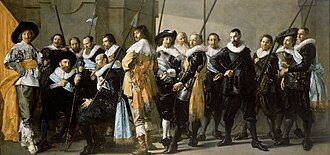 Schützen XI. Bezirks unter Leitung Kapitän Reynier Reael gen. ‘Magere compagnie’ - Frans Hals (1630s)
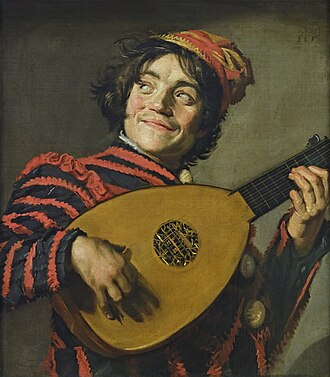 Der Lautenspieler - Frans Hals (1623)
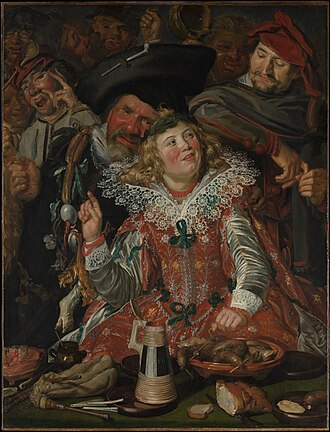 Lustige Gesellschaft - Frans Hals (1610s)
Werke verwandter Künstler
 Die Nachtwache - Rembrandt van Rijn (1642)
 Selbstbildnis - Rembrandt van Rijn (1659)
 Das Mädchen mit dem Perlenohrgehänge - Johannes Vermeer (1665)
 Dienstmagd mit Milchkrug - Johannes Vermeer (c. 1658)
 Fest des hl.Nikolaus - Jan Steen (1660s)
 Mädchen mit Austern. - Jan Steen (1658)
 Die Mühle von Wijk - Jacob van Ruisdael (1670)
 Judenfriedhof - Jacob van Ruisdael (1650s)
 Hof eines Hauses in Delft - Pieter de Hooch (1658)
 A Woman Peeling Apples - Pieter de Hooch (1663)