The Apparition of the Virgin to Saint Hyacinth
El Greco · 1605
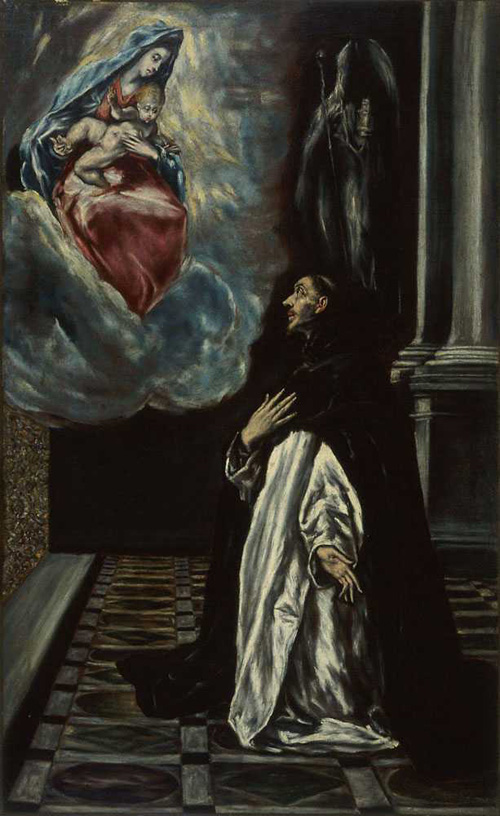
A white-robed friar looks up as the Virgin and Child appear in a cloud. In this smaller version El Greco let the reddish-orange ground glow through the paint, so the whole vision seems lit from beneath.
The story behind the painting
The painting shows Saint Hyacinth of Poland receiving a vision of the Virgin and Child on the feast of the Assumption. It is dated between 1605 and 1610, a late work, while Wikidata gives 1605. El Greco painted the scene twice: this version in the Memorial Art Gallery in Rochester, New York, about 100 by 62 cm, and a larger one, 158.4 by 98.7 cm, in the Barnes Foundation in Philadelphia. Both appear in the inventory of El Greco's possessions at his death in 1614, where the word grande tells them apart, and again in 1621 when they passed from his son Jorge Manuel, this time with dimensions.
What to look for
This version is painted far more roughly than the Barnes canvas. El Greco laid a dark reddish-orange ground and painted most of the composition quickly on top of it, without trying to hide it. The ground shows through in many places, for example in the lead white of Saint Hyacinth's habit, so the tones come straight from that warm layer seen through strokes of white and chromatic greys. In the clouds around the Virgin and Child, light ultramarine lies over lead white, and the ground reappears around the clouds, especially at the edge between cloud and the niche behind. In the larger version these areas are fully covered.
Meaning and intent
Why keep two versions at home? The historian Fernando Marías describes this subject as a specific kind of picture that would be painted on demand for particular clients, unlike the often copied works that customers could buy on a walk-in basis in the Toledo workshop. Portraits of saints could be painted and shown for sale in the studio, while complex subjects like visions or apparitions were bespoke. Yet both versions of this vision were still in El Greco's possession, which suggests they may never have left the workshop. The rough handling of this one lets us see how he thought with colour, building light from the ground up.
Legacy
Using the ground as part of the image was not unusual for El Greco. In his portrait of Diego de Covarrubias y Leiva he applied lead white directly to the support and let the bare canvas give the tones of the fabric. Exposed red grounds are prominent in skies and clouds in large works such as the Laocoön, Our Lady of Charity and The Annunciation, and Saint Martin and the Beggar uses its ground too, though in a bluish silver colour. Seen beside those paintings, this small Rochester canvas shows the same habit at an intimate scale, a vision still visibly in the making.
Schon gewusst?
- Dated 1605-1610 by Wikipedia, 1605 by Wikidata.
- One of two versions; the larger is in the Barnes Foundation.
- Listed in El Greco's 1614 inventory and again in 1621.
- Painted directly over a dark reddish-orange ground left visible.
Über den Künstler
El Greco (1541-1614)
Mehr von El Greco
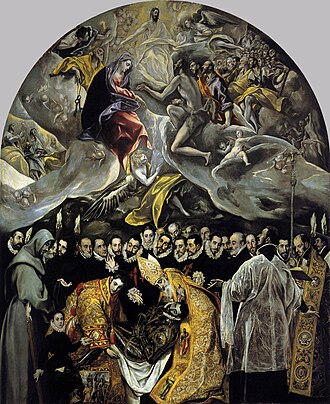 Begräbnis des Grafen von Orgaz - El Greco (1586)
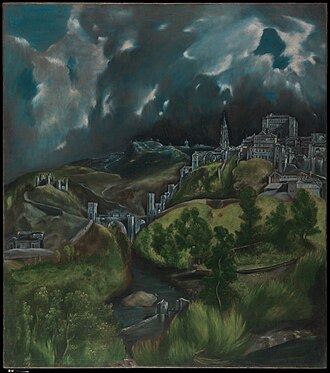 Ansicht von Toledo - El Greco (1596)
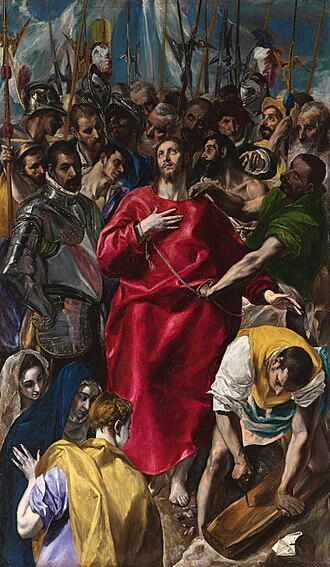 Die Entkleidung Christi - El Greco (1570s)
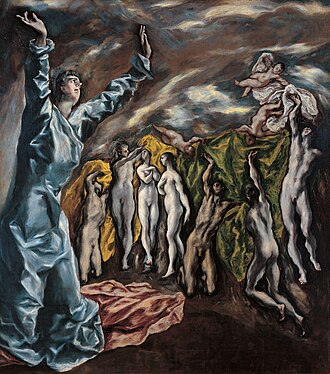 Die Öffnung des fünften Siegels - El Greco (1610)
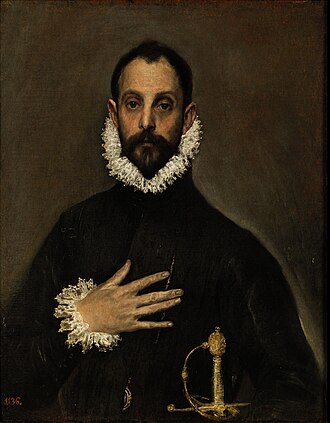 Bildnis eines Edelmanns mit der Hand auf der Brust - El Greco (1580)
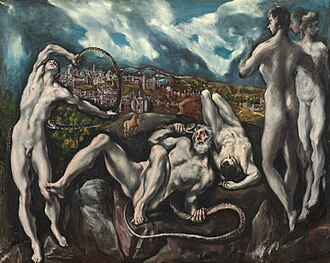 Laokoon - El Greco (1610s)
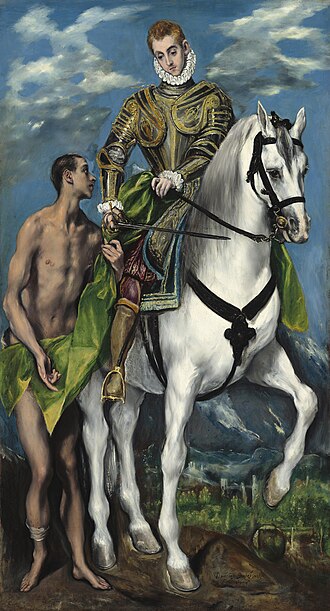 Der hl. Martin und der Bettler - El Greco (1597)
 Anbetung der Hirten - El Greco (1612)
Werke verwandter Künstler
 Die Hochzeit zu Kana - Paolo Veronese (1560s)
 Das Gastmahl im Hause des Levi - Paolo Veronese (1573)
 Das letzte Abendmahl - Jacopo Tintoretto (1563)
 Der heilige Markus befreit den gefesselten Sklaven - Jacopo Tintoretto (1540s)
 Venus von Urbino - Titian (1538)
 Mariä Himmelfahrt - Titian (1510s)
 Das Abendmahl in Emmaus - Caravaggio (1601)
 Die Berufung des Hl. Matthäus - Caravaggio (1609)
 Die Gesandten - Hans Holbein the Younger (1533)
 Der Leichnam Christi im Grabe - Hans Holbein the Younger (1520s)