Die Öffnung des fünften Siegels
El Greco · 1610
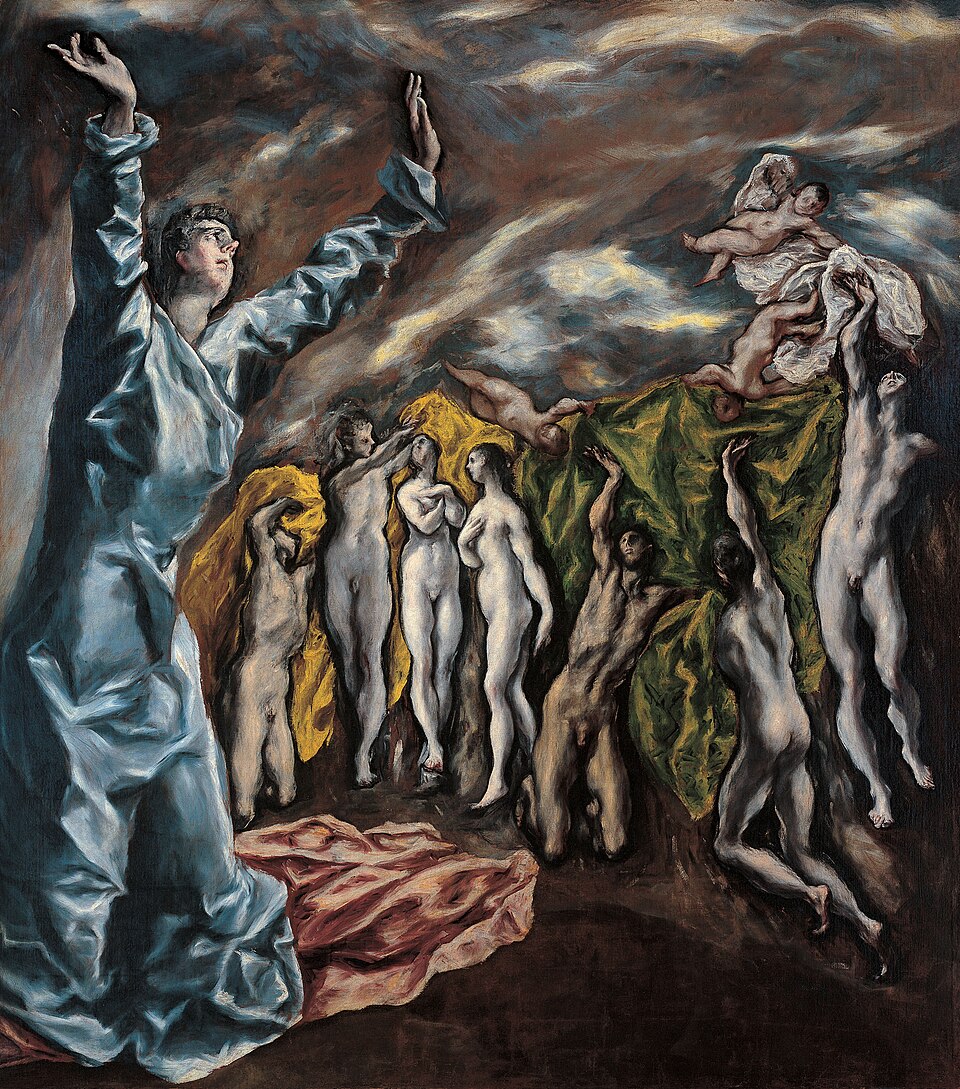
A saint flings up his arms toward a sky that is no longer there. Behind him, naked souls twist like flames as they receive their white robes.
The story behind the painting
El Greco painted this canvas in the last years of his life for a side altar of the church of Saint John the Baptist outside the walls of Toledo. Wikidata dates it to 1610; El Greco's own Wikipedia article gives 1608-1614. When he died in 1614 it passed to his son, Jorge Manuel Theotocópuli. Before 1908 it was called Profane Love, until the scholar Manuel B. Cossío doubted that title and proposed the Opening of the Fifth Seal. It is also known as The Vision of Saint John. The Metropolitan Museum of Art, which owns it, notes that the picture is unfinished and much damaged and abraded.
What to look for
The subject comes from the Book of Revelation, chapter 6, verses 9 to 11, where the souls of martyrs cry out to God for justice. The ecstatic figure of Saint John dominates the canvas, his arms raised. Behind him, naked souls writhe in a storm of emotion as they receive white robes of salvation. The top of the painting is missing: in 1880 an owner, the Spanish Prime Minister Antonio Cánovas del Castillo, had it restored, and at least 175 cm was cut from the top, leaving John pointing emphatically at nothing. Wikidata gives the size as 222.3 by 193 cm; the painter's article gives 225 by 193 cm.
Meaning and intent
The lost upper part may have shown the sacrificial Lamb opening the Fifth Seal, and it may have resembled El Greco's Concert of Angels. Many believe the surviving part depicts profane love while the missing part depicted divine love, a contrast between earthly and heavenly longing. Efi Foundoulaki sees the clothed figure on the left and the naked figures on the right as showing exactly that tension. What remains is a picture of yearning: the martyrs asking for justice, the saint reaching upward, and a space above them now empty, which makes the scene feel even more urgent and unfinished.
Legacy
After Cánovas died in 1897, the painter Ignacio Zuloaga acquired it; he did much to revive European interest in El Greco. It appears in the background of his painting Mis amigos. Zuloaga showed it to Pablo Picasso and Rainer Maria Rilke, calling it a precursor of modernism with visionary power. Scholars including Ron Johnson and John Richardson have linked it to Picasso's Les Demoiselles d'Avignon, which Picasso was working on when he studied this canvas in Zuloaga's Paris studio. In 1956 the Zuloaga Museum sold it to the Metropolitan Museum of Art in New York, where it is on view today.
Schon gewusst?
- Painted for a side altar of Saint John the Baptist outside the walls, Toledo
- Top cut by at least 175 cm during an 1880 restoration
- Size: 222.3 x 193 cm (Wikidata); 225 x 193 cm (El Greco article)
- Linked by scholars to Picasso's Les Demoiselles d'Avignon
Wikipedia · Wikidata · Wikipedia: El Greco
Über den Künstler
El Greco (1541-1614)
religiöse Kunst · Metropolitan Museum of Art · Engel
Mehr von El Greco
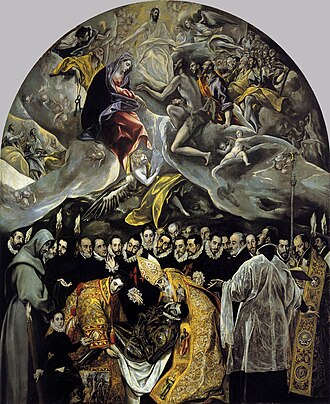 Begräbnis des Grafen von Orgaz - El Greco (1586)
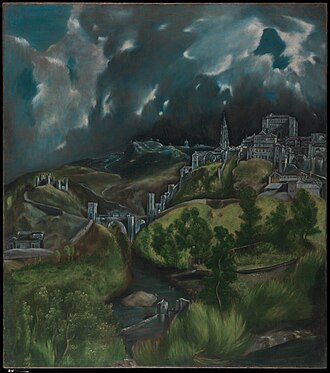 Ansicht von Toledo - El Greco (1596)
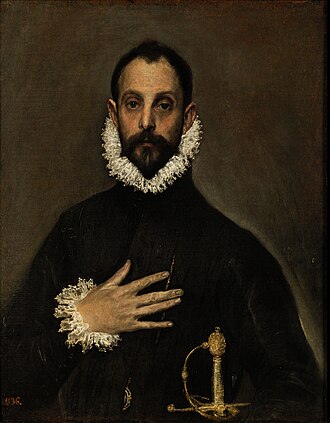 Bildnis eines Edelmanns mit der Hand auf der Brust - El Greco (1580)
%20-%20Laoco%C3%B6n%20-%20Google%20Art%20Project.jpg) Laokoon - El Greco (1610s)
Laokoon - El Greco (1610s)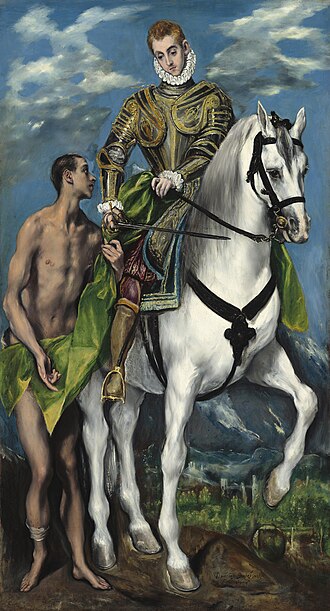 Der hl. Martin und der Bettler - El Greco (1597)
.jpg) Anbetung der Hirten - El Greco (1612)
Anbetung der Hirten - El Greco (1612)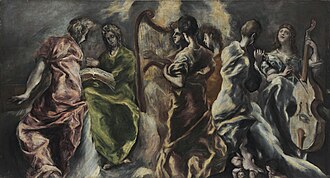 Das Konzert der Engel - El Greco (1600s)
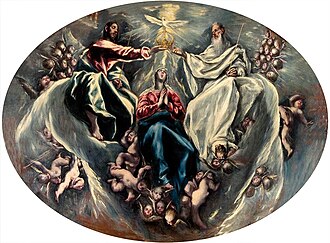 Krönung Mariens. - El Greco (1597)
Werke verwandter Künstler
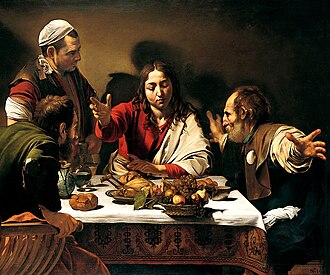 Das Abendmahl in Emmaus - Caravaggio (1601)
 Die Berufung des Hl. Matthäus - Caravaggio (1609)