Verkündigung
El Greco · 1590s
%20Prado%201597-1600.jpg)
Heaven breaks into Mary's room and the room disappears. In this tall canvas from the altarpiece of Doña María de Aragón, El Greco fills the space with a burning bush, a dove in yellow light and a concert of angels.
The story behind the painting
This canvas belonged to the altarpiece of the college of Doña María de Aragón in Madrid. It is documented in 1596 to 1600 according to Harold Wethey, or 1597 to 1600 according to the Museo del Prado, where it hangs today as catalogue number P003888. After the college it passed to the Museo de la Trinidad in Madrid before reaching the Prado. It is a large painting, 315 by 174 cm, oil on canvas, signed in cursive Greek letters on the step below the basket. Wethey listed it as number 13 in his catalogue, and Tiziana Frati as 107-b.
What to look for
Gabriel's vivid robes contrast with his grey wings in a dazzling effect. Mary's pink tunic is studded with white highlights, and her dark blue cloak stands out against grey and blue clouds full of grey cherub heads. A green bush burns with white flames above a pink and white basket, while the dove of the Holy Spirit hovers in shining yellowish light, ringed by seraphim drawn as almost bodiless, translucent forms in constant motion. At the top, angels play the flute, psaltery, harp and viola da gamba, in robes of green, orange, brown, white and pale blue.
Meaning and intent
El Greco gives up the room and shows only the intrusion of heaven. The prie-dieu is the one reference to a real place; the burning bush symbolises Mary's purity and foreshadows Christ, and the basket alludes to the veil of the Temple of Jerusalem. In earlier versions he had shown Mary seated, surprised, a hand on her book. Here she kneels toward Gabriel with her arms in a sign of accepting God's will, and Gabriel crosses his arms in adoration: this is the very moment of the Incarnation. Nothing is superfluous, and the forms spiral endlessly, a painting set on fire by feeling and colour.
Legacy
According to Wethey, no other work by El Greco equals the brilliance and richness of colour of this canvas. The helical rhythms that run through it are, in the article's words, the key that unifies every element of the work. The original altarpiece of the college no longer stands together, but this Annunciation survives in the Prado as one of its great pieces, a vision in which every figure, gesture, object and beam of light carries a precise meaning without losing any of its beauty.
Schon gewusst?
- Painted for the altarpiece of the college of Doña María de Aragón, Madrid.
- Dated 1596 to 1600 by Wethey, 1597 to 1600 by the Prado.
- Measures 315 by 174 cm.
- Wethey: no other El Greco equals its brilliance of colour.
Über den Künstler
El Greco (1541-1614)
religiöse Kunst · Museo del Prado · Manierismus · Laute · Blockflöte
Mehr von El Greco
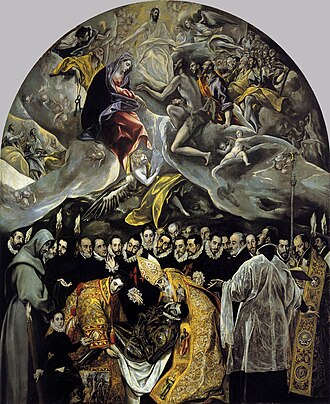 Begräbnis des Grafen von Orgaz - El Greco (1586)
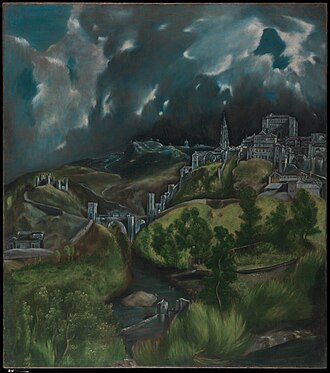 Ansicht von Toledo - El Greco (1596)
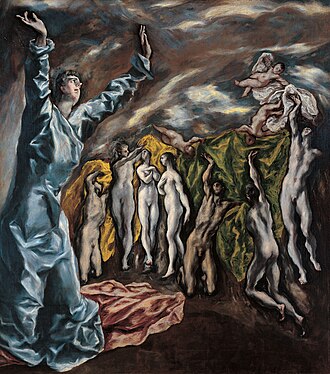 Die Öffnung des fünften Siegels - El Greco (1610)
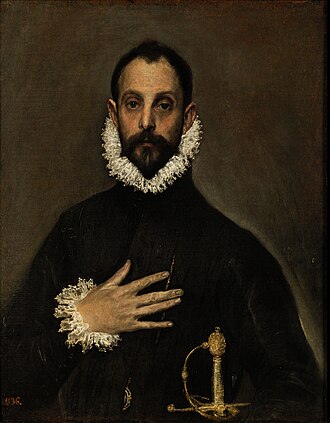 Bildnis eines Edelmanns mit der Hand auf der Brust - El Greco (1580)
%20-%20Laoco%C3%B6n%20-%20Google%20Art%20Project.jpg) Laokoon - El Greco (1610s)
Laokoon - El Greco (1610s)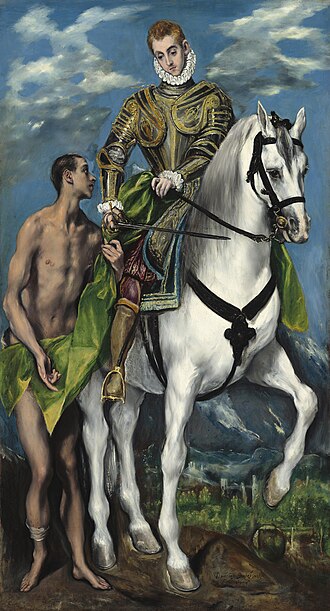 Der hl. Martin und der Bettler - El Greco (1597)
.jpg) Anbetung der Hirten - El Greco (1612)
Anbetung der Hirten - El Greco (1612)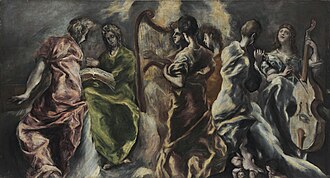 Das Konzert der Engel - El Greco (1600s)
Werke verwandter Künstler
.jpg) Venus von Urbino - Titian (1538)
Venus von Urbino - Titian (1538)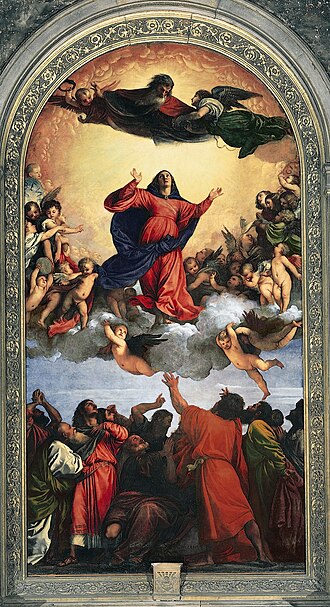 Mariä Himmelfahrt - Titian (1510s)
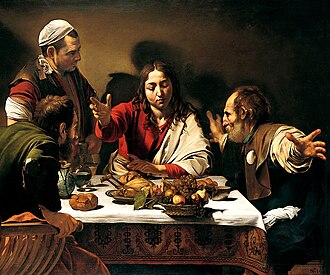 Das Abendmahl in Emmaus - Caravaggio (1601)
 Die Berufung des Hl. Matthäus - Caravaggio (1609)
 Die Gesandten - Hans Holbein the Younger (1533)
 Der Leichnam Christi im Grabe - Hans Holbein the Younger (1520s)