Skaters in the Bois de Boulogne
Pierre-Auguste Renoir · 1868
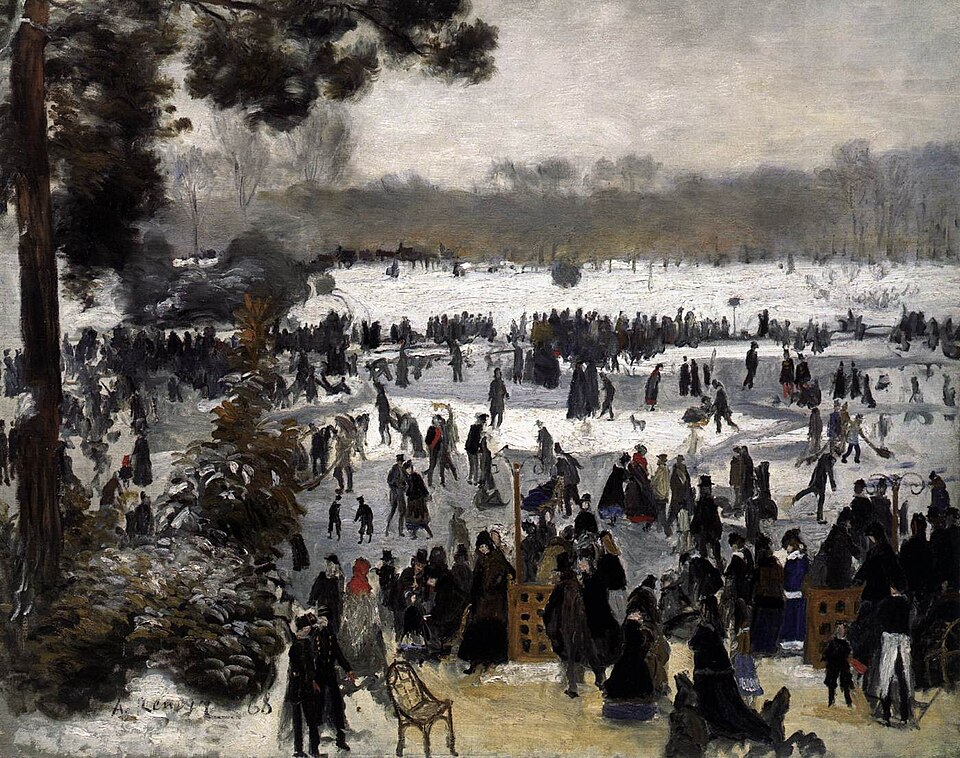
Parisians young and old crowd onto a frozen lake, skating, strolling, walking their dogs. Renoir hated the cold and called snow a blight on nature, yet in January 1868 he stood outdoors and painted this.
The story behind the painting
In 1861 Renoir met Sisley, Monet and Bazille in the studio of Charles Gleyre, and the friendships shaped his work. Like Monet he painted outdoors, but unlike Monet he could not stand the cold. Years later he told the dealer Ambroise Vollard that even if you can bear the cold, why paint snow, which he called a blight on the face of Nature. Still, in January 1868, aged 26, he painted this scene in the Bois de Boulogne. Newspapers of the time reported temperatures so low that people walked across the Seine and skated on rivers and streams.
What to look for
The view is from above, looking over the western part of the park, thought to be near the artificial Skating Lake. Renoir chose the park because he liked painting crowds, and the ice is full of Parisians, young and old, at leisure. Look for the several dogs among them. The picture has an unfinished, sketch-like quality, in the manner of a pochade, yet the brushwork is bold and the composition fully realised. The park itself was new then: begun in 1852 under Haussmann's public works for Napoleon III, it was completed in 1858.
Meaning and intent
The theme recalls older Dutch skating scenes, made popular by painters such as Hendrick Avercamp. But Renoir's crowd is the Parisian bourgeoisie of his own day, enjoying a new public park, and the dogs reflect his interest in their lives. This motif of social leisure would come to define his later work. Because he disliked snow so much, the painting is one of the few winter landscapes he completed apart from minor studies, which makes this cheerful scene on the ice all the more unusual.
Legacy
At least four snowscapes by Renoir are known: this one and Winter Landscape, both of 1868, and two works called Snowy Landscape, dated 1870 to 1875 and 1875. He returned to the Bois de Boulogne in The Morning Ride of 1873, also called Madame Henriette Darras, which the Salon rejected. The painting has passed through the hands of Ambroise Vollard, Robert von Hirsch, the 7th Marquess of Northampton and Richard L. Feigen and Co. It now belongs to the private collection of William I. Koch, who lent it to the Museum of Fine Arts, Boston, in 2005.
Schon gewusst?
- Painted outdoors in January 1868, when Renoir was 26.
- One of the few winter landscapes Renoir completed.
- Shows the Bois de Boulogne, completed in 1858.
- In the private collection of William I. Koch.
Über den Künstler
Pierre-Auguste Renoir (1841-1919)
Mehr von Pierre-Auguste Renoir
 Tanz im Moulin de la Galette - Pierre-Auguste Renoir (1876)
 Das Frühstück der Ruderer - Pierre-Auguste Renoir (1881)
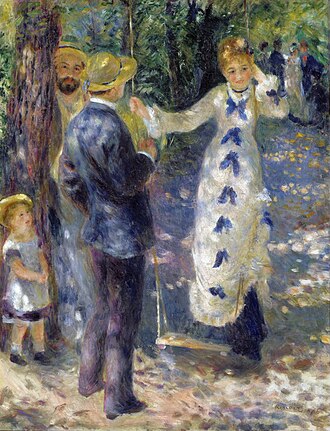 Auf der Schaukel - Pierre-Auguste Renoir (1876)
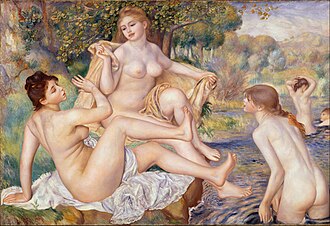 Die großen Badenden - Pierre-Auguste Renoir (1884)
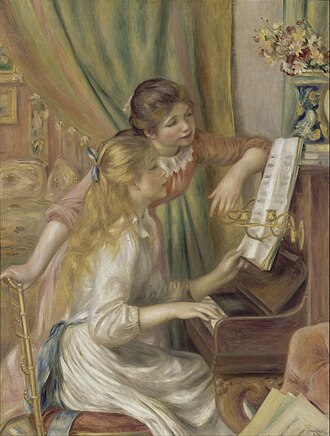 Zwei Mädchen am Klavier - Pierre-Auguste Renoir (1892)
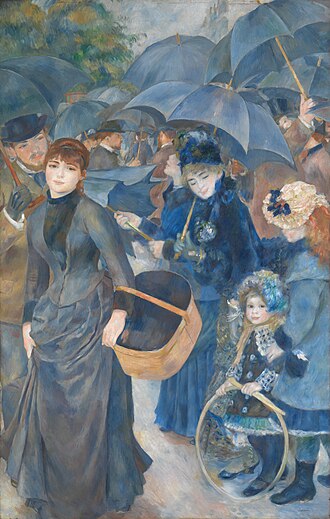 Regenschirme - Pierre-Auguste Renoir (1880s)
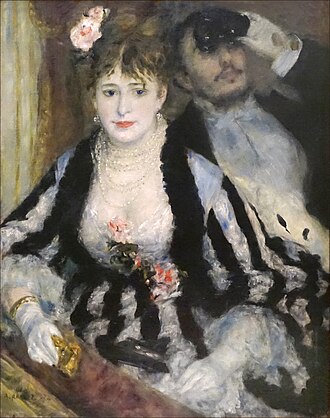 Die Loge - Pierre-Auguste Renoir (1874)
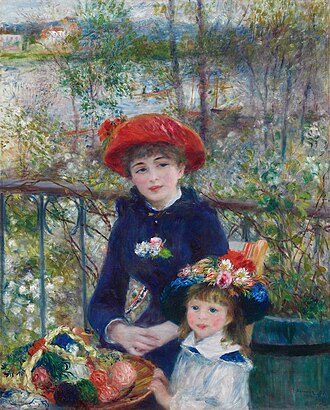 Auf der Terrasse - Pierre-Auguste Renoir (1881)
Werke verwandter Künstler
 Impression, Sonnenaufgang - Claude Monet (1872)
 Seerosen - Claude Monet (1906)
 Das Frühstück im Grünen - Édouard Manet (1863)
 Olympia - Édouard Manet (1863)
 Wiege - Berthe Morisot (1872)
 Sommertag - Berthe Morisot (1879)
 Der Absinth - Edgar Degas (1875)
 Die Bellelli Familie - Edgar Degas (1858)
 Der Kanal von Loing - Alfred Sisley (1892)
 The Watering Pond at Marly with Hoarfrost - Alfred Sisley (1876)
 Straße in Paris an einem regnerischen Tag - Gustave Caillebotte (1877)
 Die Parkettschleifer - Gustave Caillebotte (1875)