Selbstporträt
.jpg)
Wrapped in a wide coat, alert and at ease, Rubens painted the face he wanted the world to know. It was never for sale: it was a model for his pupils, and it came home to his own house in Antwerp in 1972.
The story behind the painting
This self-portrait was made no later than 1630, because it was first reproduced in print that year. Rubens looks younger here than he would have been in 1630, when he was fifty-three or fifty-four, which suggests it was painted earlier. Wikidata gives no date. The picture was not intended for sale. It was a workshop model, an example used to teach students how to paint portraits, and it served as the model for a small etching by Willem Panneels dated 1630 and for the portrait of Rubens that Anthony van Dyck included in his Iconography.
What to look for
Rubens wraps himself in a capacious coat and takes a pose as elegant as it is casual. His expression is alert and intelligent. The painting measures about 64 by 48 cm. Contemporaries would have read such a picture as eloquent. The writer Giovanni Paolo Lomazzo, in his treatise on painting of 1584, said that the poses of gifted people could show excellence, dignity, composure and grace, that full, lively drapery could enrich a pose, and that vivid expressions, made by stressing the eyes and the forehead, were the mark of an active mind. Look at how the coat and the bright eyes do that work here.
Meaning and intent
For viewers of the time, bearing and manner expressed qualities of intellect and character, and hands stood for reason and eloquence. This portrait established Rubens's official view of himself, the image of an alert, composed, graceful man. When van Dyck made his version for the Iconography, he added a hand-on-heart gesture, a popular sign of sincerity, giving it rhetorical feeling. The same official face echoes in Panneels's etching and in a bust dated 1633. Because it was a teaching model, it was also how Rubens's pupils learned to see their master.
Legacy
After it left Rubens's hands its history is unclear. It reappears in a sale catalogue of 1765, bought by the Prince of Rubempre, and for about two centuries it moved between cities around the world, ending with the Greek billionaire Stavros Niarchos, who put it up for auction at Christie's in 1972. The city of Antwerp won the auction, had it restored and placed it in the Rubenshuis, Rubens's former home and workshop, where it hangs today. In 2015 researchers at the National Gallery confirmed that it is authentic.
Schon gewusst?
- Painted no later than 1630, perhaps earlier.
- A workshop model for teaching portraiture, not for sale.
- Model for van Dyck's portrait of Rubens in the Iconography.
- Bought by Antwerp in 1972 and shown in the Rubenshuis.
Über den Künstler
Peter Paul Rubens (1577-1640)
Selbstbildnis · Peter Paul Rubens
Mehr von Peter Paul Rubens
.jpg) Die Aufrichtung des Kreuzes - Peter Paul Rubens (1609)
Die Aufrichtung des Kreuzes - Peter Paul Rubens (1609)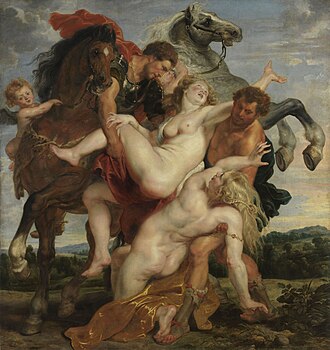 Der Raub der Töchter des Leukippos - Peter Paul Rubens (1618)
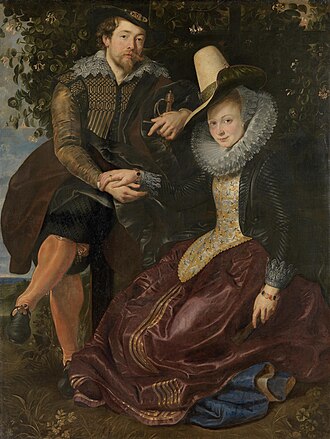 Rubens und Isabella Brant in der Geißblattlaube - Peter Paul Rubens (1600s)
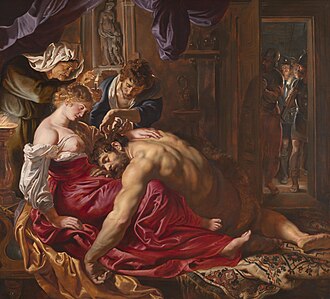 Samson und Delilah - Peter Paul Rubens (1600s)
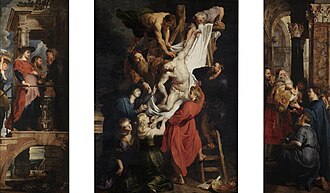 Kreuzabnahme - Peter Paul Rubens (1611)
 Haupt der Medusa - Peter Paul Rubens (1618)
 Helena Fourment - Peter Paul Rubens (1638)
.jpg) Der Liebesgarten - Peter Paul Rubens (1632)
Der Liebesgarten - Peter Paul Rubens (1632)
Werke verwandter Künstler
 Die Sternennacht - Vincent van Gogh (1889)
.jpg) Caféterrasse am Abend - Vincent van Gogh (1888)
Caféterrasse am Abend - Vincent van Gogh (1888) Das Abendmahl in Emmaus - Caravaggio (1601)
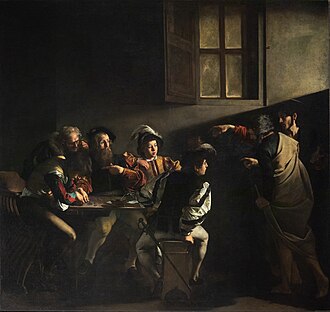 Die Berufung des Hl. Matthäus - Caravaggio (1609)
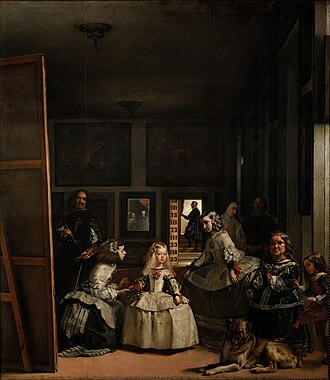 Las Meninas - Diego Velázquez (1656)
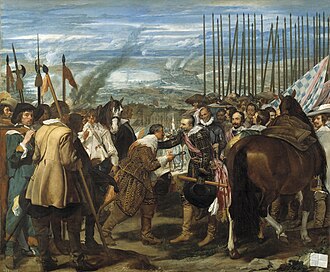 Die Übergabe von Breda - Diego Velázquez (1635)
%20-%20Google%20Art%20Project.jpg) Dreifachporträt von Karl I. - Anthony van Dyck (1635)
Dreifachporträt von Karl I. - Anthony van Dyck (1635)%20with%20M.%20de%20St%20Antoine%20-%20Google%20Art%20Project.jpg) Karl I mit M. de St. Antoine - Anthony van Dyck (1636)
Karl I mit M. de St. Antoine - Anthony van Dyck (1636) Die Nachtwache - Rembrandt van Rijn (1642)
 Selbstbildnis - Rembrandt van Rijn (1659)
 Das Mädchen mit dem Perlenohrgehänge - Johannes Vermeer (1665)
 Dienstmagd mit Milchkrug - Johannes Vermeer (c. 1658)