Selbstbildnis im Kreise der Mantuaner Freunde
Peter Paul Rubens · 1602
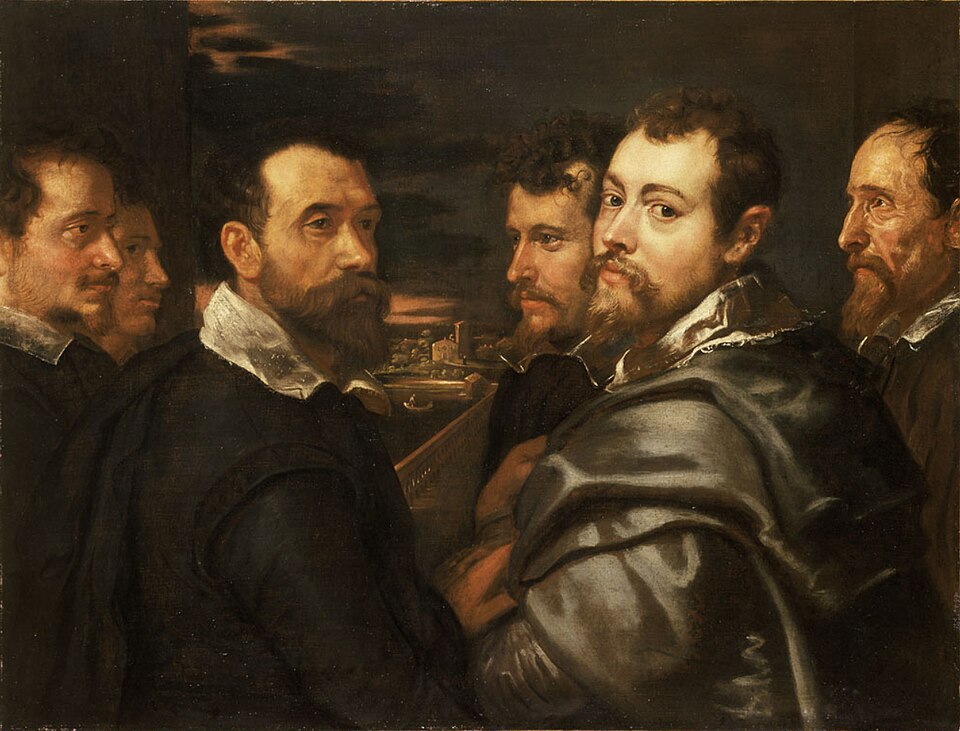
Six men gather before a strange glowing sky over Mantua, and the young Rubens turns back over his shoulder to meet our eyes. It is his oldest known self-portrait, and one of the faces beside him may be Galileo.
The story behind the painting
Rubens painted this canvas while he was court painter to the Gonzaga family in Mantua. Wikipedia places it between 1602 and 1606, while Wikidata gives 1602. It belongs to a genre popular in the sixteenth and seventeenth centuries, the friendship portrait, which shows friends or companions linked by something they share. Scholars agree that the six men never actually met like this. It is an imagined gathering of Stoic friends who mattered to Rubens, personally and intellectually, during his Mantuan years. It is the oldest known self-portrait by Rubens and hangs today in the Wallraf-Richartz Museum in Cologne.
What to look for
Six men appear at bust length, in profile or half profile, before a marine landscape lit by an unnatural light, with a small boat on the water. The view was first thought to be Rome, but careful study showed it is Mantua: the Ponte di San Giorgio, now destroyed, between two lakes, seen from the Palazzo Ducale where Rubens lived. Rubens sits centre right in a satin costume with a lace collar, richer than the others, placed a little closer and higher, his back half turned in the Venetian pose. A reddish glow in the left half of the sky has been read as an aurora borealis.
Meaning and intent
Behind Rubens is his older brother Philip, a scholar who studied with the philosopher Justus Lipsius, and Lipsius himself appears like a bust at the right edge, as if watching over his pupils. The boat may refer to the Styx, which could mean Lipsius was already dead, though this is uncertain. The man touching Rubens's arm was long thought to be the painter Frans Pourbus the Younger; he is now believed to be Galileo, and X-rays show a mark under the left eye that recalls Galileo's wart. By painting himself among learned humanists, Rubens showed he wanted to be seen as an educated painter, a pictor doctus.
Legacy
The identities of some sitters are still debated, and the picture shows how much Rubens valued being part of this circle. The pose that brings him nearer to us than anyone else has been read as an expression of his self-confidence. Rubens and Galileo are known to have formed a lifelong friendship. In 1611 to 1612 Rubens returned to the theme in a better known group, The Four Philosophers, now in the Palazzo Pitti in Florence, showing himself, Philip, Lipsius and Joannes Woverius beside a bust then believed to be Seneca, since identified as an imagined portrait of the Greek poet Hesiod.
Schon gewusst?
- The oldest known self-portrait by Rubens.
- Painted in Mantua, dated 1602 to 1606 by Wikipedia and 1602 by Wikidata.
- The landscape shows the lost Ponte di San Giorgio in Mantua.
- The man touching Rubens's arm is now believed to be Galileo.
Über den Künstler
Peter Paul Rubens (1577-1640)
Mann · Selbstbildnis · Landschaft · Blick auf den Betrachter · Gruppenporträt · Munich Central Collecting Point · Wallraf-Richartz-Museum & Fondation Corboud · Peter Paul Rubens
Mehr von Peter Paul Rubens
.jpg) Die Aufrichtung des Kreuzes - Peter Paul Rubens (1609)
Die Aufrichtung des Kreuzes - Peter Paul Rubens (1609) Der Raub der Töchter des Leukippos - Peter Paul Rubens (1618)
 Rubens und Isabella Brant in der Geißblattlaube - Peter Paul Rubens (1600s)
 Samson und Delilah - Peter Paul Rubens (1600s)
 Kreuzabnahme - Peter Paul Rubens (1611)
 Haupt der Medusa - Peter Paul Rubens (1618)
 Helena Fourment - Peter Paul Rubens (1638)
.jpg) Der Liebesgarten - Peter Paul Rubens (1632)
Der Liebesgarten - Peter Paul Rubens (1632)
Werke verwandter Künstler
 Die Sternennacht - Vincent van Gogh (1889)
.jpg) Caféterrasse am Abend - Vincent van Gogh (1888)
Caféterrasse am Abend - Vincent van Gogh (1888) Das Abendmahl in Emmaus - Caravaggio (1601)
 Die Berufung des Hl. Matthäus - Caravaggio (1609)
 Las Meninas - Diego Velázquez (1656)
 Die Übergabe von Breda - Diego Velázquez (1635)
%20-%20Google%20Art%20Project.jpg) Dreifachporträt von Karl I. - Anthony van Dyck (1635)
Dreifachporträt von Karl I. - Anthony van Dyck (1635)%20with%20M.%20de%20St%20Antoine%20-%20Google%20Art%20Project.jpg) Karl I mit M. de St. Antoine - Anthony van Dyck (1636)
Karl I mit M. de St. Antoine - Anthony van Dyck (1636)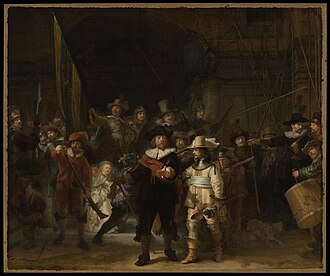 Die Nachtwache - Rembrandt van Rijn (1642)
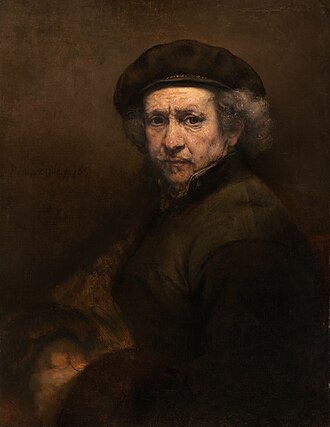 Selbstbildnis - Rembrandt van Rijn (1659)
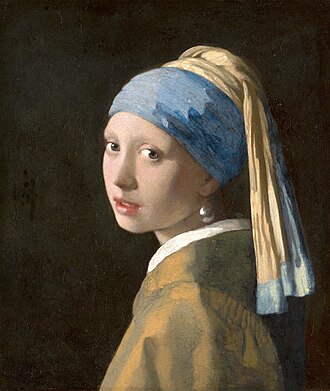 Das Mädchen mit dem Perlenohrgehänge - Johannes Vermeer (1665)
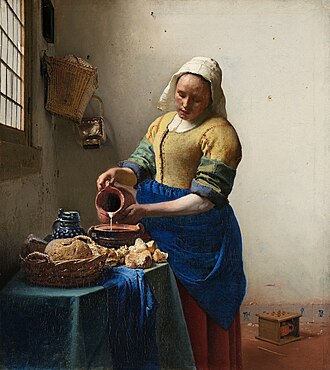 Dienstmagd mit Milchkrug - Johannes Vermeer (c. 1658)