Die heilige Praxedis
Johannes Vermeer · 1655
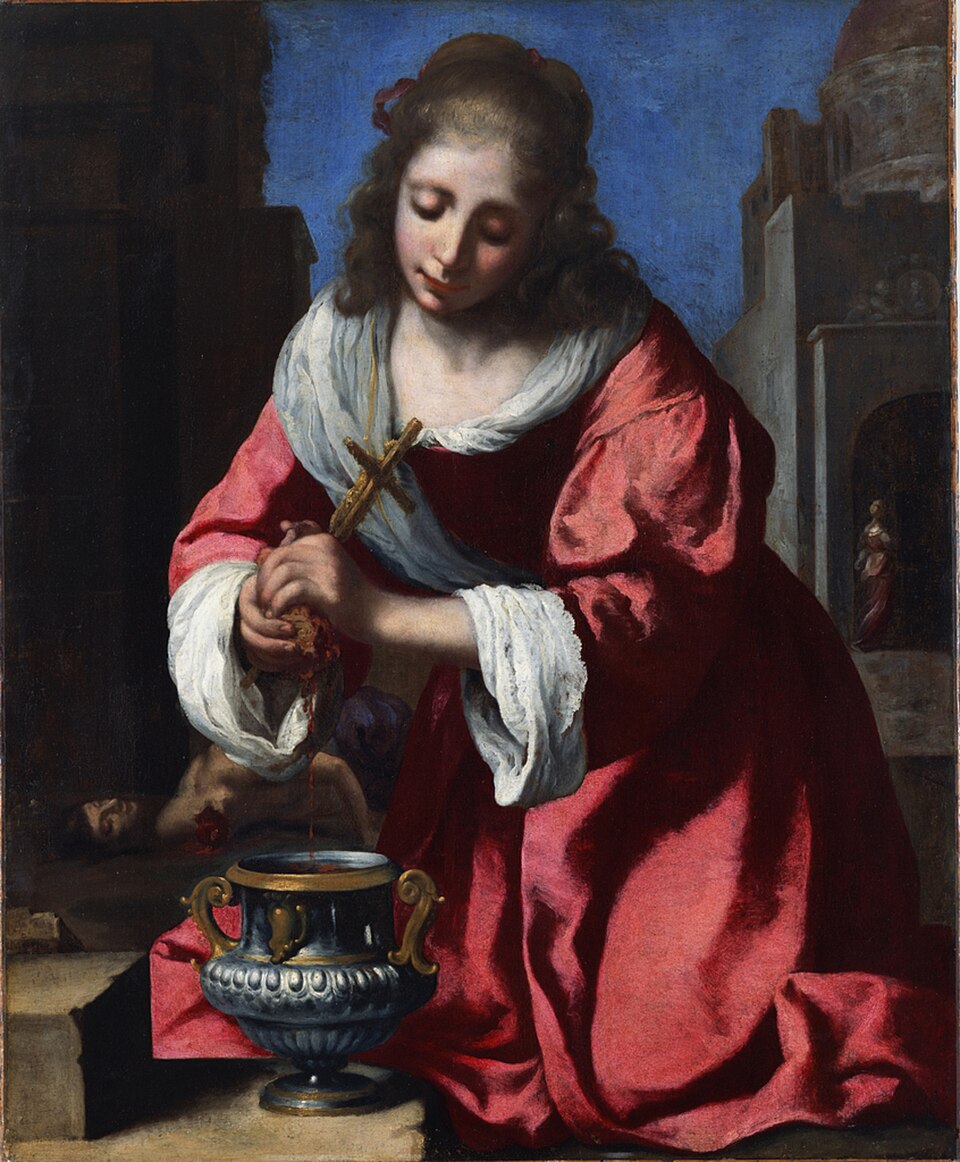
A young saint wrings a martyr's blood from a sponge into a golden vessel. Signed Meer 1655, it may be one of Vermeer's earliest works, and for decades scholars have argued over whether his hand painted it at all.
The story behind the painting
The painting shows Saint Praxedis, an early Roman martyr, and is closely related to a work by the Florentine painter Felice Ficherelli from 1640 to 1645, now in the Collection Fergnani in Ferrara. It is generally taken to be a copy of it, which would make it Vermeer's only known close copy of another work. Nothing is known of its history before the mid twentieth century. The collector Jacob Reder bought it at a minor New York auction house in 1943, and it drew attention as a possible Vermeer at a 1969 exhibition of Florentine Baroque art at the Metropolitan Museum.
What to look for
The saint squeezes blood from a sponge into an ornate vessel. The most obvious difference from the Ferrara picture is a crucifix, which appears here and not there. Look for the signature: the clear one reads Meer 1655, which would make this one of only four dated Vermeer paintings, with The Procuress, The Astronomer and The Geographer. A second, fainter mark seems to read Meer N R o o, perhaps once Meer naar Riposo, Vermeer after Riposo, Ficherelli's nickname, though it is too indistinct to be deciphered. The painting uses an unusually large amount of ultramarine.
Meaning and intent
The case for Vermeer rests on several clues. The leading scholar Arthur K. Wheelock Jr. saw links with the early history paintings and with the face in A Girl Asleep, and suggested that Vermeer's conversion to Catholicism could explain his interest in a martyr saint. A 2014 analysis of the lead white paint pointed to Dutch or Flemish origin, possibly related to the paint of Diana and Her Companions. The conservator Jorgen Wadum argued in 1998 that the background was painted before the foreground, more typical of an original than a copy, while Christie's suggested a young artist experimenting with another master's design.
Legacy
Doubt has followed the picture: it was left out of The Young Vermeer exhibition in 2010 to 2011, yet included in a Rome exhibition in 2012 to 2013. In 2014 Christie's announced that its investigations had established it as a Vermeer. From March 2015 it has been shown at the National Museum of Western Art in Tokyo, labelled as attributed to Johannes Vermeer, apparently on long-term loan from a private owner. Before its 2023 exhibition, the Rijksmuseum announced that it had confirmed the attribution, one of three disputed works it accepted as authentic.
Schon gewusst?
- Signed and dated Meer 1655.
- Closely related to a painting by Felice Ficherelli.
- Attribution to Vermeer long debated, confirmed by the Rijksmuseum in 2023.
- Shown at the National Museum of Western Art in Tokyo since 2015.
Über den Künstler
Johannes Vermeer (1632-1675)
religiöse Kunst · Niederländisches Goldenes Zeitalter der Malerei
Mehr von Johannes Vermeer
 Das Mädchen mit dem Perlenohrgehänge - Johannes Vermeer (1665)
 Dienstmagd mit Milchkrug - Johannes Vermeer (c. 1658)
 Ansicht von Delft - Johannes Vermeer (1660s)
 Der Astronom - Johannes Vermeer (1664)
 Die Malkunst - Johannes Vermeer (1660s)
 Straße in Delft - Johannes Vermeer (1658)
 Brieflesendes Mädchen am offenen Fenster - Johannes Vermeer (1650s)
 Frau mit Waage - Johannes Vermeer (1665)
Werke verwandter Künstler
 Die Nachtwache - Rembrandt van Rijn (1642)
 Selbstbildnis - Rembrandt van Rijn (1659)
 Fest des hl.Nikolaus - Jan Steen (1660s)
 Mädchen mit Austern. - Jan Steen (1658)
 Ein Schütze einen Berkemeyer haltend, bekannt als „Der fröhliche Trinker" - Frans Hals (1620s)
 Der lachende Kavalier - Frans Hals (1624)
 Die Mühle von Wijk - Jacob van Ruisdael (1670)
 Judenfriedhof - Jacob van Ruisdael (1650s)
 Hof eines Hauses in Delft - Pieter de Hooch (1658)
 A Woman Peeling Apples - Pieter de Hooch (1663)