Die Predigt des Heiligen Antonius an die Fische
Paolo Veronese · 1580
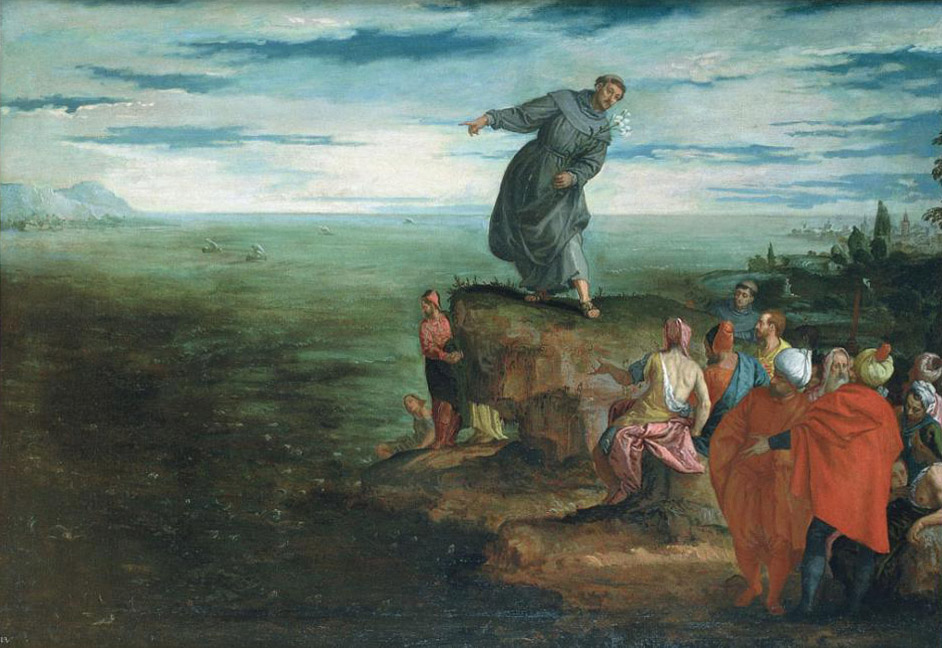
Standing on a rock like the prow of a ship, Saint Anthony points to the sea, and the fish rise to listen. Hidden for centuries under milky varnish, those fish only became visible again after a restoration in 2001.
The story behind the painting
Veronese painted this scene of Anthony of Padua in the early 1580s; Wikipedia gives 1580 to 1585, while Wikidata records 1580. Its original location is unknown, though its medium size suggests a chapel side wall or a cycle for a small scuola in the Veneto. In 1607 Francesco Barbaro, patriarch of Aquileia, sent it to Cardinal Scipione Borghese together with another Veronese sermon, Saint John the Baptist Preaching. The attribution has been debated: Giovanni Morelli gave it to Giovanni Battista Zelotti in 1897, but later scholars, including Roberto Longhi, returned it to Veronese.
What to look for
The left half is a calm, dark blue-green sea full of fish; the right half is the Rimini shore, with the city's spires in the distance. Anthony, in light grey-blue robes with white lilies, stands on a triangular rock and points down to the fish while looking sternly at the people. Veronese made him taller than he should be to give him monumental presence. Of at least sixteen listeners, only one, in yellow with his hand on his heart, looks at the saint; he is thought to be a self-portrait. An old white-bearded man between two red-robed Turks, looking out at us, may be Tintoretto.
Meaning and intent
Veronese painted this not long after the Venice Inquisition questioned him over a Last Supper they found too festive, forcing him to rename it The Feast in the House of Levi. That experience may explain the humble self-portrait, the sympathetic portrait of Tintoretto and the rich treatment of the crowd. The message is sharp: the fish listen while many people, including foreigners arguing among themselves, only stare in amazement. Standalone pictures of this sermon are rare, as it usually appears inside larger cycles of Anthony's miracles.
Legacy
The painting hung in Palazzo Torlonia by 1613, when the court poet Scipione Francucci described it in verse, and it is now in the Galleria Borghese in Rome. Restorations in 1919 and 1947 blurred it under a milky layer, so the leaping fish that Claudio Ridolfi described in 1648 became illegible. In June 2001 the heavy varnish was removed and light and colour returned. When the frame was taken off, the words Paolo Veronese were found on it, not a signature but a note for a collector or dealer.
Schon gewusst?
- Painted about 1580 to 1585.
- Gift of Francesco Barbaro to Scipione Borghese in 1607.
- One listener is thought to be a self-portrait of Veronese.
- The 2001 restoration made the fish visible again.
Über den Künstler
Paolo Veronese (1528-1588)
religiöse Kunst · Manierismus · Landschaft · Menschenmenge · Meer · Galleria Borghese
Mehr von Paolo Veronese
 Die Hochzeit zu Kana - Paolo Veronese (1560s)
 Das Gastmahl im Hause des Levi - Paolo Veronese (1573)
 Venus und Adonis - Paolo Veronese (1580)
 Allegory of Virtue and Vice - Paolo Veronese (1565)
 Mars und Venus durch Liebe vereint - Paolo Veronese (1570s)
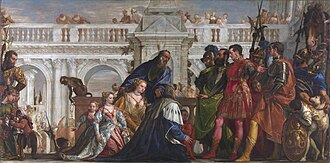 Die Familie des Darius vor Alexander - Paolo Veronese (1565)
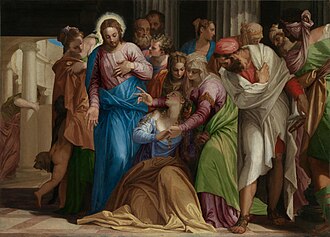 Bekehrung von Maria Magdalena - Paolo Veronese (1548)
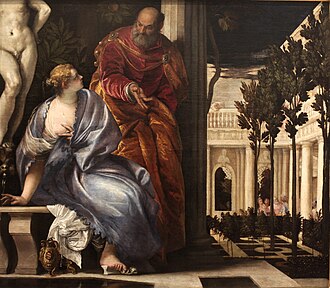 Bathseba im Bade - Paolo Veronese (1575)
Werke verwandter Künstler
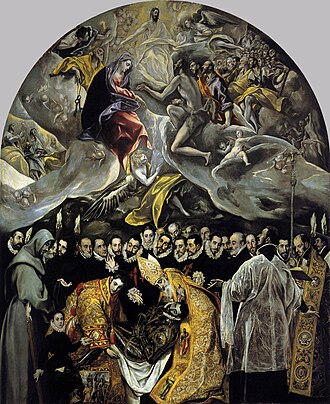 Begräbnis des Grafen von Orgaz - El Greco (1586)
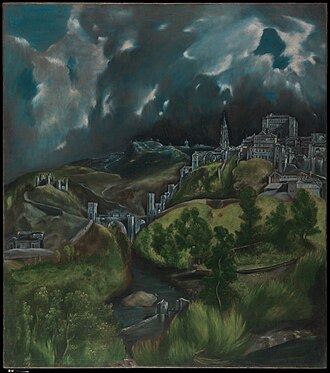 Ansicht von Toledo - El Greco (1596)
 Das letzte Abendmahl - Jacopo Tintoretto (1563)
 Der heilige Markus befreit den gefesselten Sklaven - Jacopo Tintoretto (1540s)
 Venus von Urbino - Titian (1538)
 Mariä Himmelfahrt - Titian (1510s)
 Das Abendmahl in Emmaus - Caravaggio (1601)
 Die Berufung des Hl. Matthäus - Caravaggio (1609)
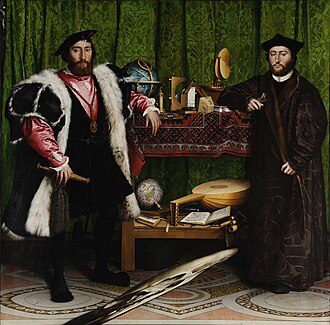 Die Gesandten - Hans Holbein the Younger (1533)
 Der Leichnam Christi im Grabe - Hans Holbein the Younger (1520s)