Bekehrung von Maria Magdalena
Paolo Veronese · 1548
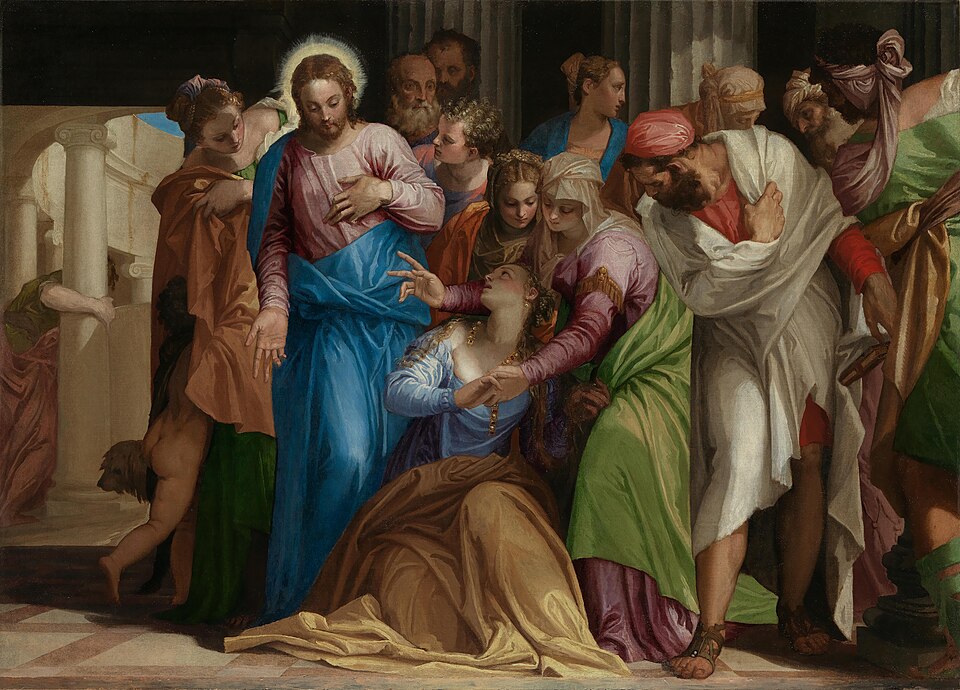
A young woman in a low-cut gown kneels beside Christ in the Temple, blushing as she listens, her necklace slipping from her neck. Veronese painted the moment of her turning when he was still in his teens.
The story behind the painting
This is an early work by Paolo Veronese (1528 to 1588), dated around 1545 to 1548, when he was still a teenager; Wikidata gives 1548. It was probably commissioned by a noble patron in Verona. The scene is not in the Gospels or the Golden Legend. It follows Pietro Aretino's 1535 book L'umanità di Cristo, widely read in Northern Italy, in which Mary goes to the Temple in Jerusalem and Christ's teaching moves her to a pious life. The subject was once debated, but this reading is now the general opinion.
What to look for
Christ preaches in the Temple. Mary Magdalene kneels beside him, turning her face to him, while Martha stretches out her hands toward them both. Mary's dress is unsuitable for a sacred building, and the source reads her low neckline as a sign of her former life and the necklace slipping from her neck as her turn from worldly things to devotion. As so often with Veronese, holy figures wear shimmering silks and brocades closer to Venetian high society than to humble scenes. Wikidata gives the size as 117.5 by 163.5 cm.
Meaning and intent
The picture reflects beliefs of its time: that Mary Magdalene and Martha were sisters living together, and that Mary Magdalene was the sinful woman mentioned elsewhere in the Gospels. Today most Christians, including the Catholic Church, see these as three different women. Veronese defended his freedom in such choices: questioned later by the Inquisition, he answered that painters take liberties, as poets and lunatics do. Here, in a youthful work, that freedom already shows.
Legacy
A conversion set in the Temple is very rare. The National Gallery also has one by Pedro Campaña of about 1562, and the Wallace Collection holds a study by Paul Delaroche of about 1835 for lunettes in the Madeleine in Paris that were never carried out. Veronese's painting entered the National Gallery in London in 1876, bequeathed from the estate of the collector Wynne Ellis. Guido Cagnacci's Repentant Magdalene of the early 1660s shows the more usual version, at the sisters' home without Christ.
Schon gewusst?
- An early work, about 1545 to 1548, painted in Veronese's teens.
- Based on Pietro Aretino's L'umanità di Cristo (1535).
- The Temple setting for this subject is very rare.
- In the National Gallery, London, since 1876.
Über den Künstler
Paolo Veronese (1528-1588)
religiöse Kunst · National Gallery · Maria Magdalena
Mehr von Paolo Veronese
 Die Hochzeit zu Kana - Paolo Veronese (1560s)
.jpg) Das Gastmahl im Hause des Levi - Paolo Veronese (1573)
Das Gastmahl im Hause des Levi - Paolo Veronese (1573).jpg) Venus und Adonis - Paolo Veronese (1580)
Venus und Adonis - Paolo Veronese (1580) Allegory of Virtue and Vice - Paolo Veronese (1565)
 Mars und Venus durch Liebe vereint - Paolo Veronese (1570s)
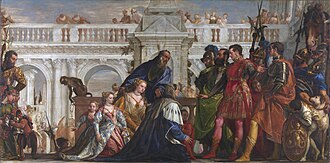 Die Familie des Darius vor Alexander - Paolo Veronese (1565)
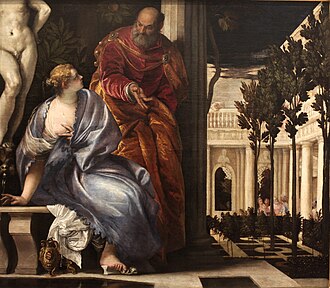 Bathseba im Bade - Paolo Veronese (1575)
%20grande.jpg) Christus und die Schriftgelehrten - Paolo Veronese (1560)
Christus und die Schriftgelehrten - Paolo Veronese (1560)
Werke verwandter Künstler
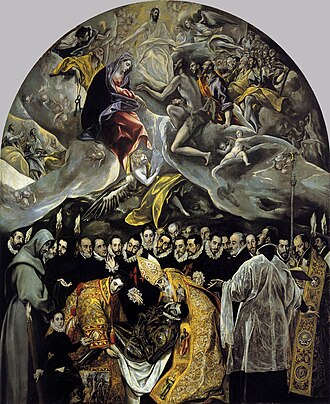 Begräbnis des Grafen von Orgaz - El Greco (1586)
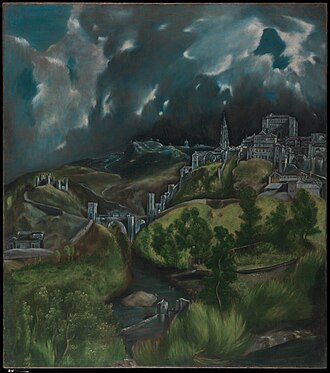 Ansicht von Toledo - El Greco (1596)
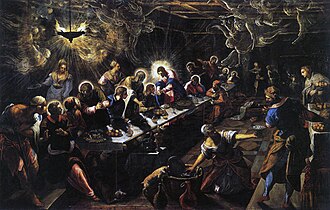 Das letzte Abendmahl - Jacopo Tintoretto (1563)
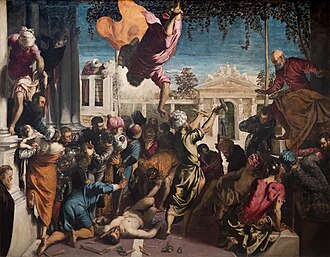 Der heilige Markus befreit den gefesselten Sklaven - Jacopo Tintoretto (1540s)
.jpg) Venus von Urbino - Titian (1538)
Venus von Urbino - Titian (1538)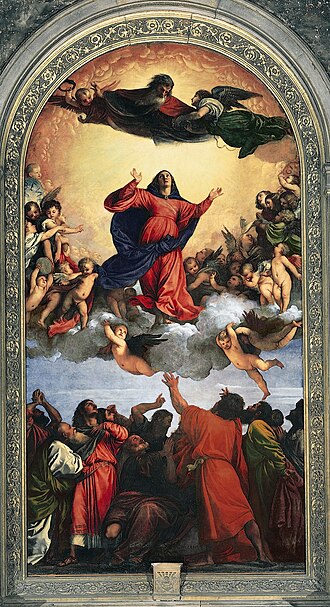 Mariä Himmelfahrt - Titian (1510s)
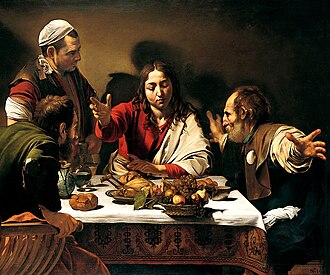 Das Abendmahl in Emmaus - Caravaggio (1601)
 Die Berufung des Hl. Matthäus - Caravaggio (1609)
 Die Gesandten - Hans Holbein the Younger (1533)
 Der Leichnam Christi im Grabe - Hans Holbein the Younger (1520s)