Marine, temps d’orage
Édouard Manet · 1860s
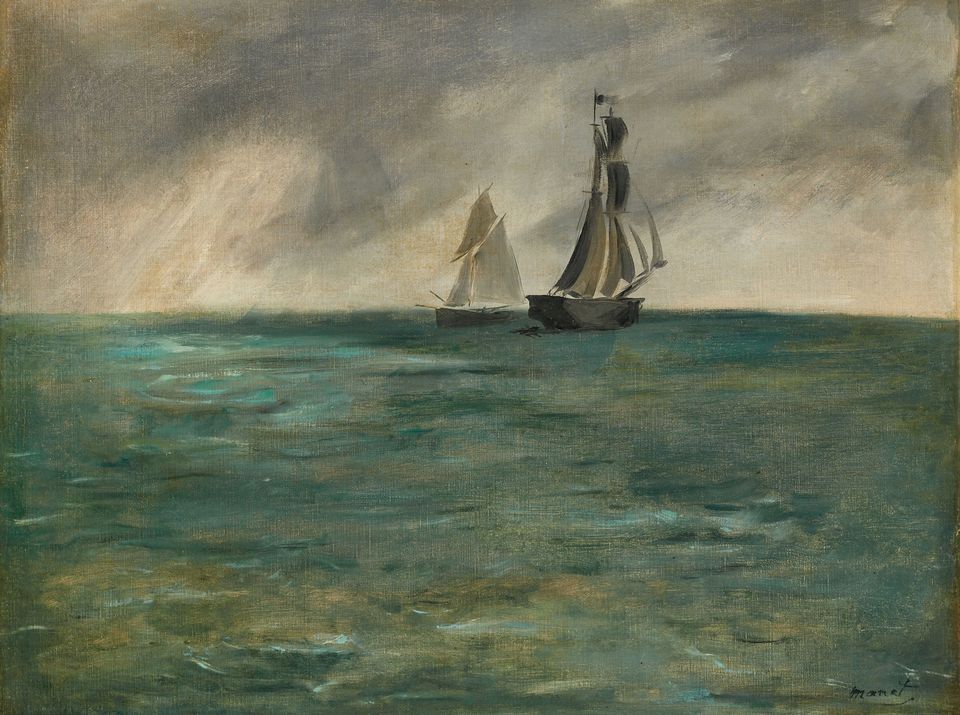
Two sailing boats lean away from each other near a high horizon, a green sea below and grey cloud sweeping down behind them. Manet's stormy seascape vanished during the Second World War and only reappeared in 2014, in Cornelius Gurlitt's house in Salzburg.
The story behind the painting
Manet had a special bond with the sea. Before choosing art he aimed to become a naval officer, and in 1848 he sailed for six months to Brazil on the training ship Le Havre et Guadeloupe, studying the water in every light and weather. His first known sea painting dates from 1864. That summer and again in 1868 he stayed at Boulogne-sur-Mer on the Channel coast, making sketches and watercolours later used in the studio. His 1868 sketchbook contains pencil drawings of sailing ships much like these. The canvas is usually dated about 1864 to 1868, though earlier authors placed it in the early 1870s.
What to look for
More than half of the picture is sea, painted with virtuoso strokes in many greens. Above is a yellowish sky largely covered by grey clouds, which right behind the ships reach down to the water and suggest rain. The left boat is seen side on, with lighter sails, heading left. The right boat is seen from behind at an angle, steering toward the horizon, its tall mast clearly higher and its rigging fuller. It is unclear where Manet stood: on the shore, at a window or on another ship. Despite the French title, Marine, temps d'orage, there is no lightning or wild wave to show an extreme storm.
Meaning and intent
The high horizon links this work to other seascapes of 1864 to 1868, such as a steamer leaving Boulogne in Chicago and sailing ships at sea in Cleveland, whose foreground waves look much the same. In about 1868 Manet also reduced a sea view to just two fishing boats. The 2003 to 2004 exhibition Manet and the Sea, shown in Chicago, Philadelphia and Amsterdam, first examined these seascapes closely, and its catalogue by Wilson-Bareau and Degener connected this painting to that period on grounds of style. The picture seems less about drama than about weather, distance and the moving surface of the water.
Legacy
After Manet's death in 1883 the painting was in his studio and was bought at his estate sale by Léon Leenhoff for his mother, Suzanne Manet. It later belonged to Charles Deudon, then to the dealer Paul Rosenberg, and probably in 1922 to the Japanese collector Matsukata Kojiro. During the war it passed through several dealers in France, and in March 1944 reached Hildebrand Gurlitt. His son Cornelius inherited it in 1956, and it emerged in Salzburg in 2014. Gurlitt left it to the Kunstmuseum Bern, which, after checking its ownership history, sold it in 2019 to the National Museum of Western Art in Tokyo.
Schon gewusst?
- Painted about 1864-1868, possibly after Boulogne sketches.
- Manet sailed to Brazil as a young man in 1848.
- Missing from the Second World War until 2014.
- Moved from the Gurlitt bequest in Bern to Tokyo in 2019.
Über den Künstler
Édouard Manet (1832-1883)
Mehr von Édouard Manet
 Das Frühstück im Grünen - Édouard Manet (1863)
 Olympia - Édouard Manet (1863)
 Bar in den Folies-Bergère - Édouard Manet (1882)
 Der Balkon - Édouard Manet (1868)
 Musik im Tuileriengarten - Édouard Manet (1862)
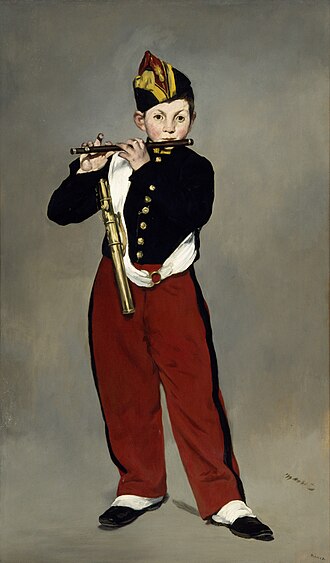 Der Pfeifer - Édouard Manet (1866)
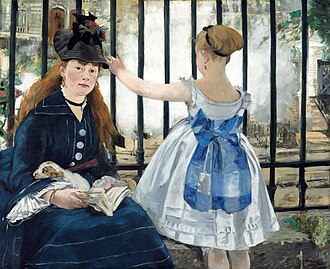 Die Eisenbahn - Édouard Manet (1873)
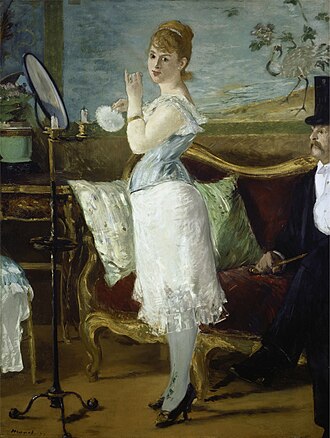 Nana - Édouard Manet (1877)
Werke verwandter Künstler
 Impression, Sonnenaufgang - Claude Monet (1872)
 Seerosen - Claude Monet (1906)
 Tanz im Moulin de la Galette - Pierre-Auguste Renoir (1876)
 Das Frühstück der Ruderer - Pierre-Auguste Renoir (1881)
 Wiege - Berthe Morisot (1872)
 Sommertag - Berthe Morisot (1879)
 Der Absinth - Edgar Degas (1875)
 Die Bellelli Familie - Edgar Degas (1858)
 Der Kanal von Loing - Alfred Sisley (1892)
 The Watering Pond at Marly with Hoarfrost - Alfred Sisley (1876)
 Straße in Paris an einem regnerischen Tag - Gustave Caillebotte (1877)
 Die Parkettschleifer - Gustave Caillebotte (1875)