Porträt eines jungen Mannes
Édouard Manet · 1850s
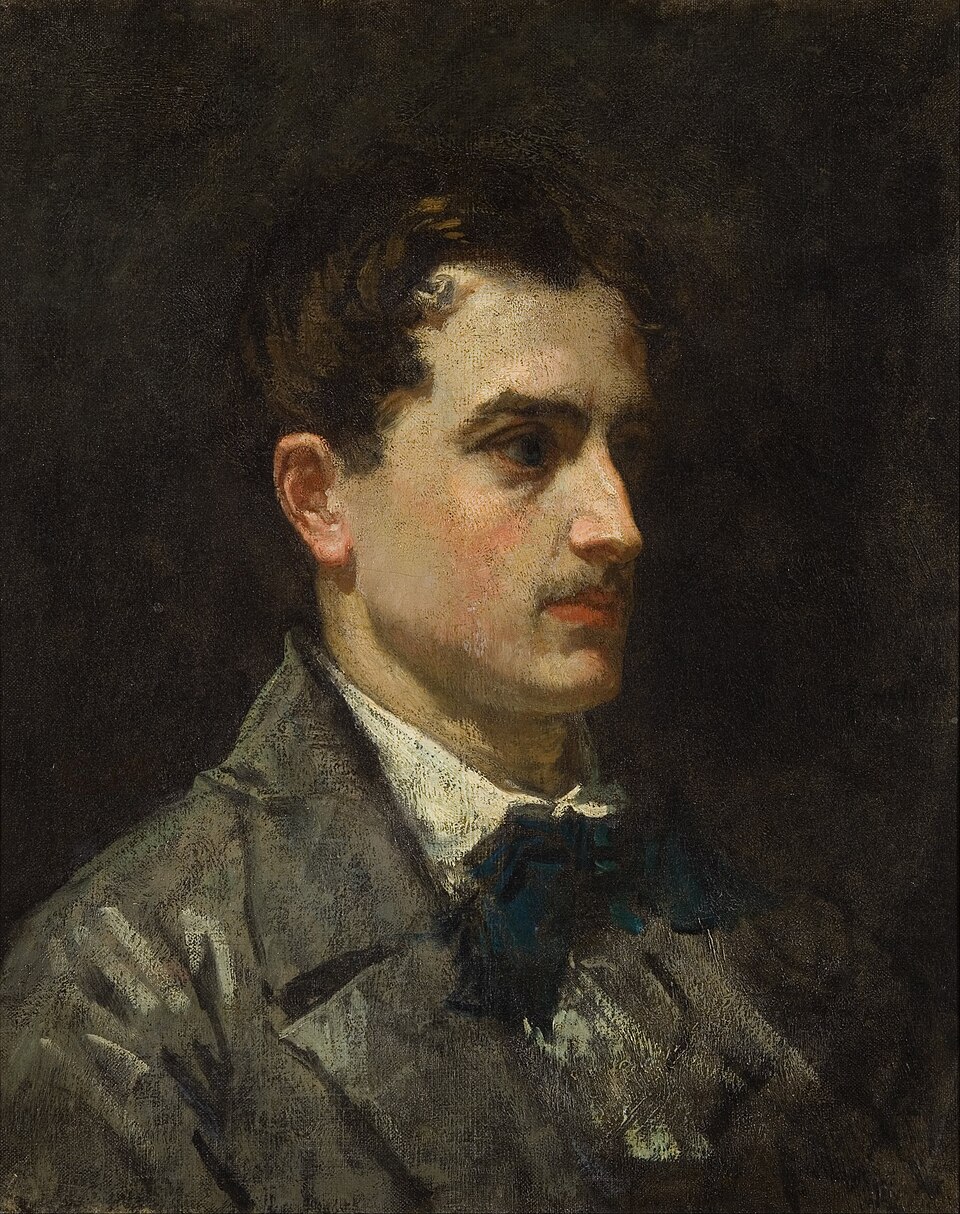
A young man with wide dark eyes, a pale face and a blue bow at his collar. For a century he was called Antonin Proust, Manet's school friend. Today no one is quite sure who he is.
The story behind the painting
This early portrait is dated by art historians to about 1855 to 1856, the last years of Manet's training in the studio of Thomas Couture, which lasted from 1850 to 1856. Few paintings from that time survive. Some authors think Manet destroyed early works that reminded him too much of his teacher. According to Antonin Proust, who studied there briefly too, Manet hated the posed models and the colours, light and shadows taught there, and said entering the studio felt like stepping into a tomb.
What to look for
The young man is seen bust length against a dark background, in three quarter view turned to the right, his wide dark eyes looking to the right edge. Frontal light makes one half of his face bright and leaves the other in shadow. His skin is almost white, with faint reds on cheek and chin, stronger red lips and a light moustache. He wears a grey jacket with broad lapels, a white collar and a blue bow. The face is finely painted, the clothes in broad, sketchy strokes. The canvas, 56.5 by 47 cm, carries only the studio stamp E. M.
Meaning and intent
The painting still shows the pronounced influence of Couture, as Gotthard Jedlicka noted, with colours close to Couture's own portraits. The sitter is the puzzle. No early portrait of Proust is documented, and Proust did not mention one in his biography of Manet. The title Portrait d'Antonin Proust appeared only when the work was offered for sale in 1906. Sandra Orienti, and later Denis Rouart and Daniel Wildenstein, pointed to another school friend, Paul Roudier, whom a red chalk drawing by Manet resembles. Ronald Pickvance called that only a hypothesis, and in 2011 Stéphane Guégan still saw Proust as possible.
Legacy
The first known owner was the opera singer Jean-Baptiste Faure. After passing through galleries in Paris and Munich and a collector in Alexandria, it reached the industrialist Oskar Federer in Moravian Ostrava. As a Jew facing Nazi persecution he emigrated in 1939; he had lent works to Amsterdam in 1938 and managed to take them to North America, where they were shown in New York in 1940. The National Gallery Prague acquired the painting in 1968 and has shown it since, catalogued as a portrait of Antonio Proust.
Schon gewusst?
- Painted about 1855-1856, while Manet trained with Thomas Couture.
- The sitter may be Antonin Proust or Paul Roudier; it is disputed.
- It carries only the studio stamp E. M., no signature or date.
- Held by the National Gallery Prague since 1968.
Über den Künstler
Édouard Manet (1832-1883)
Porträt · Nationalgalerie Prag
Mehr von Édouard Manet
 Das Frühstück im Grünen - Édouard Manet (1863)
 Olympia - Édouard Manet (1863)
 Bar in den Folies-Bergère - Édouard Manet (1882)
 Der Balkon - Édouard Manet (1868)
 Musik im Tuileriengarten - Édouard Manet (1862)
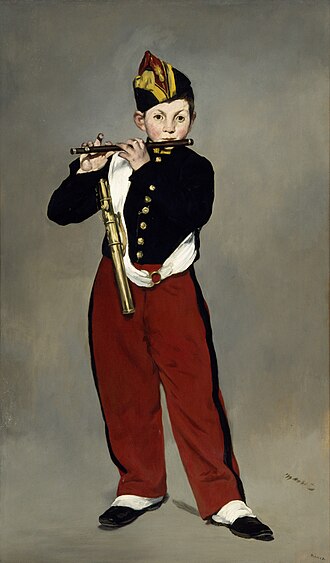 Der Pfeifer - Édouard Manet (1866)
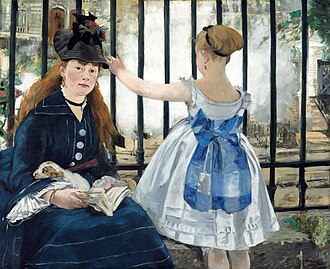 Die Eisenbahn - Édouard Manet (1873)
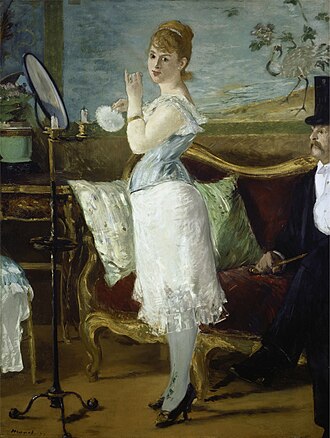 Nana - Édouard Manet (1877)
Werke verwandter Künstler
 Impression, Sonnenaufgang - Claude Monet (1872)
 Seerosen - Claude Monet (1906)
 Tanz im Moulin de la Galette - Pierre-Auguste Renoir (1876)
 Das Frühstück der Ruderer - Pierre-Auguste Renoir (1881)
 Wiege - Berthe Morisot (1872)
 Sommertag - Berthe Morisot (1879)
 Der Absinth - Edgar Degas (1875)
 Die Bellelli Familie - Edgar Degas (1858)
 Der Kanal von Loing - Alfred Sisley (1892)
 The Watering Pond at Marly with Hoarfrost - Alfred Sisley (1876)
 Straße in Paris an einem regnerischen Tag - Gustave Caillebotte (1877)
 Die Parkettschleifer - Gustave Caillebotte (1875)