Pallas Athena
Gustav Klimt · 1899
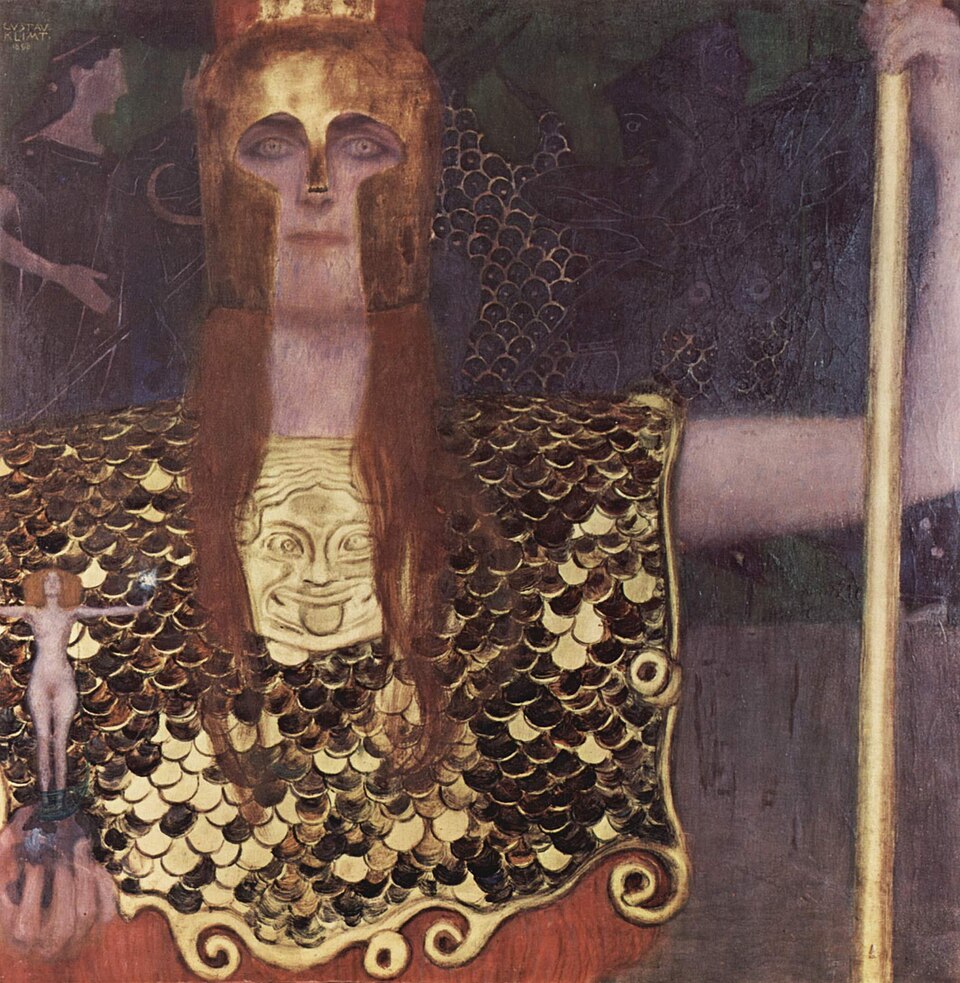
Athena stares straight out from under a golden helmet, calm and unbending, a tiny naked figure of Truth in her hand. Klimt's goddess became the banner of the Vienna Secession and the first glint of his golden phase.
The story behind the painting
Klimt painted Pallas Athena as the young Vienna Secession was fighting the art establishment. Wikipedia dates it 1898, the year it was first exhibited at the Secession's second exhibition in November, while Wikidata gives 1899. He had painted Athena twice before: in a spandrel at the Kunsthistorisches Museum, with her traditional Nike and spear, and on the poster for the first Secession exhibition, watching Theseus fight the Minotaur, as a liberator of the arts. This third Athena stands apart from battle, as victory itself.
What to look for
The canvas is square, 75 by 75 cm. Athena wears a golden helmet and breastplate and holds her spear; her wide, calm eyes and tight mouth give her a strong, almost masculine look, in keeping with ancient images of the goddess. On her breastplate is an archaic Medusa head sticking out its tongue. In her right hand, where Nike would usually stand, is a nude figure of Nuda Veritas, naked truth, holding a mirror. Behind her, Heracles fights Triton, a scene taken from a Greek black-figure vase now in Toledo, Ohio. Note the gold leaf and the patterns of scales, spirals and waves. The frame was made by Klimt's brother Georg.
Meaning and intent
Unlike his later Judith I or The Kiss, this painting has no erotic charge; Klimt stresses Athena's divine power instead. Nuda Veritas makes her a symbol of freedom, strength and victory, and Klimt painted that figure again in 1899. Some interpreters see the Medusa's tongue as mockery aimed at the Secession's opponents. Mixing the body with flat ornament, he moved away from traditional history painting, and the work is often called the first of his golden phase, which lasted until 1909. Contemporaries compared it with Franz von Stuck of the Munich Secession.
Legacy
Some viewers were shocked by so modern a goddess, and one critic said Klimt's affectation peaked in Pallas Athene. Ludwig Hevesi instead praised a Pallas of today, of her time, of her place, and of her creator, hoping it would enter a public collection. It was shown in London in 1899 and at the 1900 Paris Exposition. Its first owner was the patron Fritz Waerndorfer; after two more private owners, Franz Glück acquired it for the city of Vienna in 1954. It hangs in the Vienna Museum.
Schon gewusst?
- First shown at the second Vienna Secession exhibition, November 1898.
- Often seen as the first work of Klimt's golden phase.
- Athena holds Nuda Veritas, naked truth, instead of Nike.
- In the Vienna Museum, acquired by the city in 1954.
Wikipedia · Wikidata · Wikipedia
Über den Künstler
Gustav Klimt (1862-1918)
mythologische Malerei · Athene
Mehr von Gustav Klimt
 Der Kuss - Gustav Klimt (1907-1908)
 Adele Bloch-Bauer I - Gustav Klimt (1907)
 Danaë - Gustav Klimt (1907)
.jpg) Judith I - Gustav Klimt (1901)
Judith I - Gustav Klimt (1901)%20Google%20Art%20Project.jpg) Die drei Lebensalter einer Frau - Gustav Klimt (1905)
Die drei Lebensalter einer Frau - Gustav Klimt (1905)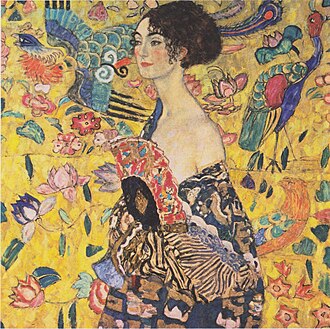 Dame mit Fächer - Gustav Klimt (1917)
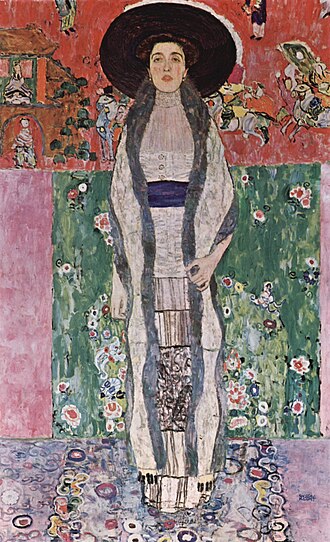 Bildnis Adele Bloch-Bauer II - Gustav Klimt (1912)
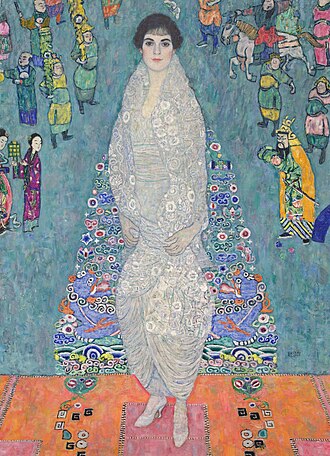 Bildnis der Elisabeth Lederer - Gustav Klimt (1910s)