Judith I
Gustav Klimt · 1901
.jpg)
She has just saved her city, yet Klimt's Judith does not look like a pious widow. With half-closed eyes and parted lips, she meets our gaze over a severed head, glowing against gold.
The story behind the painting
Klimt painted Judith I in 1901, also known as Judith and the Head of Holofernes. The biblical heroine Judith seduced and then beheaded the Assyrian general Holofernes to save her city of Bethulia. By Klimt's time, art had long told this episode in a heroic way, celebrating Judith's courage and virtue; Caravaggio and Gentileschi had shown the violence of the act, while others pictured the dazed moment afterwards. Klimt chose a different path. He set aside the narrative almost entirely and concentrated on Judith alone. Scholars connect the composition and symbolism to The Sin by Franz Stuck, whose tempting figure suggested the posture of the half-revealed body and the set of the face. Klimt would return to the subject in a second version in 1909.
What to look for
Begin with the face, slightly lifted with pride, yet languid, the lips parted between defiance and seduction. Her half-closed eyes look straight out at you. Now drift to the right edge: Holofernes' head is cut off by the margin of the picture, and there is no bloodied sword anywhere. Notice how the black hair stands against the golden background, framed by stylised trees fanning out at the sides. Her dark green, semi-sheer garment falls open over a nearly bare torso. Look, too, at the strong lines: the upright body and head are answered by horizontal bands near the bottom, the arm, the shoulders joined by a collar, the base of the hair. The panel measures 84 by 42 cm.
Meaning and intent
Traditionally Judith was read as a pious widow fulfilling a higher duty. Here she becomes the femme fatale Klimt portrayed again and again, and the painting hints at a sexual subtext absent from the biblical story. The historian Franz A. J. Szabo saw in it a symbol of the triumph of the erotic feminine principle over the aggressive masculine one. In 1903 the writer Felix Salten described her dark glances with a sultry fire and cruelty in the lines of her mouth. Behind the altered features, many recognise Klimt's friend, the Viennese socialite Adele Bloch-Bauer, whom he later painted in 1907 and 1912. The missing sword and the merging of seduction and killing into one moment invite comparison with Salome.
Legacy
That comparison caused confusion: critics mislabeled the painting as Salome, the title character of Oscar Wilde's 1891 tragedy. To make his intention unmistakable, Klimt had his brother Georg make a metal frame engraved with the words Judith and Holofernes. In 1909 Klimt painted Judith II, where the heroine gains sharper features and a fierce expression, leaving behind the magnetic sensuality of this first version. Judith I places Klimt among symbolist artists and writers such as Wilde and Moreau, who imagined bewitching, dangerous women. Today the painting belongs to the Belvedere in Vienna, where its gold still frames one of the most arresting gazes in his art.
Schon gewusst?
- Painted in 1901; also called Judith and the Head of Holofernes (Wikipedia).
- Size 84 × 42 cm; held by the Belvedere (Wikidata).
- Klimt's brother Georg made the engraved frame naming the subject (Wikipedia).
- A second version, Judith II, followed in 1909 (Wikipedia).
Mehr von Gustav Klimt
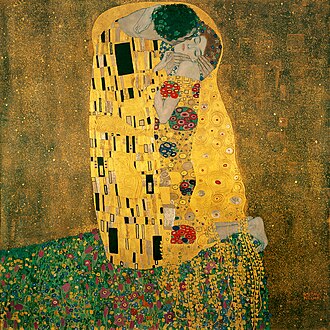 Der Kuss - Gustav Klimt (1907-1908)
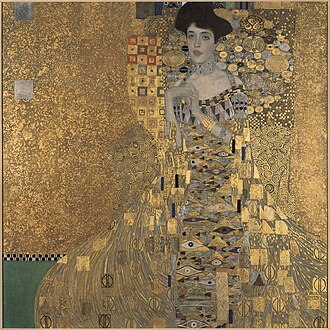 Adele Bloch-Bauer I - Gustav Klimt (1907)
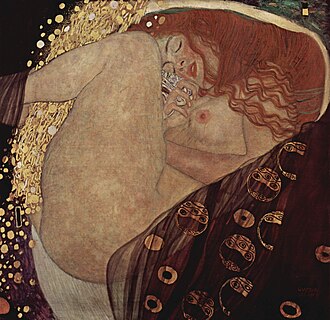 Danaë - Gustav Klimt (1907)