Die drei Lebensalter einer Frau
Gustav Klimt · 1905
%20Google%20Art%20Project.jpg)
A mother holds her sleeping child, eyes closed, wrapped in a blue glow, while beside them an old woman bows her head and hides her face. Klimt put the whole cycle of a life on one square canvas.
The story behind the painting
Klimt completed The Three Ages of Woman in Austria in 1905, the same year he left the Vienna Secession, the group he had co-founded and led as its first president from 1897 to 1903. That year the painting was shown at the second exhibition of the Deutsche Künstlerbund in Berlin, from May to October, under the simpler title The Three Ages. It belongs to Klimt's Golden Period, the years of high ornament and gold and metallic paint that also produced The Kiss, and its decorative surface links it with Art Nouveau. It is an oil on canvas, a large square of 180 by 180 cm.
What to look for
The three figures stand at the centre against a background with almost no depth, so the picture feels flat, like a decorated panel. The child and the young mother share a vertical blue aura of cool, fluid patterns; they are the only two who touch, both with eyes closed, sheer blue fabric falling down their legs and flowers in the mother's bright hair, a sign of spring. The old woman stands apart in a warm, earthy aura with harder patterns. Her head is turned down and away, her skin sagging, belly swollen, veins showing, and unlike the others both her feet are visible. The auras overlap only slightly.
Meaning and intent
The painting is an allegory of the cycle of life: childhood, motherhood and old age side by side. The calm, neutral colours give it a restful effect, yet the contrast is stark. Youth is cool, soft and connected; age is warm, isolated and shown in full, down to both feet, so that, as one reading puts it, the viewer sees the effects of age in their entirety. Klimt does not soften that ending. The old woman's hidden face, turned from the tender pair beside her, may be the most moving detail: the sources describe her separation but leave her feelings to us.
Legacy
The canvas shows the impasto that was common in Klimt's work. He mixed drying solvents into his paint to avoid an unwanted gloss, and he often retouched works, which limited how many he could finish each year. That slow care is visible in the dense ornament of the two auras. The Three Ages of Woman did not stay in Vienna: it is now in Rome, in the Galleria Nazionale d'Arte Moderna. There it remains one of the clearest statements of the themes that ran through Klimt's Golden Period, where decoration and the human body meet.
Schon gewusst?
- Completed in 1905, oil on canvas, 180 x 180 cm.
- Shown in Berlin in 1905 as The Three Ages.
- Part of Klimt's Golden Period, like The Kiss.
- Now in the Galleria Nazionale d'Arte Moderna, Rome.
Über den Künstler
Gustav Klimt (1862-1918)
Mehr von Gustav Klimt
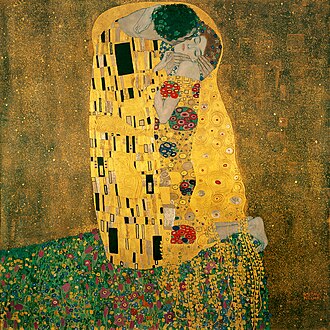 Der Kuss - Gustav Klimt (1907-1908)
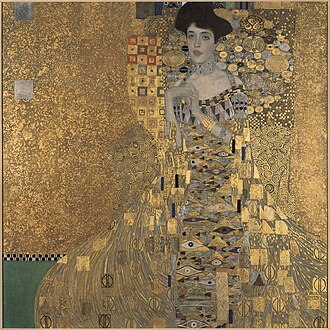 Adele Bloch-Bauer I - Gustav Klimt (1907)
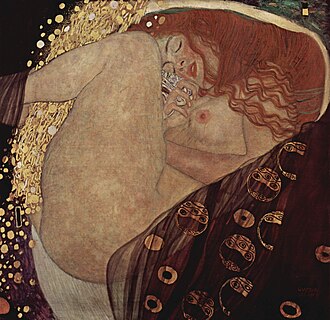 Danaë - Gustav Klimt (1907)
.jpg) Judith I - Gustav Klimt (1901)
Judith I - Gustav Klimt (1901)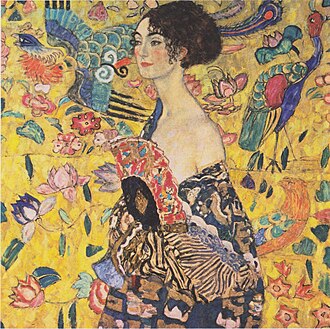 Dame mit Fächer - Gustav Klimt (1917)
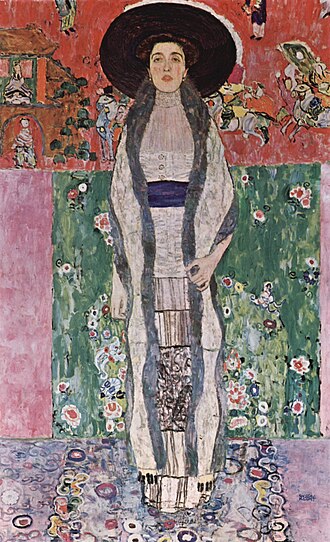 Bildnis Adele Bloch-Bauer II - Gustav Klimt (1912)
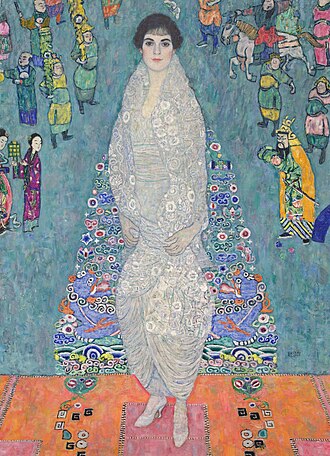 Bildnis der Elisabeth Lederer - Gustav Klimt (1910s)
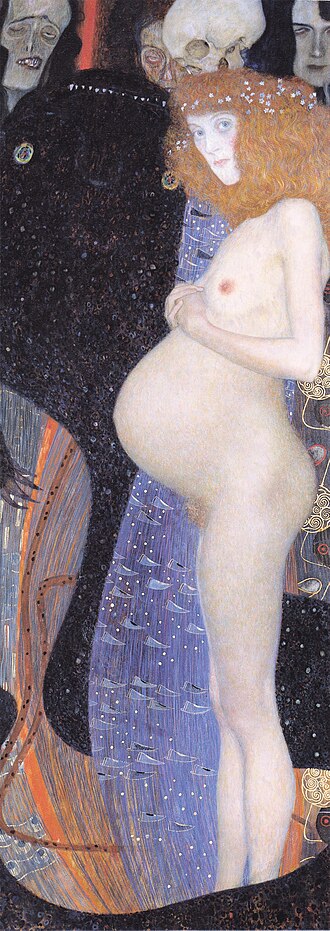 Die Hoffnung I - Gustav Klimt (1903)