Leda and the Swan
Peter Paul Rubens · 1601
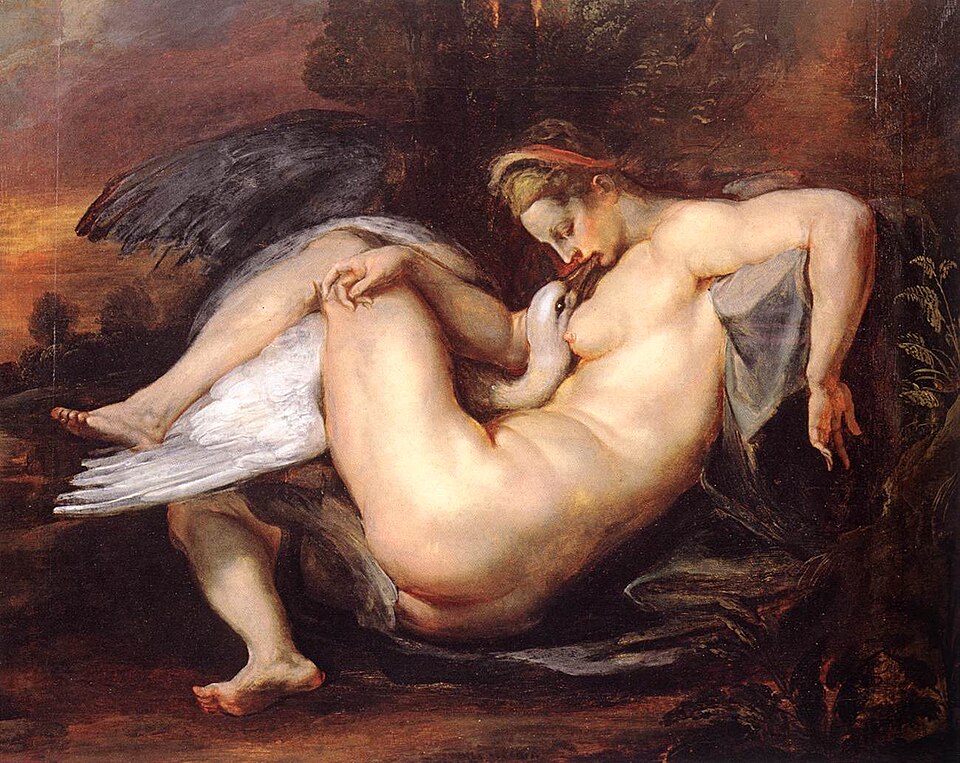
A young Rubens in Italy met Michelangelo's lost Leda and answered it in paint. His first version, from 1601, turns the hard marble-like body into soft, glowing flesh.
The story behind the painting
Rubens painted Leda and the Swan twice, first in 1601 and again in 1602. He had travelled to Italy and gone to Rome to copy paintings and study the great Italian Renaissance masters of the previous century. There he encountered Michelangelo's Leda and the Swan, a famous painting now lost and known only from copies and prints. Rubens made a copy of it himself, and Michelangelo's version is considered the prototype for both of his own works. This 1601 painting, about 64.5 by 80.5 cm, is in the Museum of Fine Arts, Houston.
What to look for
The pose follows Michelangelo closely: the twisting body, even the position of the fingers, and the way the swan caresses Leda are the same. The figure itself is very different. Michelangelo gave women a masculine build, with defined muscles, hard thin bodies and neatly styled hair. Rubens made Leda curvaceous and soft, her hair loose, her proportions more natural. Compared with the 1602 version, this first one has looser brushwork, less detail and less landscape, no elaborate headdress, muted colours and green drapery. X-rays show it was first planned inside a painted oval that cut off the left elbow and part of the right foot; today it is rectangular.
Meaning and intent
In the most common myth, Zeus turned himself into a swan to couple with Leda, wife of King Tyndareus of Sparta. Some versions say she loved Zeus, others that she was seduced. She bore Helen, Clytemnestra, Castor and Pollux. Women abducted or seduced by gods, such as Leda, Europa, Antiope and Danae, were a common theme of Renaissance and Baroque art, often shown sensually. Rubens's Leda is openly erotic: she is fully nude, and the swan, graceful yet capable of ravishing, rests its neck between her breasts.
Legacy
In Lucian's Dialogues of the Dead, Hermes names Leda and her daughter Helen as the only women worthy of the title beauties of old. Rubens's Leda, with her curving figure, alabaster skin and golden hair, already shows the kind of female figure that made him famous and that we still call Rubenesque. This early canvas lets us watch a young painter learning from Michelangelo and then quietly changing him, keeping the pose but giving the body warmth and weight of his own.
Schon gewusst?
- Painted in 1601; a second version followed in 1602.
- Based on Michelangelo's lost Leda, which Rubens copied in Italy.
- X-rays show it was first planned as an oval.
- In the Museum of Fine Arts, Houston.
Über den Künstler
Peter Paul Rubens (1577-1640)
Frau · mythologische Malerei · Akt · Nacktheit · weibliche Brust · Zeus · Jupiter · Gesäß · Leda · Schwan
Mehr von Peter Paul Rubens
.jpg) Die Aufrichtung des Kreuzes - Peter Paul Rubens (1609)
Die Aufrichtung des Kreuzes - Peter Paul Rubens (1609) Der Raub der Töchter des Leukippos - Peter Paul Rubens (1618)
 Rubens und Isabella Brant in der Geißblattlaube - Peter Paul Rubens (1600s)
 Samson und Delilah - Peter Paul Rubens (1600s)
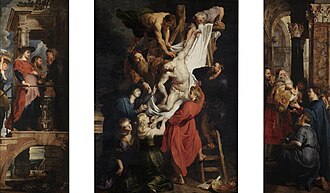 Kreuzabnahme - Peter Paul Rubens (1611)
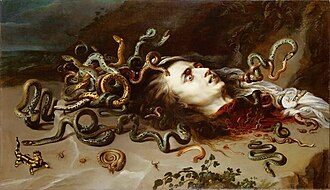 Haupt der Medusa - Peter Paul Rubens (1618)
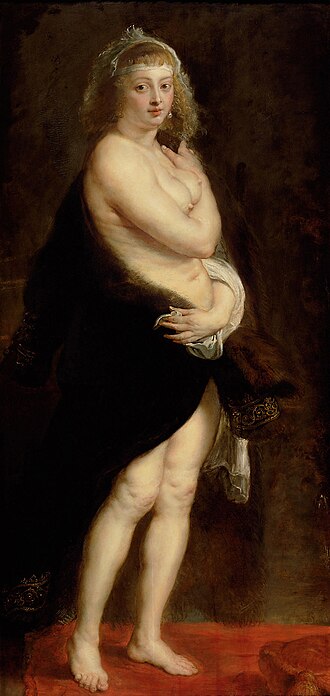 Helena Fourment - Peter Paul Rubens (1638)
.jpg) Der Liebesgarten - Peter Paul Rubens (1632)
Der Liebesgarten - Peter Paul Rubens (1632)
Werke verwandter Künstler
 Die Sternennacht - Vincent van Gogh (1889)
.jpg) Caféterrasse am Abend - Vincent van Gogh (1888)
Caféterrasse am Abend - Vincent van Gogh (1888) Das Abendmahl in Emmaus - Caravaggio (1601)
 Die Berufung des Hl. Matthäus - Caravaggio (1609)
 Las Meninas - Diego Velázquez (1656)
 Die Übergabe von Breda - Diego Velázquez (1635)
%20-%20Google%20Art%20Project.jpg) Dreifachporträt von Karl I. - Anthony van Dyck (1635)
Dreifachporträt von Karl I. - Anthony van Dyck (1635)%20with%20M.%20de%20St%20Antoine%20-%20Google%20Art%20Project.jpg) Karl I mit M. de St. Antoine - Anthony van Dyck (1636)
Karl I mit M. de St. Antoine - Anthony van Dyck (1636)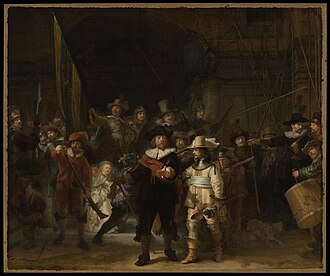 Die Nachtwache - Rembrandt van Rijn (1642)
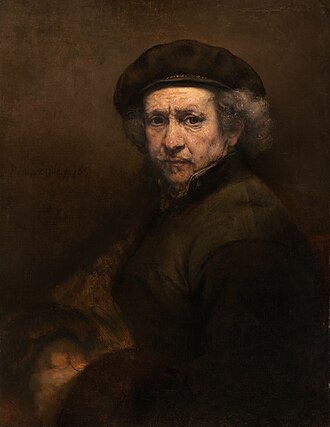 Selbstbildnis - Rembrandt van Rijn (1659)
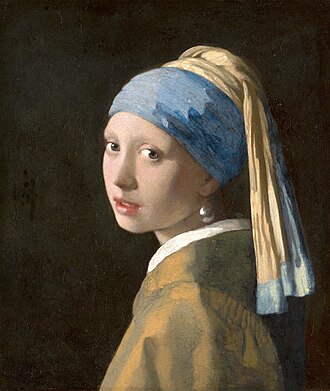 Das Mädchen mit dem Perlenohrgehänge - Johannes Vermeer (1665)
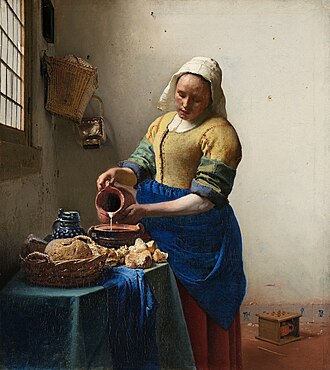 Dienstmagd mit Milchkrug - Johannes Vermeer (c. 1658)