Beweinung Christi
Andrea Mantegna · 1483
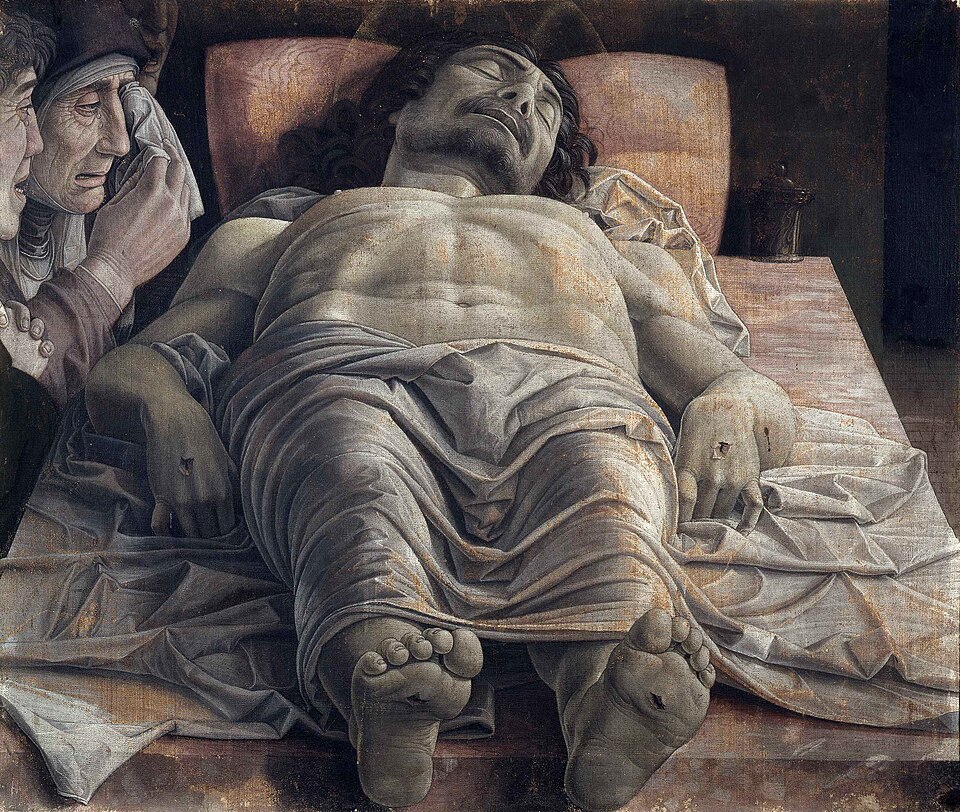
We stand at the feet of the dead Christ, so close we could touch the wounds, yet no one in the picture dares to touch him. Mantegna's foreshortened body is one of the most startling images of the Renaissance.
The story behind the painting
The date is debated. The painting was completed somewhere between 1475 and 1501, probably in the early 1480s; Wikidata gives 1483. It was among Mantegna's possessions when he died, which leads some historians, such as Roberto Longhi, to see it as a late work, while others, such as Paul Kristeller, place it earlier. It may have been refused by its original patron, possibly Ercole d'Este, for its jarring intensity or for breaking too sharply with how a lamentation was usually shown.
What to look for
Christ lies on his back on a marble slab, the Stone of Unction, seen feet first. The nail wounds in his feet and hands are plain, the spear wound in his side less so. A sharply drawn sheet covers the body. At the side, the Virgin Mary, Saint John and Mary Magdalene weep. The colours are dark, almost monochrome browns, with strong contrasts of light and shadow, in a small, closed space that feels like a morgue. Herbert von Einem called it almost spooky.
Meaning and intent
The perspective does not obey the rules exactly. Mantegna shrank the feet, which would otherwise hide much of the body, and no single viewpoint makes the figure correct. Scholars disagree why: Kristeller saw a study in foreshortening, John Ward thought the artist painted many planes at once, and Hans Jantzen and Joseph Manca argued that drama mattered more than accuracy. Placed at eye level at Christ's feet, before his wounds, we are asked to remember why he died. As Hubert Schrade put it, he is untouchable.
Legacy
After Mantegna's death his son Lorenzo sold the painting to Cardinal Sigismondo Gonzaga, with the permission of Isabella d'Este. It decorated the rooms of Margherita Paleologa in 1531 and stayed in Mantua until around 1630, when much of that collection was stolen and sold. It then appeared in Rome with Cardinal Mazarin, and much later in Milan with the Bossi family, who sold it to the Pinacoteca di Brera, where it hangs today. A version without the mourners, found in the United States in 1941, is widely thought to be a copy.
Schon gewusst?
- Completed between 1475 and 1501, probably in the early 1480s.
- Christ lies on the Stone of Unction, seen feet first.
- Mantegna reduced the size of the feet against strict perspective.
- Now in the Pinacoteca di Brera, Milan.
Über den Künstler
Andrea Mantegna (1431-1506)
religiöse Kunst · Jesus Christus · Frührenaissance · Pinacoteca di Brera · Beweinung Christi
Mehr von Andrea Mantegna
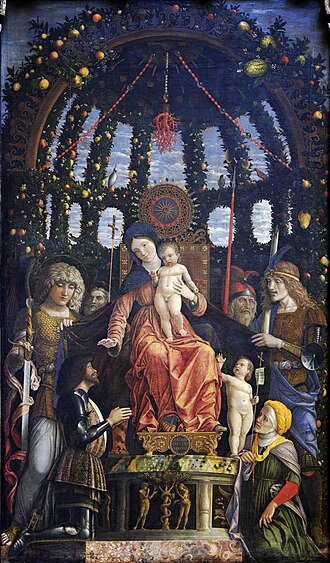 Madonna della Vittoria - Andrea Mantegna
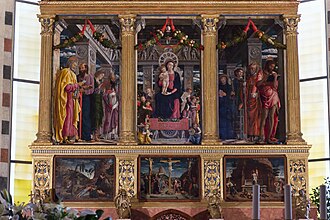 San-Zeno-Altar - Andrea Mantegna (1457)
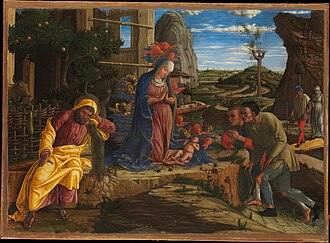 Anbetung der Hirten - Andrea Mantegna (1450)
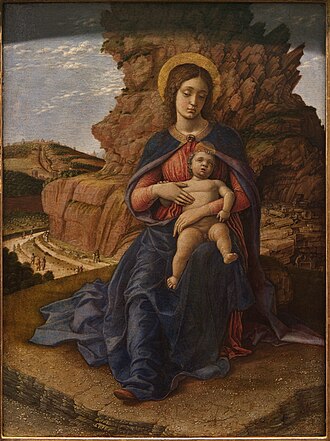 Madonna in der Felsengrotte - Andrea Mantegna (1489)
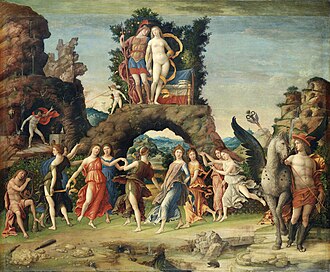 Der Parnaß - Andrea Mantegna
 Die Einführung des Kybelekults in Rom - Andrea Mantegna (1500s)
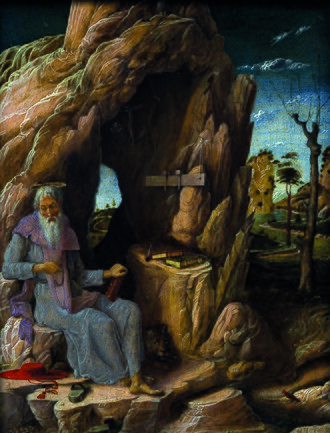 St. Hieronymus in der Wüste - Andrea Mantegna
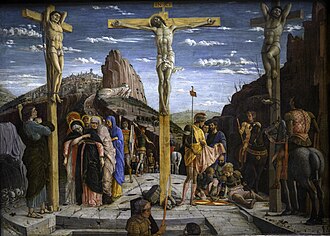 Kreuzigung - Andrea Mantegna (1450s)
Werke verwandter Künstler
 Die Geburt der Venus - Sandro Botticelli (c. 1485)
 Primavera - Sandro Botticelli (1480s)
 Die Geißelung Christi - Piero della Francesca (1450s)
 Madonna mit Kind, Heiligen, Engeln und Federico da Montefeltro (Altar des hl. Berhard} - Piero della Francesca (1472)
 Mona Lisa - Leonardo da Vinci (1503-1519)
 Dame mit dem Hermelin - Leonardo da Vinci (1490)
 Verkündigung - Fra Angelico (1425)
 Die Anbetung der Könige, Tondo - Fra Angelico (1430)