Frau mit Schirm / La Femme à l'Ombrelle
Édouard Manet · 1872
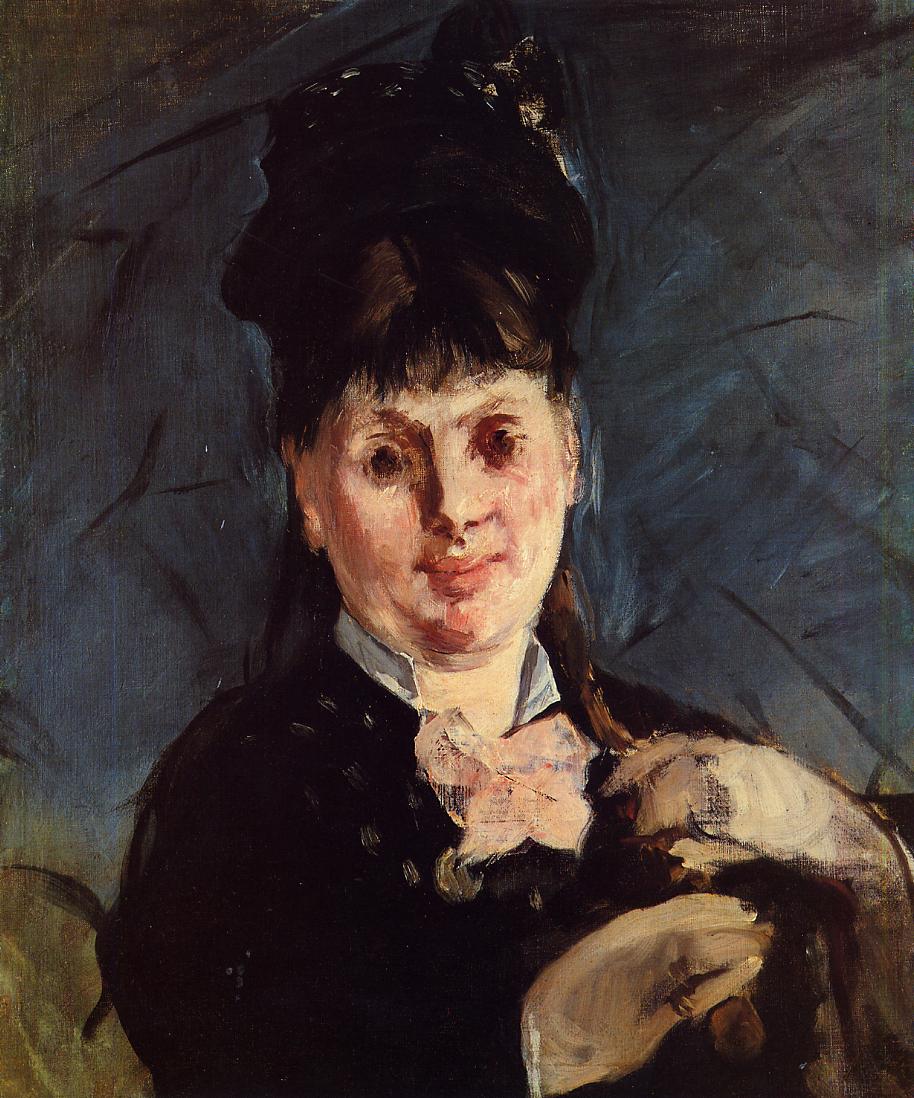
A young Parisian looks straight at us, smiling a little, while a blue parasol opens behind her like a whole sky. Manet painted her in 1872, and art historians still debate who she was.
The story behind the painting
Manet rarely used professional models and often painted family and friends, so the question of who posed for this half-length portrait has been argued over. His wife Suzanne and Berthe Morisot, whom he often painted in these years, do not resemble her, and neither does his pupil Eva Gonzalès. The art historian John Richardson proposed Alice Legouvé, and the authors of Manet's catalogue raisonné, Denis Rouart and Daniel Wildenstein, agreed. Manet probably met her through the painter Alfred Stevens, for whom she often posed. The picture is small, 48.2 by 40 cm, oil on canvas, neither signed nor dated.
What to look for
She faces us frontally, with wide dark eyes, rosy full cheeks and a hint of a double chin. Her skin shifts from white through light brown and grey to pink and red, so the face seems modelled and alive, while the eyes are almost simple dark dots and the closed lips are drawn more finely, with a slight friendly smile. A fringe falls over her forehead, a dark hat with a small light bow sits on top. A salmon-coloured bow closes her white collar. Her hands, roughly painted, hold the parasol handle; its shaft rests on her shoulder and the open shade, shifting between light and dark blue, fills nearly the whole background. Small green-yellow patches in the corners suggest a garden or park.
Meaning and intent
Manet was always interested in the fashion of Parisian women, and the woman with a parasol appears again and again in his work: in Music in the Tuileries, The Balcony, The Swallows, In the Conservatory, and late in his career in Spring, where Jeanne Demarsy rests the parasol on her shoulder in a similar way. His colleagues took up the theme too, Renoir in Lise with a Parasol and Monet in several pictures. Renoir's own Woman with a Parasol of 1873 is strikingly close in framing, direct gaze, high collar and little bow, yet it is unclear whether Renoir knew Manet's picture or the two arrived at it independently.
Legacy
The first known owner was Auguste Pellerin, a Paris margarine manufacturer who collected many Manets. Around 1912 it went to the Hungarian banker Baron Adolf Kohner in Budapest, then in 1930 to the dealers Wildenstein & Company, who kept it for several years in New York. In 1947 the film producer William Goetz and his wife Edith Mayer Goetz bought it in Los Angeles. After their deaths it was auctioned in New York in 1988, and again in 2019, each time to an unnamed buyer. The painting remains in a private collection, which makes every reproduction a rare chance to meet her gaze.
Schon gewusst?
- Painted by Manet in 1872, oil on canvas, 48.2 by 40 cm.
- The sitter is probably Alice Legouvé, but this is not certain.
- Very close in composition to a Renoir of 1873.
- Now in a private collection.
Über den Künstler
Édouard Manet (1832-1883)
Mehr von Édouard Manet
 Das Frühstück im Grünen - Édouard Manet (1863)
 Olympia - Édouard Manet (1863)
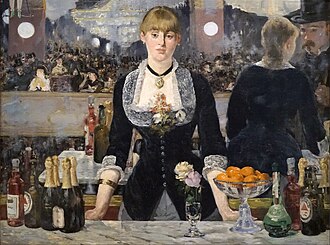 Bar in den Folies-Bergère - Édouard Manet (1882)
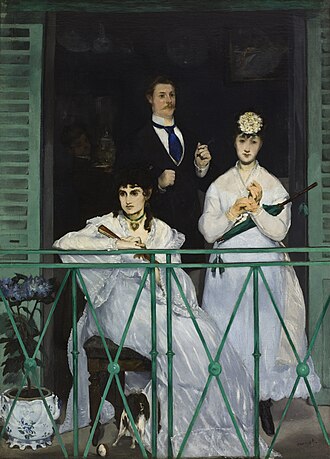 Der Balkon - Édouard Manet (1868)
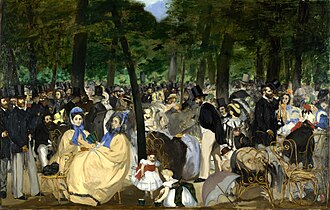 Musik im Tuileriengarten - Édouard Manet (1862)
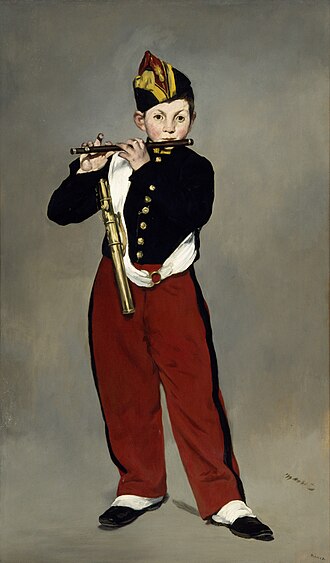 Der Pfeifer - Édouard Manet (1866)
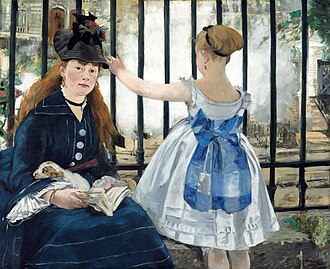 Die Eisenbahn - Édouard Manet (1873)
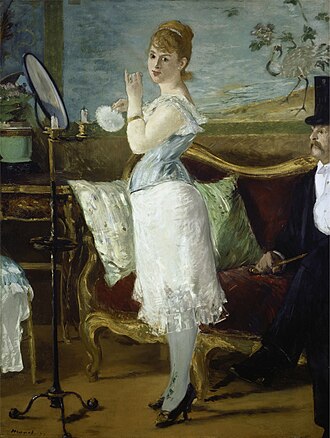 Nana - Édouard Manet (1877)
Werke verwandter Künstler
 Impression, Sonnenaufgang - Claude Monet (1872)
 Seerosen - Claude Monet (1906)
 Tanz im Moulin de la Galette - Pierre-Auguste Renoir (1876)
 Das Frühstück der Ruderer - Pierre-Auguste Renoir (1881)
 Wiege - Berthe Morisot (1872)
 Sommertag - Berthe Morisot (1879)
 Der Absinth - Edgar Degas (1875)
 Die Bellelli Familie - Edgar Degas (1858)
 Der Kanal von Loing - Alfred Sisley (1892)
 The Watering Pond at Marly with Hoarfrost - Alfred Sisley (1876)
 Straße in Paris an einem regnerischen Tag - Gustave Caillebotte (1877)
 Die Parkettschleifer - Gustave Caillebotte (1875)