Kitchen Scene with the Supper in Emmaus
Diego Velázquez · 1610s
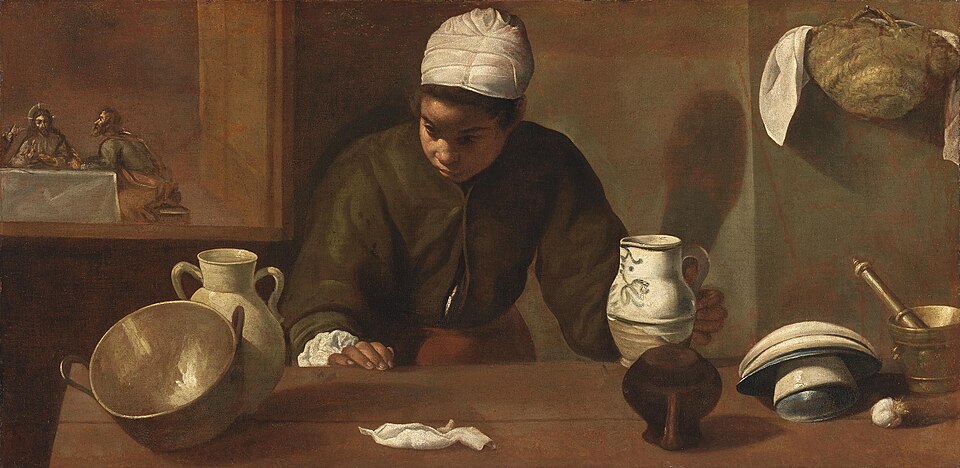
A young maid stands at a kitchen table among jugs, a mortar and a head of garlic. In 1933 a cleaning uncovered a window behind her, and through it Christ blessing bread at Emmaus.
The story behind the painting
This picture, also known as La mulata, is attributed to the young Velázquez during his first Seville period, before 1623. Critics disagree on its date: some place it around 1617 to 1618, which would make it one of his earliest known works, others around 1620 to 1622, while Wikidata simply gives the 1610s. In 1913 it was shown in London at the Grafton Galleries, lent by Otto Beit as attributed to Velázquez, and Aureliano Beruete was the first to publish it as an original. Since 1987 it has belonged to the National Gallery of Ireland in Dublin, a bequest of Alfred Beit.
What to look for
A young dark-skinned woman in a white coif stands behind a kitchen table that hides half her body. With her left hand she holds a glazed ceramic jug among other earthenware and bronze jugs, a mortar and pestle and a head of garlic. On the back wall a wicker basket hangs from a hook with a white cloth spilling out. In the upper left, look for the window revealed in 1933: through it Christ blesses the bread, a bearded man beside him. A second disciple is reduced to a hand, because the canvas was cut down on that side.
Meaning and intent
The scene follows Luke's account of the supper at Emmaus, so the kitchen still life becomes a still life in the presence of the divine, a genre theorists looked down on because of its lowly subjects. Yet it gives dignity to a humble servant, since the risen Christ appearing at Emmaus shows his presence beside ordinary people. Julián Gállego recalled Saint Teresa of Ávila's saying that God moves among the cooking pots. The window has been compared to a picture within the picture, or a mirror like the one Velázquez later used in Las Meninas.
Legacy
August Mayer first championed the Chicago version as the original and treated this one as a copy, but after the 1933 cleaning he changed his view, and almost all later critics accept it as by Velázquez. Questions remain. Without records of the paint removed in 1933, no one knows when the Emmaus window was painted over, or whether Velázquez himself removed it soon after finishing, which could explain copies without it. José López-Rey even doubted that the window was by Velázquez at all, considering its authenticity impossible to verify.
Schon gewusst?
- Attributed to Velázquez, Seville, before 1623.
- A hidden Supper at Emmaus window was uncovered in 1933.
- Dates proposed range from 1617-1618 to 1620-1622.
- In the National Gallery of Ireland since 1987, a bequest of Alfred Beit.
Über den Künstler
Diego Velázquez (1599-1660)
religiöse Kunst · Frau · Genreszene · National Gallery of Ireland
Mehr von Diego Velázquez
 Las Meninas - Diego Velázquez (1656)
 Die Übergabe von Breda - Diego Velázquez (1635)
 Venus vor dem Spiegel - Diego Velázquez (1644)
 Die Spinnerinnen - Diego Velázquez
 Bildnis Innozenz X. - Diego Velázquez
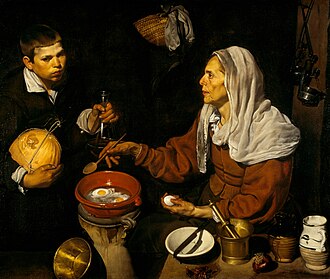 Eine alte Frau brät Eier - Diego Velázquez (1618)
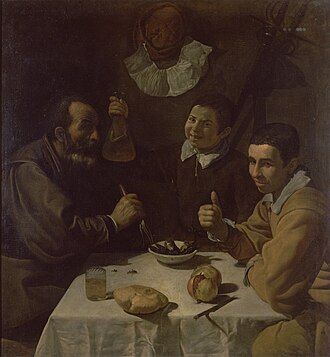 Drei Männer am Tisch - Diego Velázquez (1617)
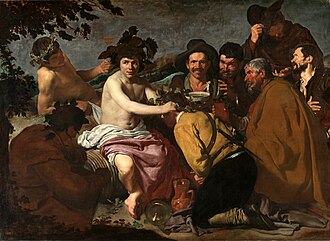 Der Triumph des Bacchus - Diego Velázquez (1628)
Werke verwandter Künstler
 Das Abendmahl in Emmaus - Caravaggio (1601)
 Die Berufung des Hl. Matthäus - Caravaggio (1609)
 Saint Francis in Meditation - Francisco de Zurbarán (1639)
 The Immaculate Conception - Francisco de Zurbarán (1661)
 Dreifachporträt von Karl I. - Anthony van Dyck (1635)
 Karl I mit M. de St. Antoine - Anthony van Dyck (1636)
 Die Aufrichtung des Kreuzes - Peter Paul Rubens (1609)
 Der Raub der Töchter des Leukippos - Peter Paul Rubens (1618)
 Die Nachtwache - Rembrandt van Rijn (1642)
 Selbstbildnis - Rembrandt van Rijn (1659)
 Ein Schütze einen Berkemeyer haltend, bekannt als „Der fröhliche Trinker" - Frans Hals (1620s)
 Der lachende Kavalier - Frans Hals (1624)