Irma Brunner
Édouard Manet · 1880s
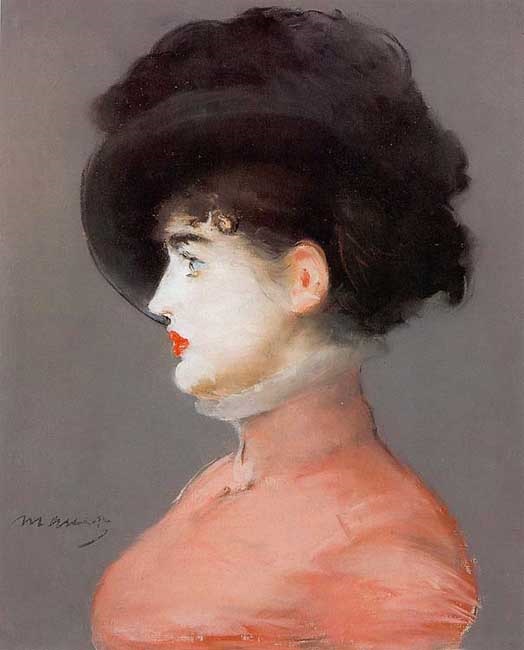
A woman in a black velvet hat, seen in pure profile against a soft grey ground, her lips a bright red note. Manet, ill and no longer able to tackle large canvases, turned to pastel and made one of his most exquisite portraits.
The story behind the painting
In the early 1880s Manet returned to female portraits in pastel on cardboard, partly because his steadily worsening health kept him from more ambitious compositions. He often invited friends and acquaintances to sit, asking them to wear their finest clothes, especially showy hats, and gave back works of great elegance. Irma Brunner was a woman of Parisian society, introduced to Manet by their mutual friend Méry Laurent. The French Wikipedia article dates the pastel to 1881, while Wikidata gives only the 1880s. The work is also known as La Viennoise, the Viennese woman, or as Woman in a Black Hat.
What to look for
Manet draws on choices that go back to the Italian Renaissance: the sitter is shown in profile, a pose that stresses the regularity of her features and gives her a clear outline. He makes the most of the velvety tones of pastel. The glow of her face is heightened by makeup, but also by the black velvet hat and the soft, luminous hair. Look for the balance between the dark upper part and her bodice, a strong pink that echoes the colour of her ear, which escaped the whitening makeup. The plain grey background and the vivid red of the lips complete the harmony. The sheet measures about 53 by 44 cm.
Meaning and intent
Manet does not try to probe the character of his model, as many contemporaries such as Degas did. Irma Brunner is not drawn in depth psychologically. Instead, in the words of the critic Marco Abate, she is described as if she were a beautiful flower. That choice is the point: the portrait becomes a vivid testimony of Parisian elegance in the second half of the 19th century, a celebration of colour, fabric and poise rather than a study of inner life. Made at a time when Manet's body was failing him, the work turns limitation into refinement.
Legacy
Marco Abate judged the Portrait of Irma Brunner one of the most exquisite of Manet's late pastels. It belongs today to the Musée d'Orsay in Paris, and Wikidata also links it to the Department of Prints and Drawings of the Louvre, which looks after works on paper. The pastel shows a side of Manet less famous than his large Salon paintings: a small, intimate format, worked with soft chalks, in which a friend of a friend becomes a timeless image of style. Its several names, from Irma Brunner to La Viennoise, carry both the person and the fashion she wore.
Schon gewusst?
- Pastel on cardboard, about 53 x 44 cm.
- Dated 1881 by French Wikipedia; Wikidata gives the 1880s.
- Also called La Viennoise.
- Now in the Musée d'Orsay, Paris.
Über den Künstler
Édouard Manet (1832-1883)
Frau · Porträt · Musée d’Orsay · Kleid · Hut · brünett · Chignon · Augenbraue
Mehr von Édouard Manet
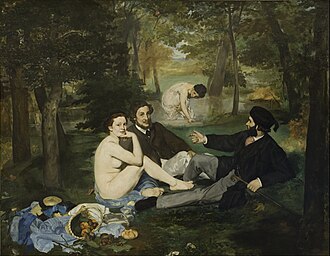 Das Frühstück im Grünen - Édouard Manet (1863)
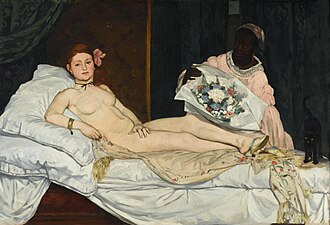 Olympia - Édouard Manet (1863)
%20(33539037428).jpg) Bar in den Folies-Bergère - Édouard Manet (1882)
Bar in den Folies-Bergère - Édouard Manet (1882)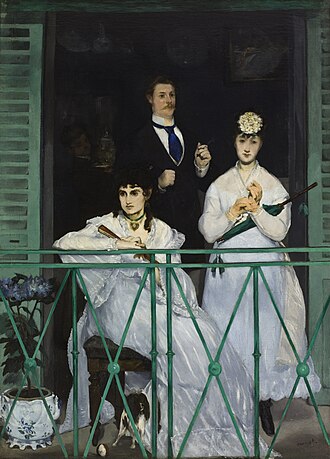 Der Balkon - Édouard Manet (1868)
.jpg) Musik im Tuileriengarten - Édouard Manet (1862)
Musik im Tuileriengarten - Édouard Manet (1862).jpg) Der Pfeifer - Édouard Manet (1866)
Der Pfeifer - Édouard Manet (1866) Die Eisenbahn - Édouard Manet (1873)
 Berthe Morisot mit Veilchenstrauß - Édouard Manet (1872)
Werke verwandter Künstler
 Impression, Sonnenaufgang - Claude Monet (1872)
 Seerosen - Claude Monet (1906)
 Tanz im Moulin de la Galette - Pierre-Auguste Renoir (1876)
 Das Frühstück der Ruderer - Pierre-Auguste Renoir (1881)
 Die Sternennacht - Vincent van Gogh (1889)
.jpg) Caféterrasse am Abend - Vincent van Gogh (1888)
Caféterrasse am Abend - Vincent van Gogh (1888) Die letzte Fahrt der Temeraire - J. M. W. Turner (1839)
 Rain, Steam and Speed - The Great Western Railway - J. M. W. Turner (1844)
 Woher kommen wir? Wer sind wir? Wohin gehen wir? - Paul Gauguin (1897-1898)
%201889.jpg) Der gelbe Christus - Paul Gauguin (1889)
Der gelbe Christus - Paul Gauguin (1889)