Holy Trinity
Sandro Botticelli · 1490s
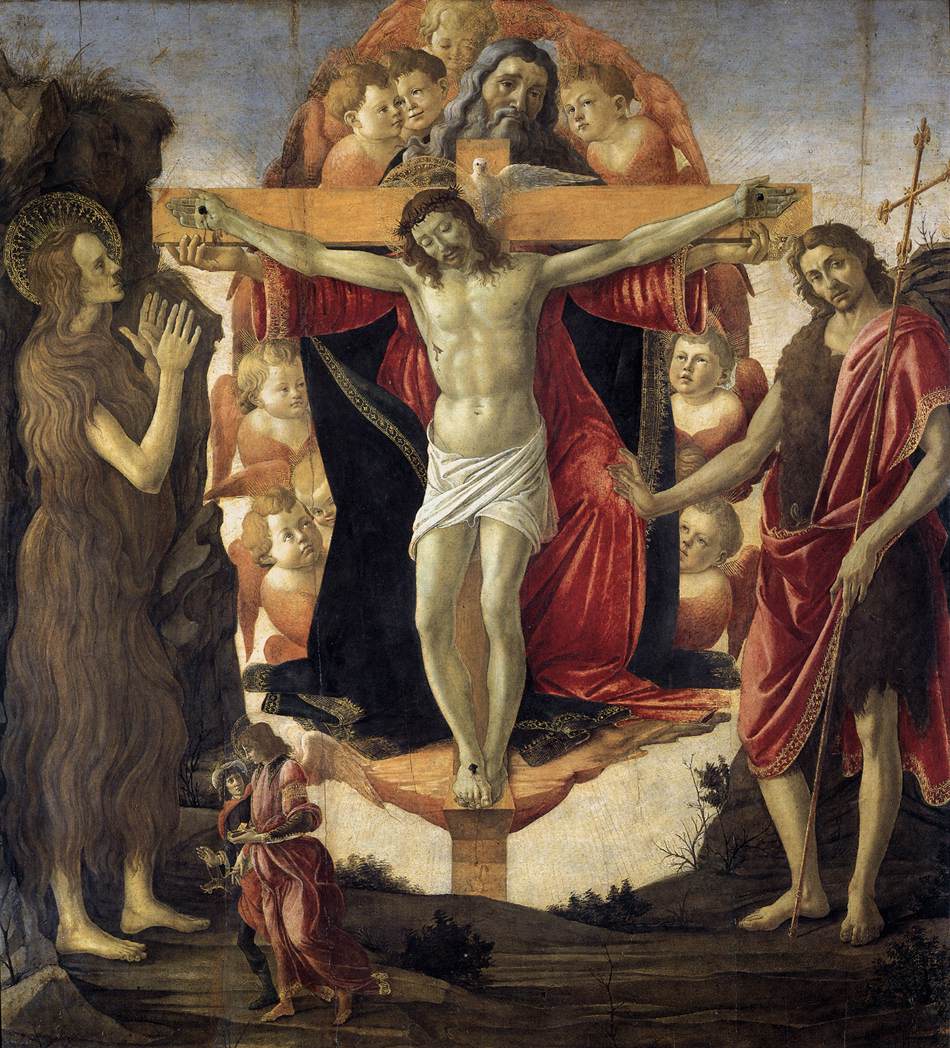
Mary Magdalene prays with fierce intensity beside the crucified Christ, while far below, tiny and unbothered, Tobias and the Angel stroll past with a fish. Botticelli's altarpiece for a house of converted women took perhaps three decades to finish.
The story behind the painting
Known as the Pala delle Convertite, or The Trinity with Saints Mary Magdalen and John the Baptist, this altarpiece by Botticelli and his workshop is traditionally dated to about 1491 to 1493, and Wikidata places it in the 1490s. It is now thought to have been begun much earlier, perhaps in the 1470s, and worked on over three decades. It was commissioned by the guild of Doctors and Pharmacists, to which painters also belonged, for Santa Elisabetta delle Convertite in Florence, a house for former prostitutes whose patron was Mary Magdalene. Convertite means the converted ones.
What to look for
Painted in tempera on poplar, about 215 by 200 cm, the main scene shows the Trinity, Christ crucified, God the Father and the dove of the Holy Spirit, inside an almond-shaped mandorla ringed with seraphim. Behind lies blue sky between two rocky spurs. Mary Magdalene kneels in an intense pose of prayer, and Saint John the Baptist, patron of Florence, points to the centre. Below, at a much smaller scale, the Archangel Raphael walks with Tobias, who holds the fish from the biblical tale, though his usual dog is missing. They ignore the vision above.
Meaning and intent
The Magdalene recalls Donatello's Penitent Magdalene of about 1440 and Desiderio da Settignano's of about 1455 in Santa Trinita, fitting for a church of women who had turned to her as their model. Tobias and the Angel are there because Raphael was the patron saint of the commissioning guild. Differences in style between the two standing saints suggest they were painted at different times, and the seraphim heads are thought to be workshop work.
Legacy
Modern imaging has shown that Tobias and the Angel were first placed on the right, behind the cross, in a landscape that was later painted over. The first pair is now thought to be by Filippino Lippi, Botticelli's main assistant in the earlier years, while the moved pair we see today is probably by Botticelli himself in the 1490s, painted in a different and, the article says, better style than the large figures above. The altarpiece is now in the Courtauld Gallery in London, and a restoration was completed in 2021.
Schon gewusst?
- Made for Santa Elisabetta delle Convertite, Florence.
- Commissioned by the guild of Doctors and Pharmacists.
- Possibly begun in the 1470s and worked on over three decades.
- In the Courtauld Gallery, London; restored in 2021.
Über den Künstler
Sandro Botticelli (1445-1510)
religiöse Kunst · Frau · Mann · Frührenaissance · Jesus Christus · langes Haar · Engel · Maria Magdalena · Courtauld Gallery
Mehr von Sandro Botticelli
 Die Geburt der Venus - Sandro Botticelli (c. 1485)
 Primavera - Sandro Botticelli (1480s)
 Venus und Mars - Sandro Botticelli (1485)
 Anbetung der Heiligen drei Könige - Sandro Botticelli (1470s)
 Madonna des Magnificat - Sandro Botticelli (1481)
 Die Verleumdung des Apelles - Sandro Botticelli (1490s)
.jpg) Minerva und der Kentaur - Sandro Botticelli (1482)
Minerva und der Kentaur - Sandro Botticelli (1482)%20-%20Google%20Art%20Project.jpg) Weibliches Idealbildnis - Sandro Botticelli (1480)
Weibliches Idealbildnis - Sandro Botticelli (1480)
Werke verwandter Künstler
 Mona Lisa - Leonardo da Vinci (1503-1519)
 Dame mit dem Hermelin - Leonardo da Vinci (1490)
 Verkündigung - Fra Angelico (1425)
 Die Anbetung der Könige, Tondo - Fra Angelico (1430)