Head of a Man in Profile
Diego Velázquez · 1618
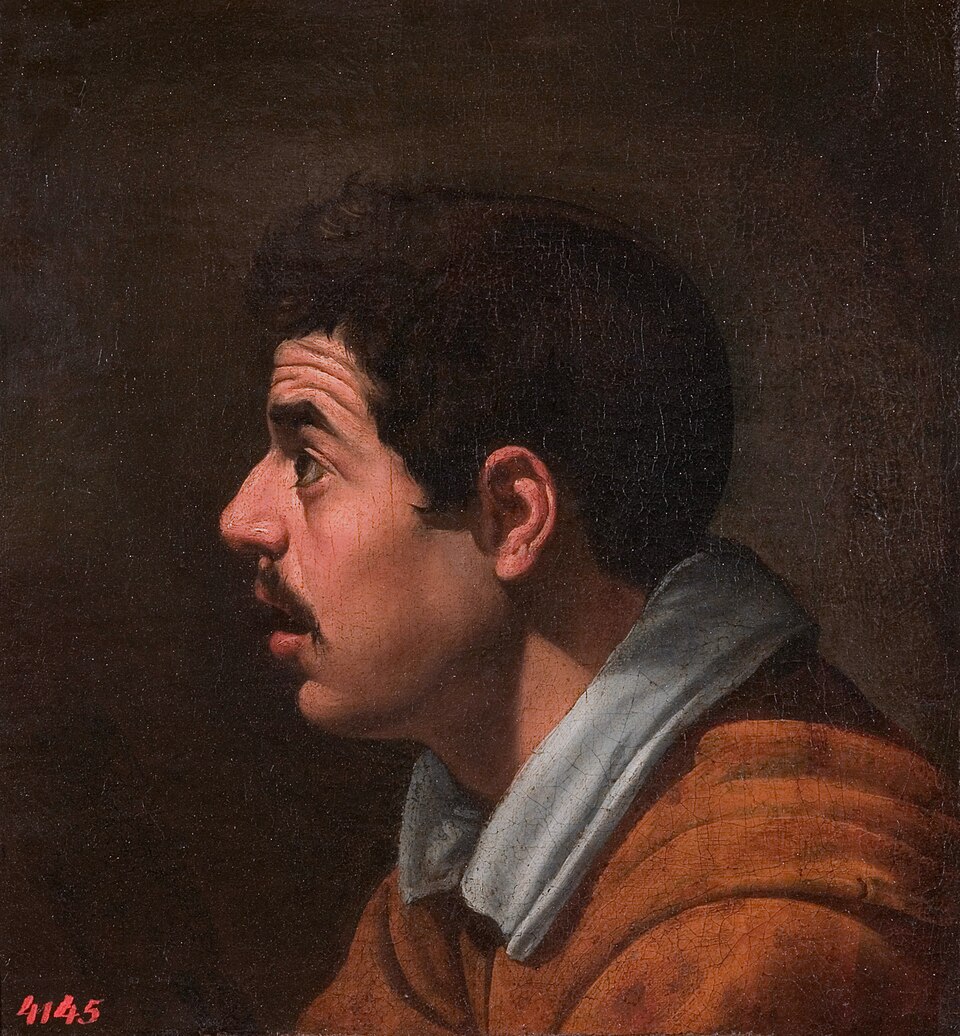
A young man turns his head, listening to someone we cannot see, caught in a moment of surprise. Velázquez painted him in Seville, and for a long time no one was sure the head was his at all.
The story behind the painting
This small oil on canvas was painted by Diego Velázquez in Seville, perhaps as a colour study for a larger composition. Wikidata dates it to 1618. In 1814 it entered the Hermitage after Tsar Alexander I of Russia bought it in Amsterdam, explicitly as a work by Velázquez. Later catalogues gave it to Francisco de Zurbarán instead. In 1959 José López-Rey examined it, confirmed an earlier idea of Allende-Salazar and restored the attribution to Velázquez, calling the head extraordinarily beautiful.
What to look for
Look at the face in profile: the young man is attentive, listening to explanations that come from outside the frame, and his expression reads as surprise or astonishment at what he hears. The finish is careful and complete, so much so that some critics think it is not a study but a fragment of a larger picture. An X-ray made by the museum found another, earlier face beneath this one, seen from the front and closely resembling the central figure of Velázquez's Three Musicians, though turned the other way.
Meaning and intent
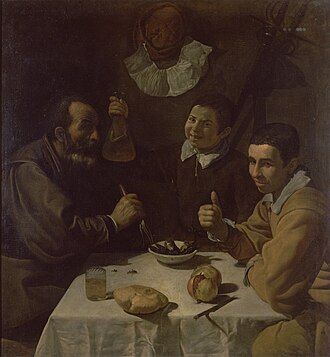
López-Rey linked the head to the figure seated on the right of Velázquez's Lunch of peasants in Budapest, and the source judges this study the deeper psychological portrait of the two. The X-ray suggests that a canvas was begun, abandoned and cut, and a fragment reused for this head. Scholars such as McKim-Smith explain the repeated models in Velázquez's early work by the common practice of reusing printed engravings, with creativity found in recomposing and reinterpreting existing elements, and Velázquez adding his own variations each time.
Legacy
Several copies of the Lunch survive, in the L. Garrouste collection in Madrid and Lord Moyne's collection in Andover, and they repeat this seated man on the right, in effect copying this study. Their older figures and the boy with the wine jug match the Hermitage Lunch, probably the first version of the theme. That places this head between the Saint Petersburg and Budapest pictures. It remains in the Hermitage, a small canvas at the heart of a puzzle about how the young Velázquez built his scenes.
Schon gewusst?
- Painted in Seville; Wikidata dates it to 1618.
- Bought in Amsterdam by Alexander I and in the Hermitage since 1814.
- Once given to Zurbarán; returned to Velázquez by López-Rey in 1959.
- An X-ray reveals an earlier frontal face beneath.
Über den Künstler
Diego Velázquez (1599-1660)
Mehr von Diego Velázquez
 Las Meninas - Diego Velázquez (1656)
 Die Übergabe von Breda - Diego Velázquez (1635)
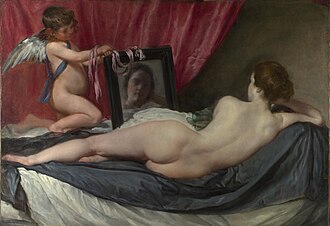 Venus vor dem Spiegel - Diego Velázquez (1644)
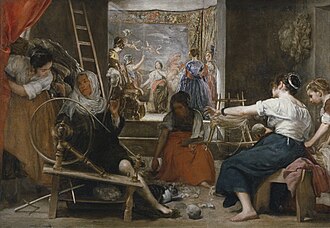 Die Spinnerinnen - Diego Velázquez
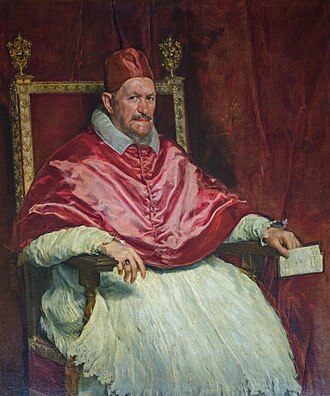 Bildnis Innozenz X. - Diego Velázquez
 Eine alte Frau brät Eier - Diego Velázquez (1618)
 Drei Männer am Tisch - Diego Velázquez (1617)
 Der Triumph des Bacchus - Diego Velázquez (1628)
Werke verwandter Künstler
 Das Abendmahl in Emmaus - Caravaggio (1601)
 Die Berufung des Hl. Matthäus - Caravaggio (1609)
 Saint Francis in Meditation - Francisco de Zurbarán (1639)
 The Immaculate Conception - Francisco de Zurbarán (1661)
 Dreifachporträt von Karl I. - Anthony van Dyck (1635)
 Karl I mit M. de St. Antoine - Anthony van Dyck (1636)
 Die Aufrichtung des Kreuzes - Peter Paul Rubens (1609)
 Der Raub der Töchter des Leukippos - Peter Paul Rubens (1618)
 Die Nachtwache - Rembrandt van Rijn (1642)
 Selbstbildnis - Rembrandt van Rijn (1659)
 Ein Schütze einen Berkemeyer haltend, bekannt als „Der fröhliche Trinker" - Frans Hals (1620s)
 Der lachende Kavalier - Frans Hals (1624)