Mädchen mit rotem Hut
Johannes Vermeer · 1669
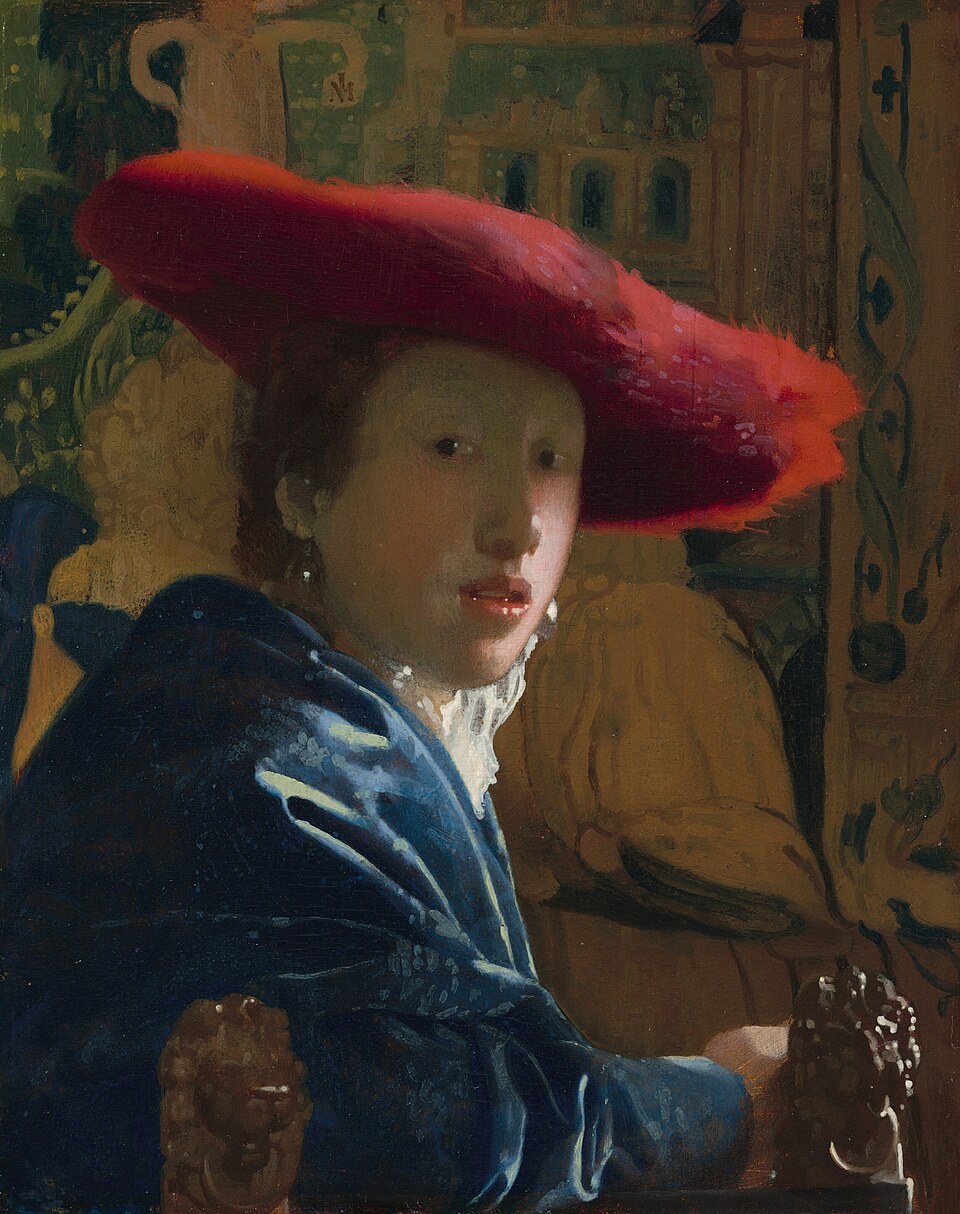
A girl in a blazing red hat turns toward us, lips parted, as if a voice has just reached her. It is one of Vermeer's smallest pictures, painted on a reused wooden panel, and for years scholars argued over whether he painted it at all.
The story behind the painting
Girl with a Red Hat is a small signed picture, about 22.8 by 18 cm, dated around 1669. It is counted among Vermeer's tronies, images of models in fanciful dress that, as far as is known, were not portraits of specific people. Because it is painted on a recycled wood panel rather than canvas, its attribution was long disputed, with scholars on both sides. A recent study by curators at the National Gallery of Art in Washington, supported by Dutch experts, established that it is by Vermeer. The Art Newspaper reported that a multidisciplinary team found it without a doubt his work, from a painter who probably made no more than 40 or 50 works in a 22-year career.
What to look for
The young woman wears blue, with what looks like a lace collar, a red hat and dangling earrings, her hair pinned up. She seems to have just turned her head toward a sound or a voice that caught her attention. Her mouth is slightly open and her face, faintly pink, is lit from the right, which is unusual in Vermeer's work. The red of the hat is built in two layers: underneath, vermilion mixed with a black pigment, and on top a glaze of madder lake. For the green areas Vermeer mixed azurite and yellow ochre, and he used umber for the browns of the wall behind her.
Meaning and intent
As a tronie, the painting is less about who the girl was than about a face, a costume and a fleeting expression. Whether Vermeer's models came from his family or from elsewhere in Delft does not change how the picture is enjoyed. Research for the 2022 exhibition Vermeer's Secrets added a surprise: using the latest technology, it found that Vermeer first began painting a portrait of a man wearing a wide-brimmed hat on this panel, before it became the girl we see. The glance toward the viewer turns a tiny panel into an encounter, a moment of sudden attention that feels personal even though the sitter's name is unknown.
Legacy
The picture may have belonged to Vermeer's patron Pieter Claesz van Ruijven and then passed by inheritance through his wife Maria de Knuijt, his daughter Magdalena van Ruijven and her husband Jacob Abrahamsz Dissius. It is thought to have been sold at an auction in Amsterdam on 16 May 1696. In 1822 Baron Louis Marie Baptiste Atthalin bought it in Paris, and it stayed with his heirs for a century. In 1925 Andrew W. Mellon acquired it through Knoedler, and after passing through his educational trust it was given to the National Gallery of Art in Washington in 1937, where it remains.
Schon gewusst?
- About 22.8 x 18 cm, on a reused wooden panel.
- Dated around 1669.
- Imaging for the 2022 exhibition Vermeer's Secrets found a man in a wide-brimmed hat underneath.
- Given to the National Gallery of Art, Washington, in 1937.
Über den Künstler
Johannes Vermeer (1632-1675)
Frau · Porträt · Niederländisches Goldenes Zeitalter der Malerei · National Gallery of Art · Andrew W. Mellon collection
Mehr von Johannes Vermeer
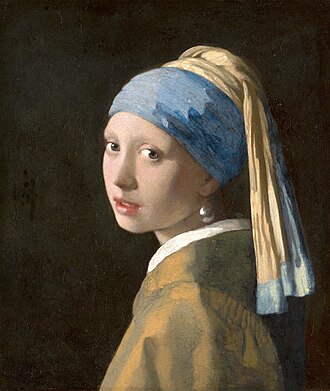 Das Mädchen mit dem Perlenohrgehänge - Johannes Vermeer (1665)
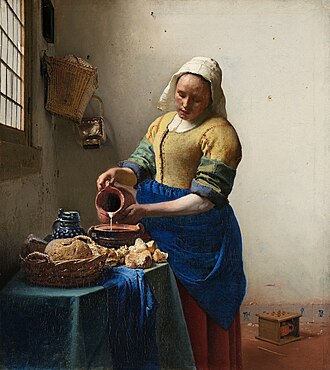 Dienstmagd mit Milchkrug - Johannes Vermeer (c. 1658)
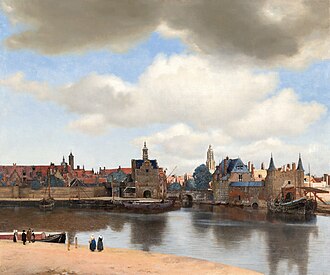 Ansicht von Delft - Johannes Vermeer (1660s)
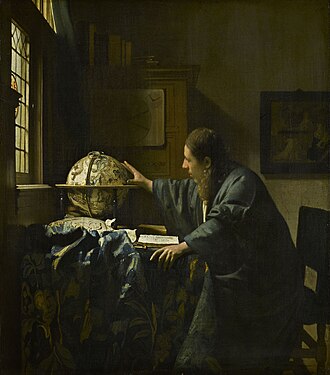 Der Astronom - Johannes Vermeer (1664)
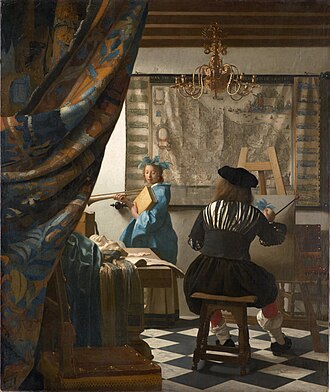 Die Malkunst - Johannes Vermeer (1660s)
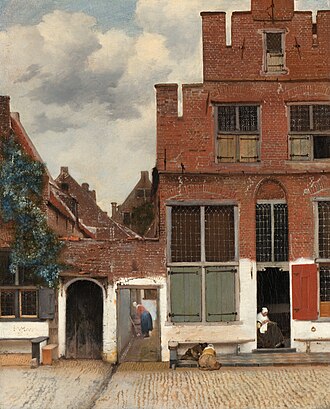 Straße in Delft - Johannes Vermeer (1658)
.jpg) Brieflesendes Mädchen am offenen Fenster - Johannes Vermeer (1650s)
Brieflesendes Mädchen am offenen Fenster - Johannes Vermeer (1650s)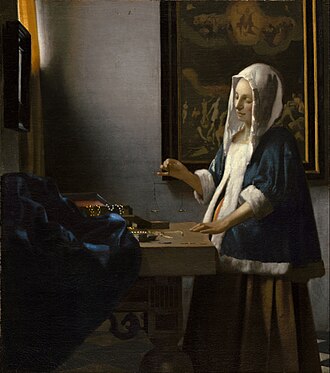 Frau mit Waage - Johannes Vermeer (1665)
Werke verwandter Künstler
 Die Nachtwache - Rembrandt van Rijn (1642)
 Selbstbildnis - Rembrandt van Rijn (1659)