Francisco Pacheco
Diego Velázquez · 1620
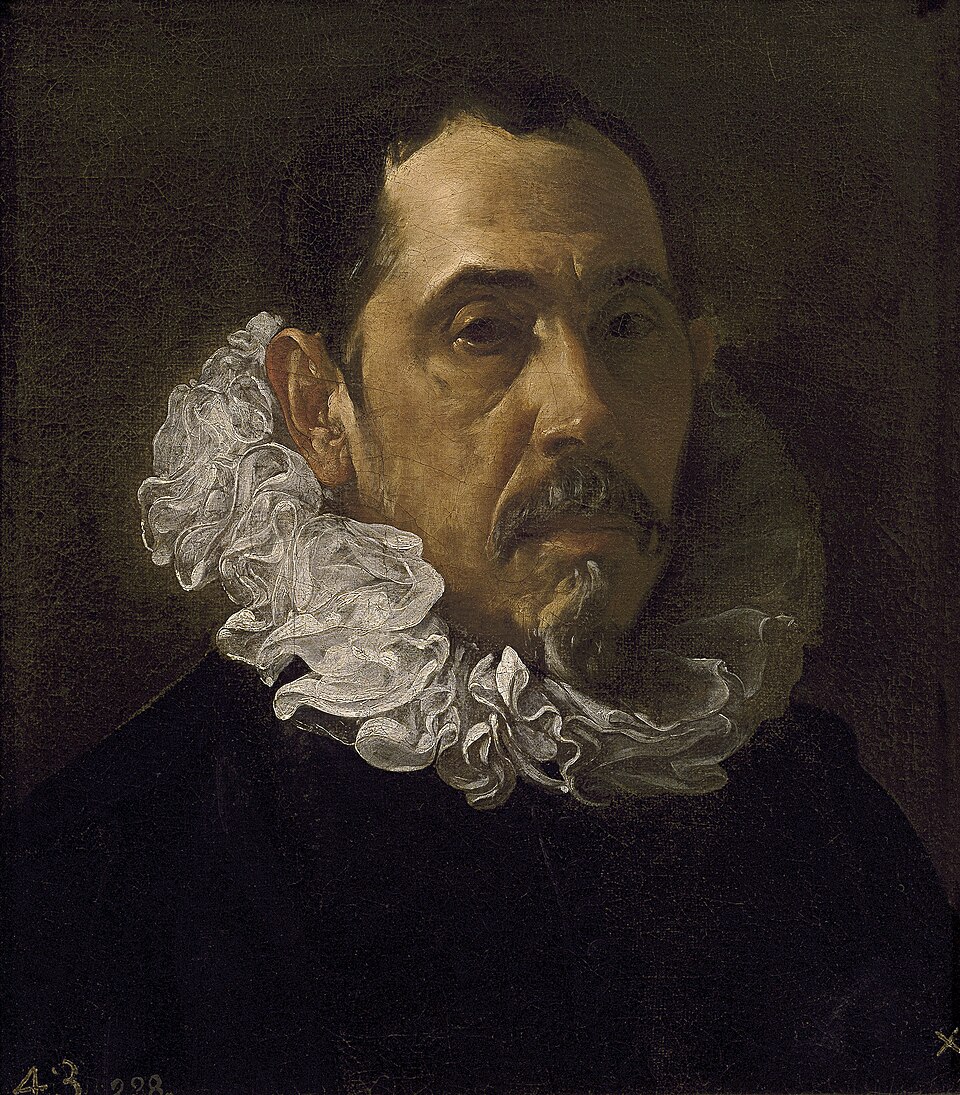
A man in black with a great ruff looks straight at us from a plain background. He may be Francisco Pacheco, the teacher and father-in-law of the young Velázquez, but no one can prove it.
The story behind the painting
The exact date is uncertain, but the canvas was painted before 1623, the year King Philip IV of Spain issued a law against luxury that banned large ruffs for men. Wikidata gives 1620, while the French Wikipedia article suggests about 1622, between Velázquez's first and second trips to court. The picture came from the palace of La Granja de San Ildefonso, where in 1746 it was listed as a work by Tintoretto. It entered the Prado when the museum opened in 1819, now as a work by Velázquez.
What to look for
The canvas follows the conventions of portraiture: the bust of a gentleman looking straight ahead against a neutral ground, dressed in black with a large ruff. Look at the small flashes of light added after the picture was finished, for example on the tip of the nose, a habit of Velázquez that he repeated in later works. The preparation of the canvas matches neither his Seville period nor exactly his later Madrid practice, which supports the date around 1622. Stylistically it is compared with his portrait of Luis de Góngora from the same time. Wikidata records it at about 41 by 36 cm.
Meaning and intent
The identity of the sitter is the great question. The Spanish scholar Allende-Salazar proposed that he is Francisco Pacheco, Velázquez's master and father-in-law and several other specialists followed him. Others, including Jonathan Brown, reject the idea for lack of evidence. Javier Portús revived it in 1999, based on likeness to Pacheco's self-portrait in his Last Judgement, now in the museum at Castres, and this is the identification the Prado accepts today for the small portrait.
Legacy
One caution remains: in his writings Pacheco never mentions a portrait of himself painted by his son-in-law, although he describes the portrait of Góngora and a self-portrait of Velázquez that he owned. So the museum label, Portrait of a Knight, possibly Francisco Pacheco, carries real doubt within it. The small canvas thus holds two stories at once: an early display of the young painter's touch with light, and a quiet mystery about the man who taught him. It remains in the Museo del Prado in Madrid.
Schon gewusst?
- Painted before 1623; Wikidata gives 1620.
- Listed as a Tintoretto in 1746; entered the Prado as a Velázquez in 1819.
- The sitter may be Pacheco, Velázquez's teacher and father-in-law; this is disputed.
- Museo del Prado, Madrid.
Über den Künstler
Diego Velázquez (1599-1660)
Porträt · Mann · Museo del Prado
Mehr von Diego Velázquez
 Las Meninas - Diego Velázquez (1656)
 Die Übergabe von Breda - Diego Velázquez (1635)
 Venus vor dem Spiegel - Diego Velázquez (1644)
 Die Spinnerinnen - Diego Velázquez
 Bildnis Innozenz X. - Diego Velázquez
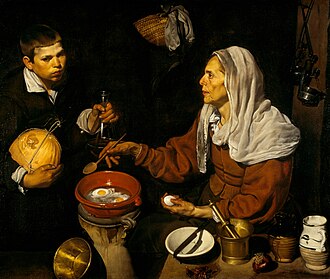 Eine alte Frau brät Eier - Diego Velázquez (1618)
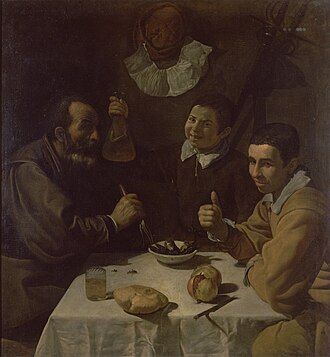 Drei Männer am Tisch - Diego Velázquez (1617)
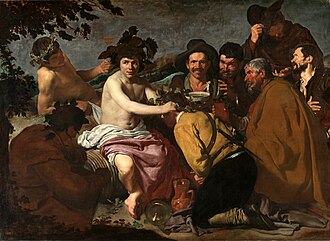 Der Triumph des Bacchus - Diego Velázquez (1628)
Werke verwandter Künstler
 Das Abendmahl in Emmaus - Caravaggio (1601)
 Die Berufung des Hl. Matthäus - Caravaggio (1609)
 Saint Francis in Meditation - Francisco de Zurbarán (1639)
 The Immaculate Conception - Francisco de Zurbarán (1661)
 Dreifachporträt von Karl I. - Anthony van Dyck (1635)
 Karl I mit M. de St. Antoine - Anthony van Dyck (1636)
 Die Aufrichtung des Kreuzes - Peter Paul Rubens (1609)
 Der Raub der Töchter des Leukippos - Peter Paul Rubens (1618)
 Die Nachtwache - Rembrandt van Rijn (1642)
 Selbstbildnis - Rembrandt van Rijn (1659)
 Ein Schütze einen Berkemeyer haltend, bekannt als „Der fröhliche Trinker" - Frans Hals (1620s)
 Der lachende Kavalier - Frans Hals (1624)