Porträt des Prinzen Balthasar Carlos zu Pferd
Diego Velázquez · 1630s
.jpg)
A five or six year old prince sits upright on a rearing pony, baton in hand, mountains glittering behind him. Velázquez made the pony strangely round on purpose: it was meant to be seen from below.
The story behind the painting
Velázquez painted Balthasar Charles, Prince of Asturias, in 1634 to 1635 for the Hall of Realms in the Buen Retiro Palace in Madrid. The picture was to fill the space above a door, between the larger equestrian portraits of the prince's parents, Philip IV and Elisabeth of France. Its smaller size, about 211 by 177 cm, matched that place. Seen from below in the hall, the prince would have ridden above the doorway between his father and mother, the heir framed by the king and queen.
What to look for
The prince sits straight in the saddle of a brown pony rearing in a levade. His face is painted in thin, light strokes, pale against blonde hair and the matte black of a feathered slouch hat. He wears a gold-woven doublet, a buff coat, dark green breeches embroidered in gold, suede boots and a ruff. Gold glints in the saddle, stirrups, sash and hair. Behind him the Sierra de Guadarrama is laid down in liquid strokes of turquoise and white, catching the cold mountain air.
Meaning and intent
According to Simona Di Nepi, the child's calm on a rearing horse is political: it presents him as a sure horseman and a strong future leader, his authority marked by the field marshal's baton, sword and military sash. Because it hung high over a door, Velázquez made the horse's barrel immensely round so it would look right from below, as Enrique Lafuente Ferrari noted. The work also marks a leap in Velázquez's colour, far brighter than his earlier pictures.
Legacy
The portrait is now in the Prado, the museum that also holds the larger equestrian portrait of his mother, Elisabeth of France, which once hung beside it in the Hall of Realms. The Wallace Collection in London has another equestrian portrait of the prince, attributed to Velázquez's studio. The prince's fresh face, the gold glinting on his clothes and the cold, bright mountain air make it one of the most luminous pictures Velázquez painted in these years.
Schon gewusst?
- Painted 1634-1635 to hang above a door in the Hall of Realms.
- The prince appears about five or six years old.
- The horse's body was enlarged to look right from below.
- Now in the Prado.
Über den Künstler
Diego Velázquez (1599-1660)
Museo del Prado · Hauspferd · Reiten · Reiterporträt
Mehr von Diego Velázquez
 Las Meninas - Diego Velázquez (1656)
 Die Übergabe von Breda - Diego Velázquez (1635)
 Venus vor dem Spiegel - Diego Velázquez (1644)
 Die Spinnerinnen - Diego Velázquez
.jpg) Bildnis Innozenz X. - Diego Velázquez
Bildnis Innozenz X. - Diego Velázquez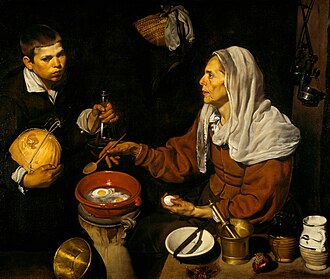 Eine alte Frau brät Eier - Diego Velázquez (1618)
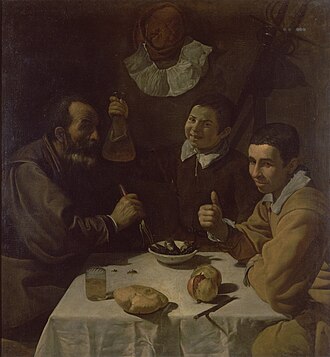 Drei Männer am Tisch - Diego Velázquez (1617)
.jpg) Der Triumph des Bacchus - Diego Velázquez (1628)
Der Triumph des Bacchus - Diego Velázquez (1628)
Werke verwandter Künstler
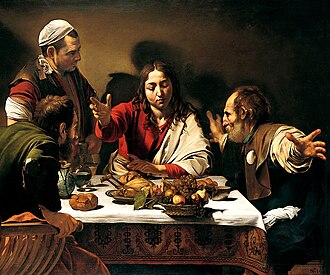 Das Abendmahl in Emmaus - Caravaggio (1601)
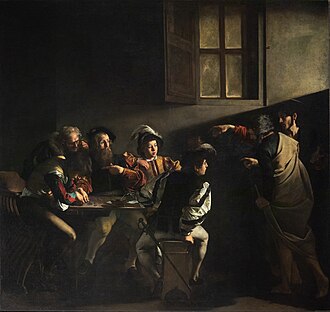 Die Berufung des Hl. Matthäus - Caravaggio (1609)
.jpg) Die Aufrichtung des Kreuzes - Peter Paul Rubens (1609)
Die Aufrichtung des Kreuzes - Peter Paul Rubens (1609)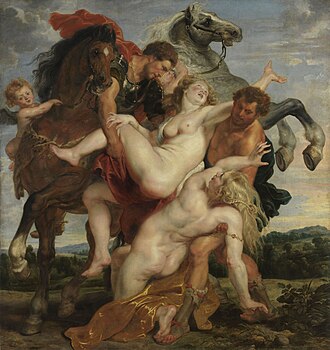 Der Raub der Töchter des Leukippos - Peter Paul Rubens (1618)
%20-%20Google%20Art%20Project.jpg) Dreifachporträt von Karl I. - Anthony van Dyck (1635)
Dreifachporträt von Karl I. - Anthony van Dyck (1635)%20with%20M.%20de%20St%20Antoine%20-%20Google%20Art%20Project.jpg) Karl I mit M. de St. Antoine - Anthony van Dyck (1636)
Karl I mit M. de St. Antoine - Anthony van Dyck (1636)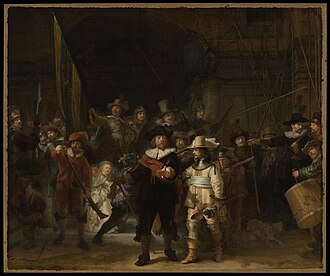 Die Nachtwache - Rembrandt van Rijn (1642)
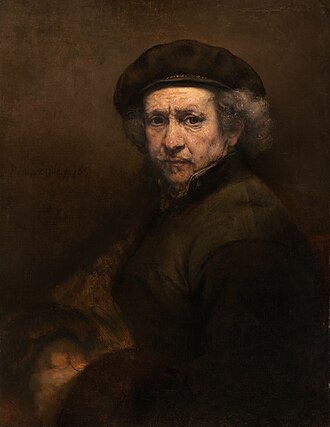 Selbstbildnis - Rembrandt van Rijn (1659)
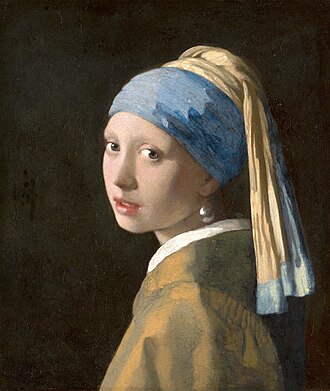 Das Mädchen mit dem Perlenohrgehänge - Johannes Vermeer (1665)
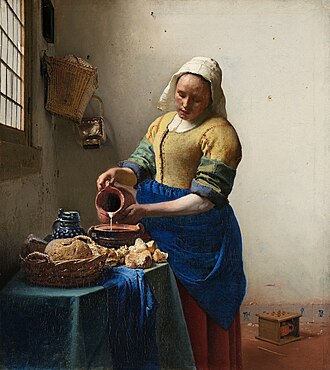 Dienstmagd mit Milchkrug - Johannes Vermeer (c. 1658)