Holländische Boote in einem Sturm
J. M. W. Turner · 1801
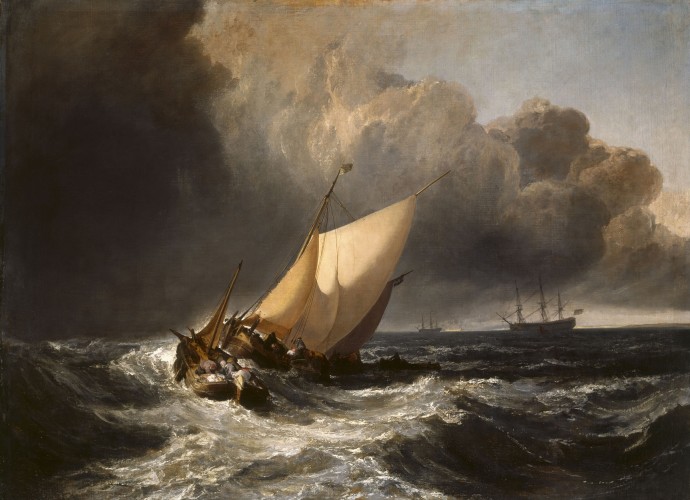
Two small Dutch boats pitch toward each other in a storm, their yellow sails blazing against black clouds. The picture made the 26-year-old Turner the youngest full member in the history of the Royal Academy.
The story behind the painting
Francis Egerton, 3rd Duke of Bridgewater, a coal and canal magnate, owned Ships on a Stormy Sea, painted around 1672 by the Dutch marine artist Willem van de Velde the Younger. He wanted a companion piece to hang beside it and commissioned Turner. Turner called the result Dutch Boats in a Gale: Fishermen Endeavouring to Put Their Fish on Board, but it became known as The Bridgewater Seapiece. Marine paintings in the Dutch style were popular then, and Turner showed this one at the Royal Academy's exhibition of 1801 with two other seascapes. It was the largest sum he had yet received for a painting.
What to look for
The canvas is about 163 by 221 cm. Two spritsail boats, called kaags in the Netherlands, ride a rough sea while fishermen struggle to avoid a collision. The gale throws white foam over the water and menacing black clouds gather overhead. Turner copied van de Velde's precision in drawing ships, and mirrored the strong diagonal of the sail in the Dutch picture in reverse, so the two works answer each other. The yellow sails catch a strong light against the dark sky. Far off, look for the silhouette of a man-of-war, which Martin Butlin said gives a vast sense of maritime scale.
Meaning and intent
Turner followed Joshua Reynolds's advice to learn from the old masters, but he was also attuned to what collectors wanted. The source says his talent took him beyond pastiche, making the Dutch style his own as a kind of homage and, at times, an indirect critique. Michael Kitson notes that a preparatory sketch shows his main aim was to convey the fishermen's peril, and that its bold light and dark recall Rembrandt's pen drawings. Years later Turner picked up a print after van de Velde and said with emotion that the Dutch artists had made him a painter.
Legacy
At the 1801 exhibition, which drew close to fifty thousand visitors, the picture hung in the best place in the Great Room. Benjamin West, the Academy's president, called it what Rembrandt thought of but could not do, and Henry Fuseli named it the best work in the show. A year later Turner was elected a full Royal Academician at 26. The painting passed through the Egerton family and later to Harry Hyams, who lent it to the National Gallery in 1998 and asked in his will that it stay there. In 2009 Tate Britain reunited it with its van de Velde companion for the first time in 170 years.
Schon gewusst?
- Commissioned as a companion to a van de Velde seascape.
- Shown at the Royal Academy in 1801 and widely praised.
- Turner became a full Academician at 26 the following year.
- On loan to the National Gallery, London, since 1998.
Über den Künstler
J. M. W. Turner (1775-1851)
National Gallery · Marinekunst · Boot · Wind
Mehr von J. M. W. Turner
 Die letzte Fahrt der Temeraire - J. M. W. Turner (1839)
 Rain, Steam and Speed - The Great Western Railway - J. M. W. Turner (1844)
 Das Sklavenschiff - J. M. W. Turner (1840)
 Dido building Carthage - J. M. W. Turner (1815)
 Die Seeschlacht von Trafalgar am 21. Oktober 1805 - J. M. W. Turner (1820s)
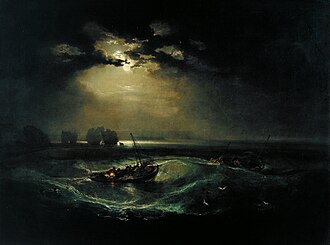 Fischer auf dem Meer - J. M. W. Turner (1796)
 Schneesturm: Hannibal und sein Herr überqueren die Alpen - J. M. W. Turner (1812)
 Schloss Dolbadarn - J. M. W. Turner (1800)
Werke verwandter Künstler
 Die Schwestern Waldegrave - Joshua Reynolds (1780)
 Porträt des Colonel George K. H. Coussmaker vom Regiment der Garde-Grenadiere - Joshua Reynolds (1782)
 Impression, Sonnenaufgang - Claude Monet (1872)
 Seerosen - Claude Monet (1906)
 Die Erschießung der Aufständischen - Francisco Goya (1814)
 Die nackte Maja - Francisco Goya (1800)
 Der Wanderer über dem Nebelmeer - Caspar David Friedrich (c. 1818)
 Abtei im Eichwald - Caspar David Friedrich (1800s)
 Die Freiheit führt das Volk - Eugène Delacroix (1830)
 Der Tod des Sardanapal - Eugène Delacroix (1827)
 Knabe in Blau - Thomas Gainsborough (1770)
 Mr. und Mrs. Andrews - Thomas Gainsborough (1748)