Schneesturm: Hannibal und sein Herr überqueren die Alpen
J. M. W. Turner · 1812
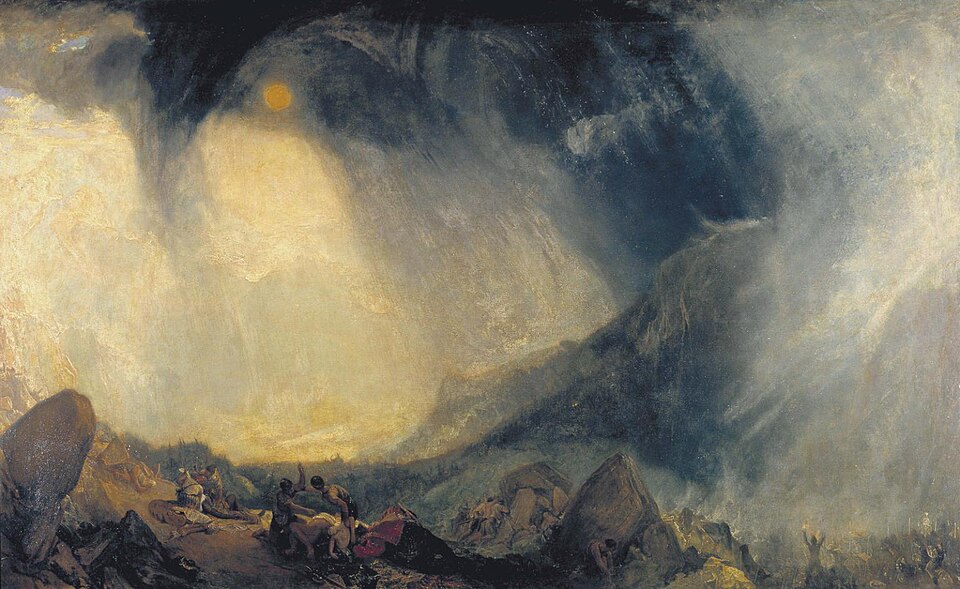
A black storm curls over the Alps like a bird of prey, and somewhere far below, Hannibal is a tiny figure on an elephant. Turner made the weather the hero, and turned a history painting into a vortex.
The story behind the painting
In 1810, staying at his friend Walter Fawkes's estate in Yorkshire, Turner was gripped by a thunderstorm and sketched it frantically on the back of a letter. Fawkes's son Hawksworth later recalled him calling out "Hawkey! Come here!" and, when the storm had passed, promising that in two years the boy would see it again as Hannibal crossing the Alps. Turner had been fascinated by the subject since around 1800, when he sketched a watercolour of Hannibal by J. R. Cozens. He also drew on his Alpine studies from a trip in 1802. The finished oil was shown at the Royal Academy Summer Exhibition in 1812.
What to look for
Turner sets the viewer low, behind broken rocks in the foreground. An orange-yellow sun glows behind dark, swirling cloud. Far away, Hannibal gestures from an elephant while attackers fall on his rear-guard, and an avalanche and an encroaching storm threaten the army. There is no linear perspective here: the picture is built on a central vortex and intersecting arcs. The historian John Walker called it an extraordinary innovation, saying the vortex of cloud and mist seems to suck the eye into vast distances. Turner even took liberties with geography, showing the Aosta Valley in the distance, though Livy placed the attacks on the ascent.
Meaning and intent
Turner wanted to prove that the sublime, an ideal described by Edmund Burke, could be reached in painting and not only in poetry, and that landscape deserved a higher place among the genres. Painted during the Napoleonic Wars, after he had seen David's heroic Napoleon Crossing the Alps in Paris in 1802, the work shrinks the great general and lets nature dominate. It may hint at a hope for Napoleon's defeat. Turner added lines from his own poem Fallacies of Hope to the catalogue, warning of the cycle of plunder and of Capua's joys, the luxury that softened Hannibal's army after its ordeal.
Legacy
Critical opinion in 1812 was divided, but the painting is now considered one of Turner's most influential works. He returned to the vortex and intersecting arcs decades later, most famously in Snow Storm: Steam-Boat off a Harbour's Mouth of 1842. The canvas came to the nation in 1856 as part of the Turner Bequest and is shown at Tate Britain in London; Wikidata lists both the National Gallery and Tate as holders. Wikidata gives its size as 237.5 by 146 cm. The source also says Turner sketched Cozens's watercolour 14 years before painting it, which does not fit the dates of around 1800 and 1812.
Schon gewusst?
- Oil on canvas, shown at the Royal Academy in 1812.
- Inspired by a storm Turner saw in Yorkshire in 1810.
- Hannibal appears only as a tiny figure on an elephant.
- Part of the Turner Bequest of 1856, now at Tate Britain.
Über den Künstler
J. M. W. Turner (1775-1851)
National Gallery · Historienmalerei · Tate
Mehr von J. M. W. Turner
 Die letzte Fahrt der Temeraire - J. M. W. Turner (1839)
 Rain, Steam and Speed - The Great Western Railway - J. M. W. Turner (1844)
 Das Sklavenschiff - J. M. W. Turner (1840)
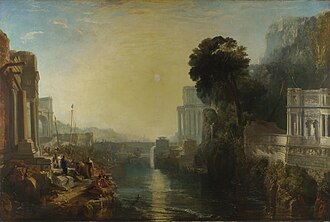 Dido building Carthage - J. M. W. Turner (1815)
.jpg) Die Seeschlacht von Trafalgar am 21. Oktober 1805 - J. M. W. Turner (1820s)
Die Seeschlacht von Trafalgar am 21. Oktober 1805 - J. M. W. Turner (1820s)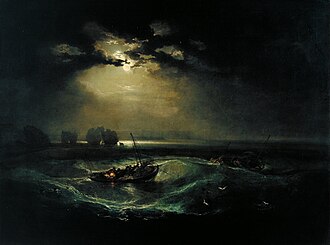 Fischer auf dem Meer - J. M. W. Turner (1796)
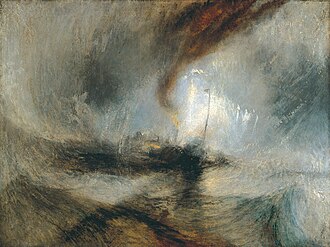 Schneesturm - ein Dampfschiff im flachen Wasser vor einer Hafeneinfahrt gibt Leuchtsignale ab - J. M. W. Turner (1842)
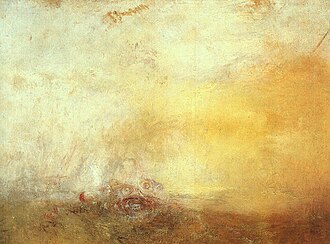 Sonnenaufgang mit Seeungeheuern - J. M. W. Turner (1845)
Werke verwandter Künstler
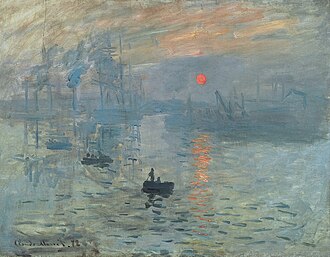 Impression, Sonnenaufgang - Claude Monet (1872)
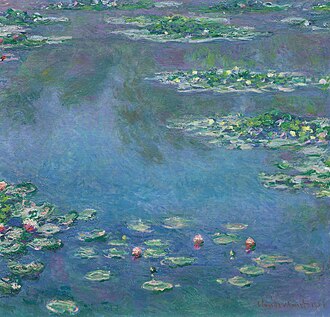 Seerosen - Claude Monet (1906)
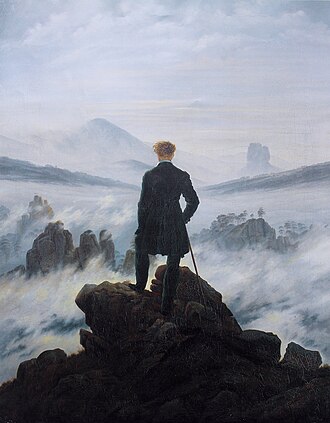 Der Wanderer über dem Nebelmeer - Caspar David Friedrich (c. 1818)
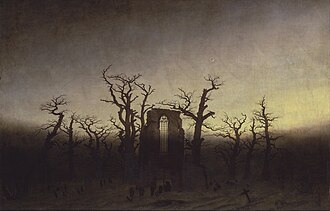 Abtei im Eichwald - Caspar David Friedrich (1800s)
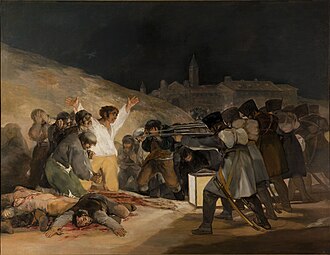 Die Erschießung der Aufständischen - Francisco Goya (1814)
.jpg) Die nackte Maja - Francisco Goya (1800)
Die nackte Maja - Francisco Goya (1800)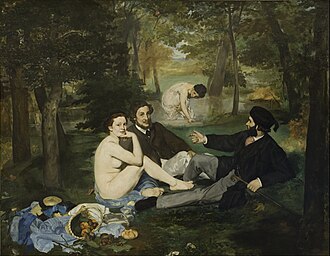 Das Frühstück im Grünen - Édouard Manet (1863)
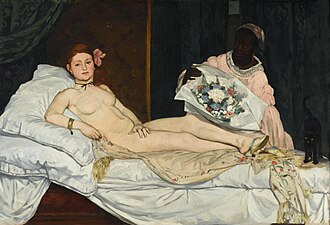 Olympia - Édouard Manet (1863)