Diana als Jägerin
Pierre-Auguste Renoir · 1867
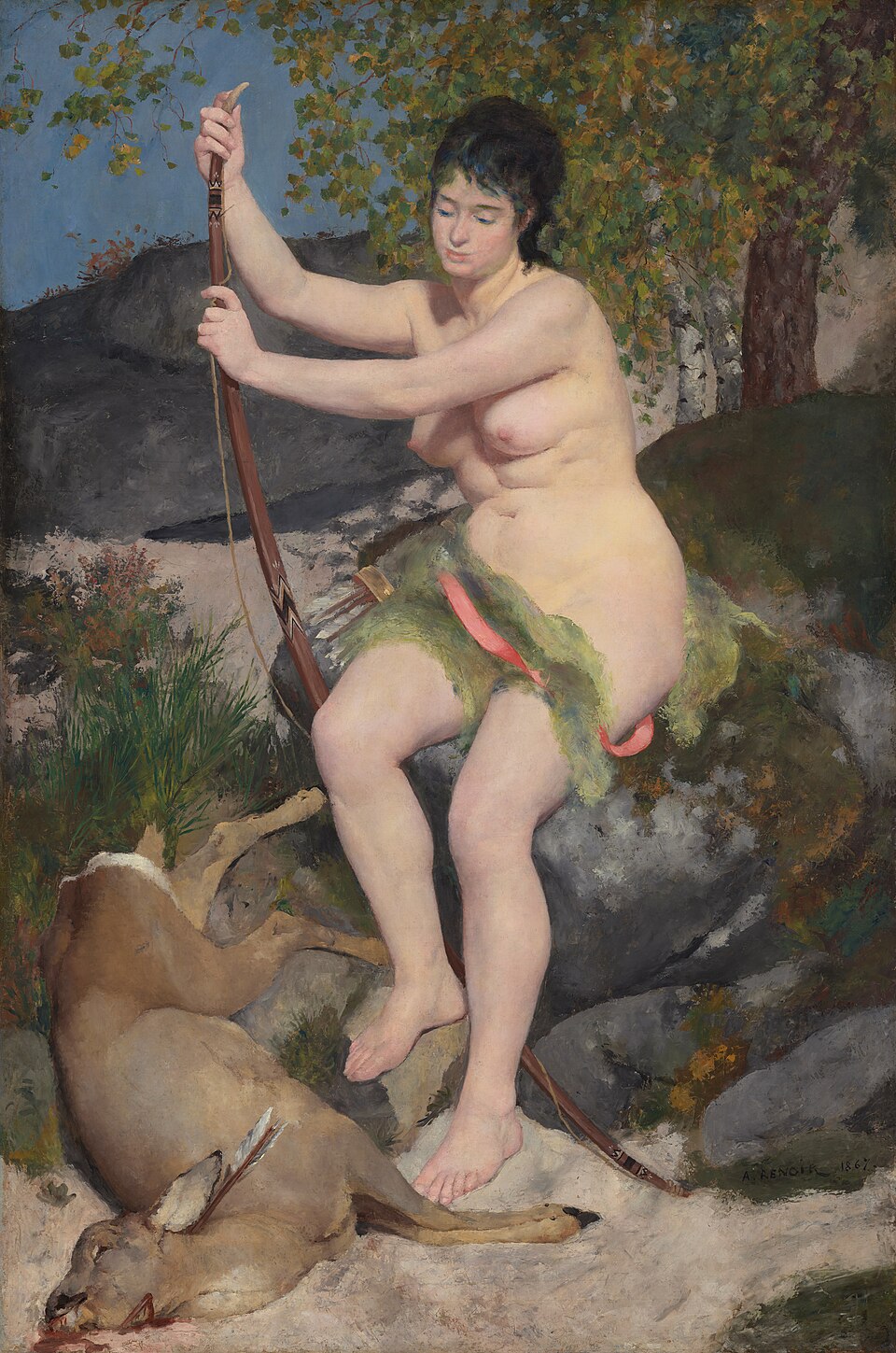
A young woman sits on a rock, bow in hand, a slain deer at her feet. She is Diana the huntress, but only because the young Renoir feared the picture was too improper. The Salon of 1867 rejected her anyway.
The story behind the painting
Renoir painted Diana in 1867. The canvas began as a nude study of a posed model in the studio, following the conventions of academic art typified by the Salon of the time. By the painter's own account, he added the attributes of the goddess Diana because the picture was considered pretty improper, and a mythological subject would make it more acceptable. The model is generally thought to be Lise Tréhot, Renoir's lover and recurring model, but this is disputed: the art historian Michael F. Zimmermann said in 2012 that it is probably not her, and Sylvie Patry, curator at the Musée d'Orsay, also questions it.
What to look for
The nude goddess sits on a large stone with her right foot raised on a higher perch, her stretched arms leaning on her bow. Below her lies a deer, its neck pierced by an arrow, blood coming from its mouth. Look at the moss on the surface of the rock and at the paint itself, applied in places with a palette knife. Then notice the bright greens and the small red accents scattered through the picture. The canvas is tall, almost two metres high, about 199.5 by 129.5 cm, and the goddess fills most of its height.
Meaning and intent
Diana shows a young painter between two worlds. The blood at the deer's mouth, the moss and the palette knife reveal the influence of the Realist Gustave Courbet. The bright greens and red accents, however, point toward the Impressionism with which Renoir would be associated a few years later. The mythological disguise itself tells us something about the art world of 1867: a nude needed a goddess's name to be shown. The critic Peter H. Feist praised it as a beautifully accurate nude, without the coarseness of Courbet's Bathers, and far healthier than the powdered nudes of the fashionable painters that Zola mocked.
Legacy
Renoir submitted the painting to the Salon of 1867, and it was rejected. He had exhibited at the Salon of 1864, though he destroyed that painting after the exhibition closed, and in 1868 his Portrait of Lise was accepted. Diana stayed in private collections. Chester Dale bought it in 1933 from Etienne Bignou and bequeathed it in 1963 to the National Gallery of Art in Washington, D.C., where it hangs in the West Building, Main Floor, Gallery 90. Wikidata lists the museum under its Spanish name, Galería Nacional de Arte.
Schon gewusst?
- Painted in 1867 and rejected by the Salon that year.
- Began as a studio nude; Renoir added Diana's attributes to make it acceptable.
- The model is usually said to be Lise Tréhot, but this is disputed.
- In the National Gallery of Art, Washington, since 1963.
Über den Künstler
Pierre-Auguste Renoir (1841-1919)
mythologische Malerei · Akt · National Gallery of Art · Diana
Mehr von Pierre-Auguste Renoir
 Tanz im Moulin de la Galette - Pierre-Auguste Renoir (1876)
 Das Frühstück der Ruderer - Pierre-Auguste Renoir (1881)
 Auf der Schaukel - Pierre-Auguste Renoir (1876)
 Die großen Badenden - Pierre-Auguste Renoir (1884)
 Zwei Mädchen am Klavier - Pierre-Auguste Renoir (1892)
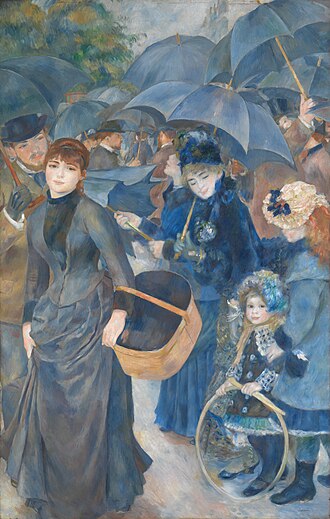 Regenschirme - Pierre-Auguste Renoir (1880s)
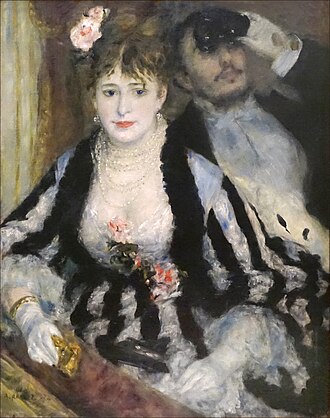 Die Loge - Pierre-Auguste Renoir (1874)
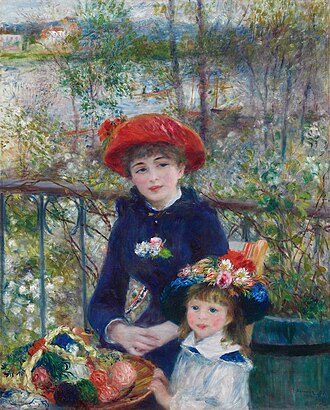 Auf der Terrasse - Pierre-Auguste Renoir (1881)
Werke verwandter Künstler
 Impression, Sonnenaufgang - Claude Monet (1872)
 Seerosen - Claude Monet (1906)
 Das Frühstück im Grünen - Édouard Manet (1863)
 Olympia - Édouard Manet (1863)
 Wiege - Berthe Morisot (1872)
 Sommertag - Berthe Morisot (1879)
 Der Absinth - Edgar Degas (1875)
 Die Bellelli Familie - Edgar Degas (1858)
 Der Kanal von Loing - Alfred Sisley (1892)
 The Watering Pond at Marly with Hoarfrost - Alfred Sisley (1876)
 Straße in Paris an einem regnerischen Tag - Gustave Caillebotte (1877)
 Die Parkettschleifer - Gustave Caillebotte (1875)