Der Neue See im Berliner Tiergarten
Lovis Corinth · 1908
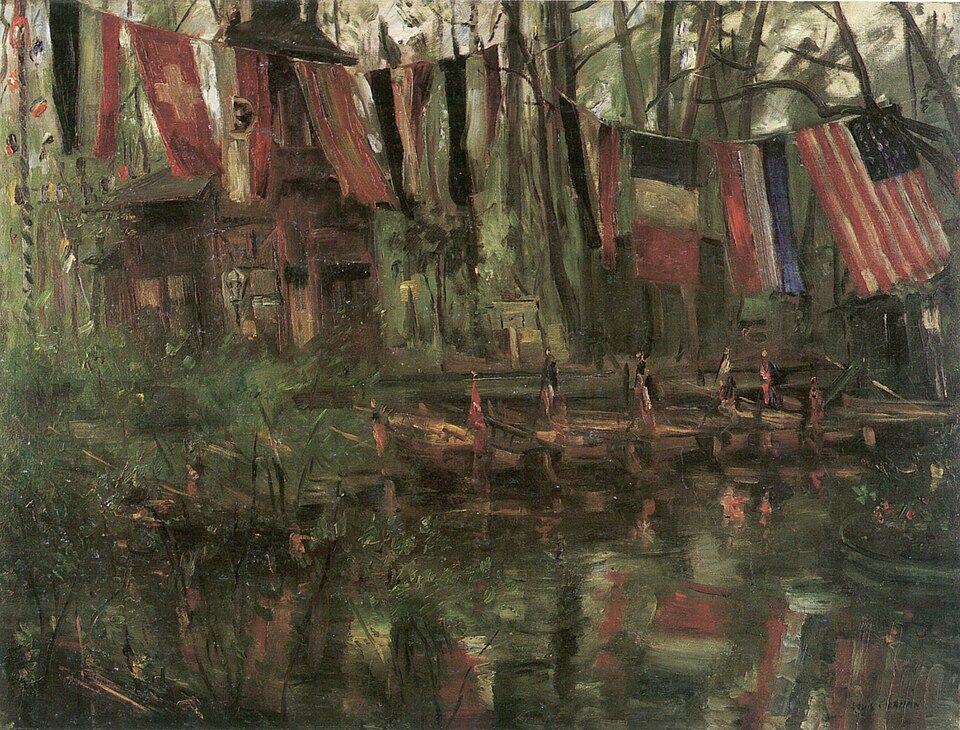
No one is out on the water. The boat rental is shut, the sky is milky, yet a line of national flags blazes between the trees and melts into the lake below. Lovis Corinth turned a dull day in Berlin into a feast of colour.
The story behind the painting
The Neuer See lies in Berlin's Großer Tiergarten. Laid out by Peter Joseph Lenné between 1833 and 1839, it became a favourite outing for the city's middle class in the nineteenth century, with a beer garden and a boat landing. It was very close to Corinth's studio in Klopstockstraße. The date is uncertain: Wikidata and the catalogue by his wife Charlotte Berend-Corinth give 1908, but she also remembered that he first painted it in 1903 under the title Bootsplatz and showed it at Paul Cassirer in 1904. Because it differs so much from his Eisbahn am Berliner Tiergarten of 1909, the earlier date is considered plausible.
What to look for
The picture shows a boat landing decorated with flags. The boathouse behind is deserted, its doors and windows closed, and there are no people at all. Boats fill the whole landing with no gaps, their hulls laid in with coarse strokes, each with a bright pennant at the water end. On a sagging line between the trees hang ten large flags of different nations, among them the black, white and red of the German Empire several times, and the flags of Switzerland, France, the Netherlands and the United States. The colours are muted greens and browns. The shore cuts the canvas in two: flags above, their blurred reflections below. Corinth's signature sits at lower right.
Meaning and intent
Corinth chose a gloomy day when the boat rental was closed, so instead of leisure the picture is about the flag-decked landing set against the lake and the trees. Charlotte Berend-Corinth wrote in her memoir that he loved painting flags. In the water the flag colours blur into one another, abstracting colour and light in a way that especially interested him. His quick, rough handling makes the reflection a nearly free composition of thick dabs of paint, a double abstraction of the flags. The scholar Steffen Haug wrote in 2008 that the picture reflects on the relationships between representation and abstraction, and between art and nature.
Legacy
The first owner was H. Wolff in Hamburg; later it belonged to Wolfgang Gurlitt in Munich and W. Hahn, and today it is in the Kunsthalle Mannheim. It was shown at Fritz Gurlitt's gallery in 1915, in Hannover in 1950, in New York in 1964, in East Berlin's Nationalgalerie in 1976, and in the 2008 retrospective for Corinth's 150th birthday at the Musée d'Orsay, Leipzig and Regensburg. In 2010 it travelled to Cologne and Houston for Liebermann, Corinth, Slevogt: The Landscapes. Corinth returned to the lake in his winter Eisbahn and in the print cycle Der Tiergarten of 1920 to 1921, and painted flags again at the Kaisertag in Hamburg.
Schon gewusst?
- Painted at the Neuer See, close to Corinth's Berlin studio.
- Dated 1908, though it may go back to 1903.
- Ten national flags hang between the trees, with no people in sight.
- Now in the Kunsthalle Mannheim.
Über den Künstler
Lovis Corinth (1858-1925)
Landschaftsmalerei · Flagge Frankreichs
Mehr von Lovis Corinth
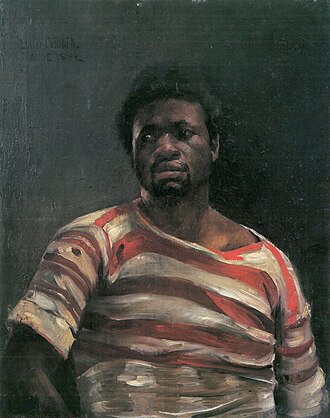 Un Othello - Lovis Corinth (1884)
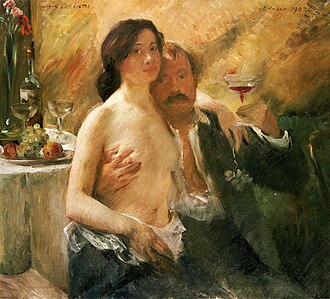 Selbstporträt mit Charlotte Berend und Sektglas - Lovis Corinth (1902)
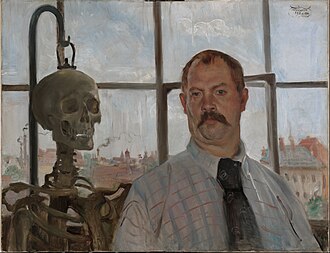 Selbstporträt mit Skelett - Lovis Corinth (1896)
 Innocentia - Lovis Corinth (1890)
 Susanna im Bade, 2. Fassung - Lovis Corinth (1890)
 Der rote Christus - Lovis Corinth (1922)
 Die Lesende - Lovis Corinth (1911)
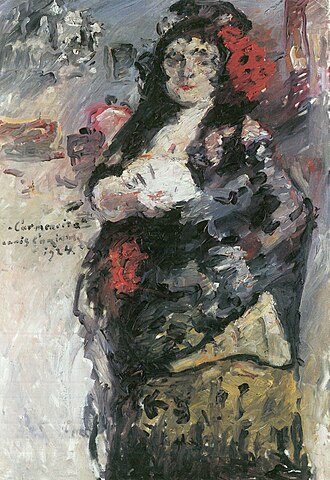 Carmencita - Lovis Corinth (1924)