Innocentia
Lovis Corinth · 1890
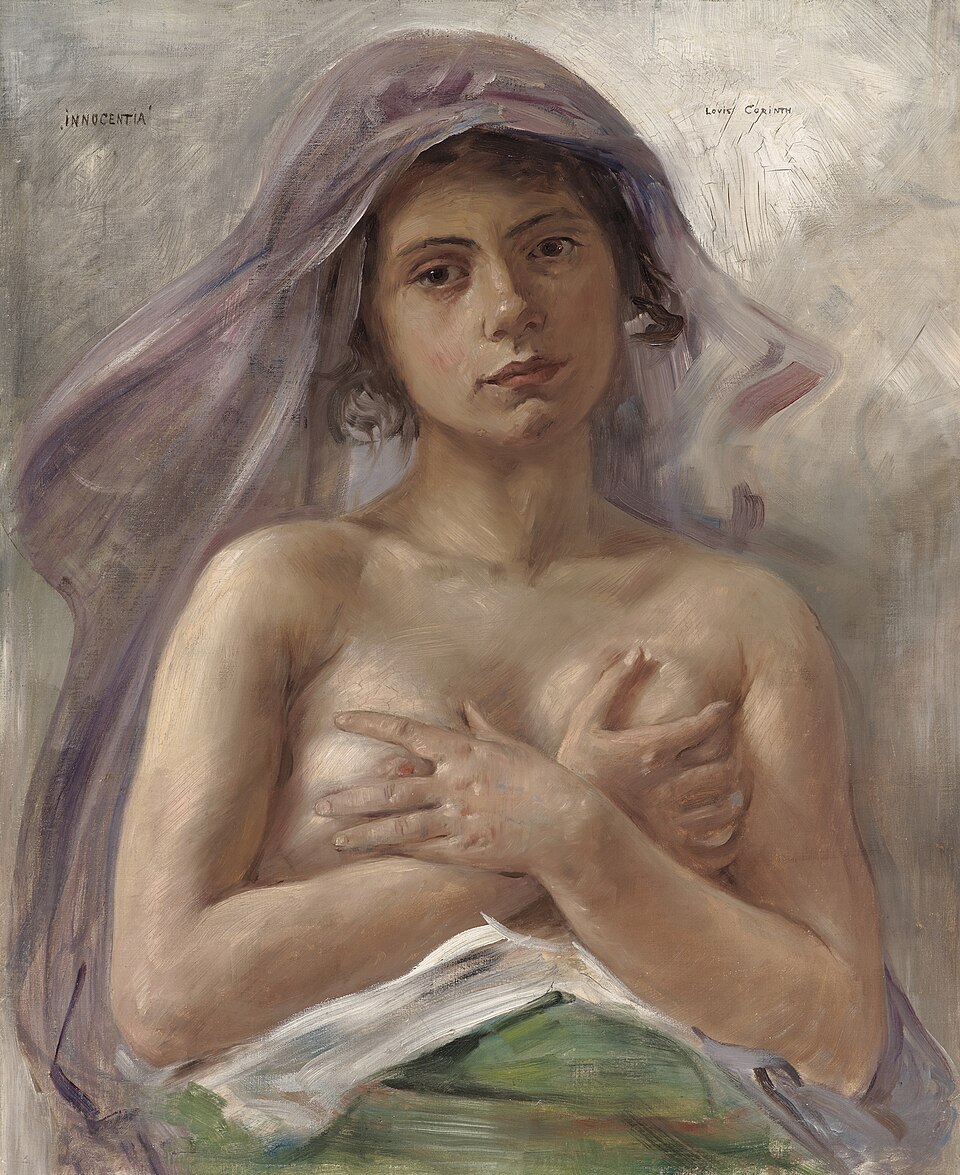
A young woman under a violet veil crosses her arms over her chest, her gaze dreamy and far away, and the word Innocentia is written in the corner. Corinth's title promises innocence, and the painting quietly questions it.
The story behind the painting
Lovis Corinth painted Innocentia in 1890. Little is known about how it came about. In Charlotte Berend-Corinth's catalogue of his paintings it appears only in the supplement to the revised second edition, as BC 998, and it is missing from the first edition. The picture stayed in private hands until it was acquired by the Städtische Galerie im Lenbachhaus in Munich. It measures 66.5 by 54.5 cm. So a painting that had slipped out of the painter's own catalogue at first came to light only later and then found a public home in a museum.
What to look for
The catalogue describes a half-nude young girl with a purple veil. She faces us, crossing her arms in front of her chest and partly covering her breasts with her hands, while the right nipple shows between the middle and index fingers of her left hand. A white and olive-green garment covers her belly below the arms. Her head is slightly tilted, and the violet veil hangs down behind her right shoulder to form a backdrop for her body. Her expression is melancholic and absently dreamy. The rest of the background is white and grey-white. Innocentia is written at upper left, with no year; Lovis Corinth signs at upper right.
Meaning and intent
Andrea Bärnreuther, in 1996, read the grasp of the hands as the woman's awareness of her own body, a gesture of humility from images of Mary and the Magdalene translated into the language of naturalism. In 2008 Andreas Dehmer also compared it with images of a Vestal virgin, Mary or the penitent Magdalene, but argued that the innocence is only on the surface: the deliberately shown nipple recalls paintings of courtesans such as Raphael's Fornarina, and the old pairing of saint and whore. He suggests Corinth may have drawn on Dutch Baroque images like Cornelis van Haarlem's Monk and Beguine. Both writers stress the play of veiling and unveiling.
Legacy
Innocentia was first shown to the public at the Lenbachhaus in 1975. It then travelled to the Folkwang Museum in Essen and to the Kunsthaus der Hypo-Kulturstiftung in Munich in 1985 and 1986, to the Kunstforum in Vienna in 1992, and to the Niedersächsisches Landesmuseum in Hanover in 1992 and 1993. In 1996 it was shown at the Alte Nationalgalerie in Berlin. For the retrospective marking Corinth's 150th birthday in 2008 it went to the Musée d'Orsay in Paris, the Museum der bildenden Künste in Leipzig and the Kunstforum Ostdeutsche Galerie in Regensburg.
Schon gewusst?
- Painted by Lovis Corinth in 1890.
- Missing from the first edition of the catalogue, added later as BC 998.
- First shown publicly at the Lenbachhaus in 1975.
- Owned by the Lenbachhaus, Munich.
Über den Künstler
Lovis Corinth (1858-1925)
Frau · Allegorie · brünett · weibliche Brust · Oberkörper frei · Schleier · Städtische Galerie im Lenbachhaus und Kunstbau München
Mehr von Lovis Corinth
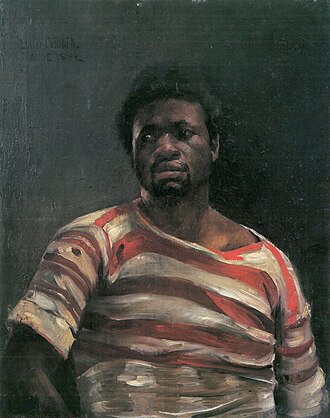 Un Othello - Lovis Corinth (1884)
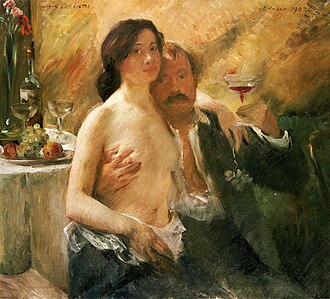 Selbstporträt mit Charlotte Berend und Sektglas - Lovis Corinth (1902)
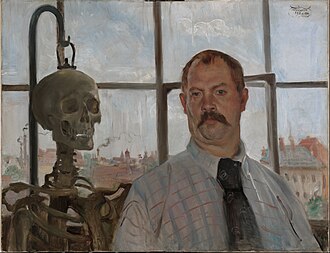 Selbstporträt mit Skelett - Lovis Corinth (1896)
 Susanna im Bade, 2. Fassung - Lovis Corinth (1890)
 Der rote Christus - Lovis Corinth (1922)
 Die Lesende - Lovis Corinth (1911)
 Carmencita - Lovis Corinth (1924)
 Selbstporträt mit Tiroler Hut - Lovis Corinth (1913)