Christus im Hause von Maria und Martha
Diego Velázquez · 1618
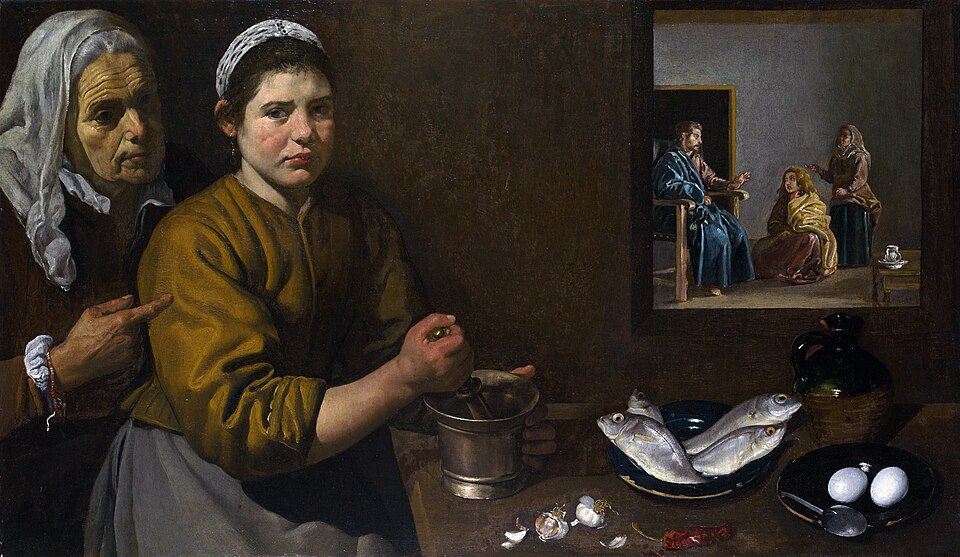
A young maid pounds garlic, her cheeks red, while an old woman points to a small scene behind her: Christ in the house of Martha and Mary. Velázquez had just finished his apprenticeship.
The story behind the painting
Velázquez painted this canvas in Seville, probably in 1618, shortly after completing his apprenticeship with Francisco Pacheco. It is dated, but the 8 is fragmentary and uncertain. At the time he was exploring the bodegón, a kind of genre painting set in taverns or kitchens that often tied scenes of contemporary Spain to stories from the Bible, frequently with people working with food and drink. This may be the work listed as by Velázquez in a 1637 inventory of the duke of Alcalá's house, described simply as a kitchen where a woman is pounding garlic.
What to look for
In the kitchen, two half-length women stand at the left. The older one also appears in Velázquez's Old Woman Cooking Eggs from the same period. On the table lie a number of foods prepared by the maid, perhaps the ingredients of an aioli, a garlic mayonnaise made to go with fish, painted so realistically that they were probably from the artist's own household. The maid has flushed, puffy cheeks and looks out at us rather than at the biblical scene. Behind, Christ, bearded and in a blue tunic, gestures towards Martha, standing behind her seated sister Mary.
Meaning and intent
In Luke 10:38-42, Martha complains that her sister Mary sits listening to Christ instead of helping, and Christ answers that Mary has chosen what is better. The maid's plight mirrors Martha's, and the old woman seems to remind her that work alone does not bring fulfilment. For a contemporary audience the story set the contemplative life above the active life, a moral drawn by Saint Augustine in the fifth century. Scholars disagree: some think the maid is Martha herself, and the small scene may be a painting on the wall, a mirror or a vision.
Legacy
After cleaning and restoration in 1964, the National Gallery says it is now clear that the small scene is framed by a hatch through the wall. The composition owes much to sixteenth century Flemish painters such as Pieter Aertsen and Joachim Beuckelaer, who set a small Gospel scene behind a crowded kitchen, and Velázquez probably knew such works through engravings. The painting reached England, was auctioned in 1881, bought by Sir William Henry Gregory and bequeathed to the National Gallery in 1892. It is an early example of the painting within the painting, a device he later used in Las Meninas.
Schon gewusst?
- Probably painted in Seville in 1618; the last digit is uncertain.
- A bodegón: a kitchen scene linked to a Bible story.
- Restoration in 1964 showed the small scene is seen through a hatch.
- Bequeathed to the National Gallery, London, in 1892.
Über den Künstler
Diego Velázquez (1599-1660)
religiöse Kunst · Mann · National Gallery · Jesus Christus
Mehr von Diego Velázquez
 Las Meninas - Diego Velázquez (1656)
 Die Übergabe von Breda - Diego Velázquez (1635)
 Venus vor dem Spiegel - Diego Velázquez (1644)
 Die Spinnerinnen - Diego Velázquez
 Bildnis Innozenz X. - Diego Velázquez
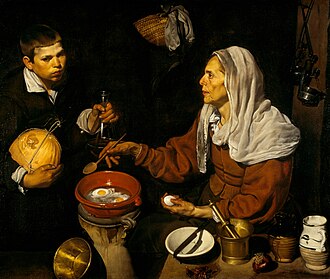 Eine alte Frau brät Eier - Diego Velázquez (1618)
 Drei Männer am Tisch - Diego Velázquez (1617)
 Der Triumph des Bacchus - Diego Velázquez (1628)
Werke verwandter Künstler
 Das Abendmahl in Emmaus - Caravaggio (1601)
 Die Berufung des Hl. Matthäus - Caravaggio (1609)
 Saint Francis in Meditation - Francisco de Zurbarán (1639)
 The Immaculate Conception - Francisco de Zurbarán (1661)
 Dreifachporträt von Karl I. - Anthony van Dyck (1635)
 Karl I mit M. de St. Antoine - Anthony van Dyck (1636)
 Die Aufrichtung des Kreuzes - Peter Paul Rubens (1609)
 Der Raub der Töchter des Leukippos - Peter Paul Rubens (1618)
 Die Nachtwache - Rembrandt van Rijn (1642)
 Selbstbildnis - Rembrandt van Rijn (1659)
 Ein Schütze einen Berkemeyer haltend, bekannt als „Der fröhliche Trinker" - Frans Hals (1620s)
 Der lachende Kavalier - Frans Hals (1624)