Christ contemplated by the Christian Soul
Diego Velázquez · 1626
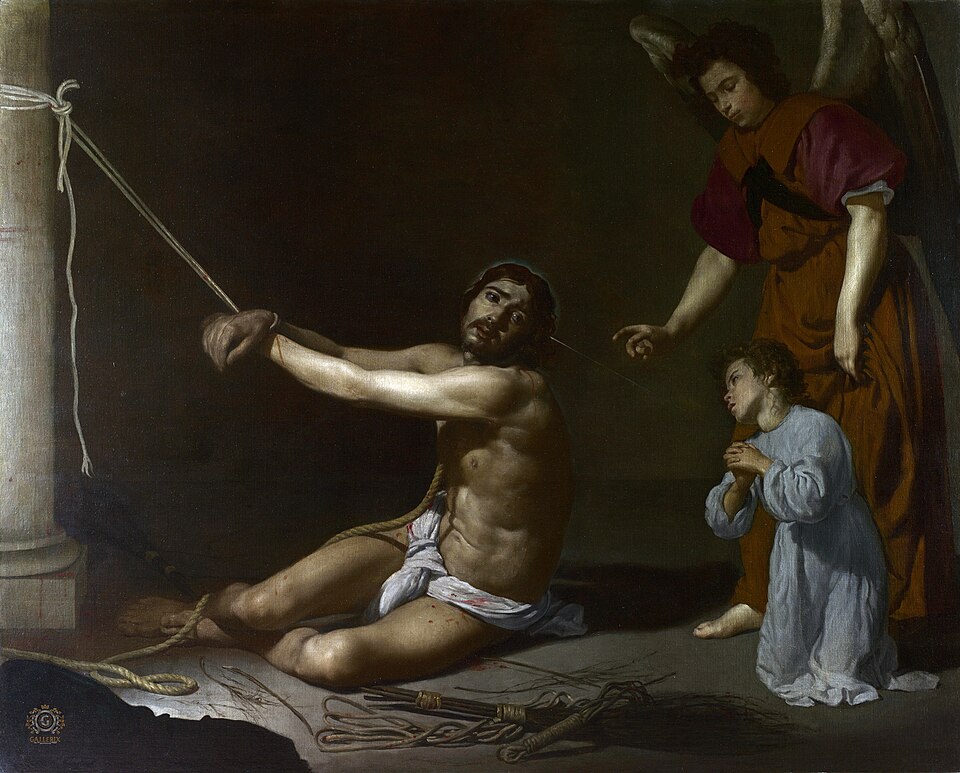
After the scourging, Christ sits bound to a column and turns his eyes towards a kneeling child, the Christian soul, while a guardian angel watches. Velázquez rarely painted such open emotion.
The story behind the painting
Nothing is known about this canvas before it was bought in Madrid in 1858 by John Savile Lumley, who bequeathed it to the National Gallery in London, where it has been since 1883. Critics agree unanimously that it is by Velázquez. José López-Rey thought it could date from 1626 to 1628, the date Wikidata follows, but most critics place it around 1632, after the painter's first journey to Italy. The rarity of the subject and its strong feeling led Carl Justi to suggest it may have been painted after the death of the artist's younger daughter, Ignacia.
What to look for
The canvas is about 165 by 206 cm. Three figures stand out against a neutral ground, lit so strongly that black shadows fall on the floor and the bodies seem fully three-dimensional. Christ, slumped, is tied to a column that is not shown in full, so we can imagine a large hall without it disturbing the view of his body. Whips and scattered twigs lie on the ground, painted with care. Only one garment, the seamless tunic, is shown. The wounds are restrained, gathered on the shoulder, where they spoil the figure least.
Meaning and intent
Velázquez followed advice from his father-in-law, the painter Francisco Pacheco, on how to show Christ after the scourging, including that Christ's gaze should go to the side, since meeting it has great effects. The child who embodies the Christian soul and the guardian angel come from devotional writing meant for meditation, by authors such as John of Avila and Luis de Granada. The central axis of the painting is the meeting of two gazes: the slumped Christ and the fragile kneeling child, hands turned towards him.
Legacy
Although these ideas were common in sermons and ascetic texts, the subject is extremely rare in painting. The only earlier canvases on it are two attributed to Juan de Roelas. On one of them Sánchez Cantón read an inscription, now invisible, in which Christ asks the soul for pity, since it put him in this state. The figure of Christ may echo classical models such as the Dying Gaul, and its anatomy is close to Michelangelo's Christ of the Minerva. A preparatory drawing of the angel, inscribed VELAZQUEZ, was destroyed in 1936.
Schon gewusst?
- At the National Gallery, London, since 1883.
- Bought in Madrid in 1858 by John Savile Lumley.
- Dated 1626-1628 by López-Rey and Wikidata, around 1632 by most critics.
- About 165 x 206 cm.
Über den Künstler
Diego Velázquez (1599-1660)
religiöse Kunst · National Gallery
Mehr von Diego Velázquez
 Las Meninas - Diego Velázquez (1656)
 Die Übergabe von Breda - Diego Velázquez (1635)
 Venus vor dem Spiegel - Diego Velázquez (1644)
 Die Spinnerinnen - Diego Velázquez
 Bildnis Innozenz X. - Diego Velázquez
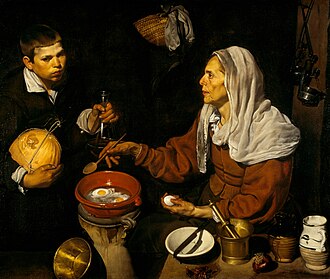 Eine alte Frau brät Eier - Diego Velázquez (1618)
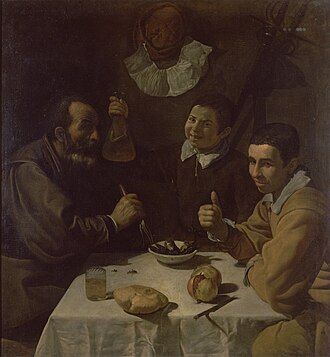 Drei Männer am Tisch - Diego Velázquez (1617)
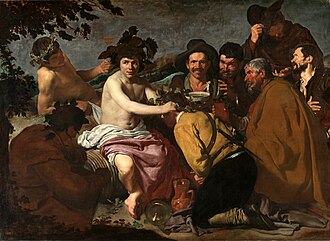 Der Triumph des Bacchus - Diego Velázquez (1628)
Werke verwandter Künstler
 Das Abendmahl in Emmaus - Caravaggio (1601)
 Die Berufung des Hl. Matthäus - Caravaggio (1609)
 Saint Francis in Meditation - Francisco de Zurbarán (1639)
 The Immaculate Conception - Francisco de Zurbarán (1661)
 Dreifachporträt von Karl I. - Anthony van Dyck (1635)
 Karl I mit M. de St. Antoine - Anthony van Dyck (1636)
 Die Aufrichtung des Kreuzes - Peter Paul Rubens (1609)
 Der Raub der Töchter des Leukippos - Peter Paul Rubens (1618)
 Die Nachtwache - Rembrandt van Rijn (1642)
 Selbstbildnis - Rembrandt van Rijn (1659)
 Ein Schütze einen Berkemeyer haltend, bekannt als „Der fröhliche Trinker" - Frans Hals (1620s)
 Der lachende Kavalier - Frans Hals (1624)