Arrangement in Black and Gold
James McNeill Whistler · 1890s
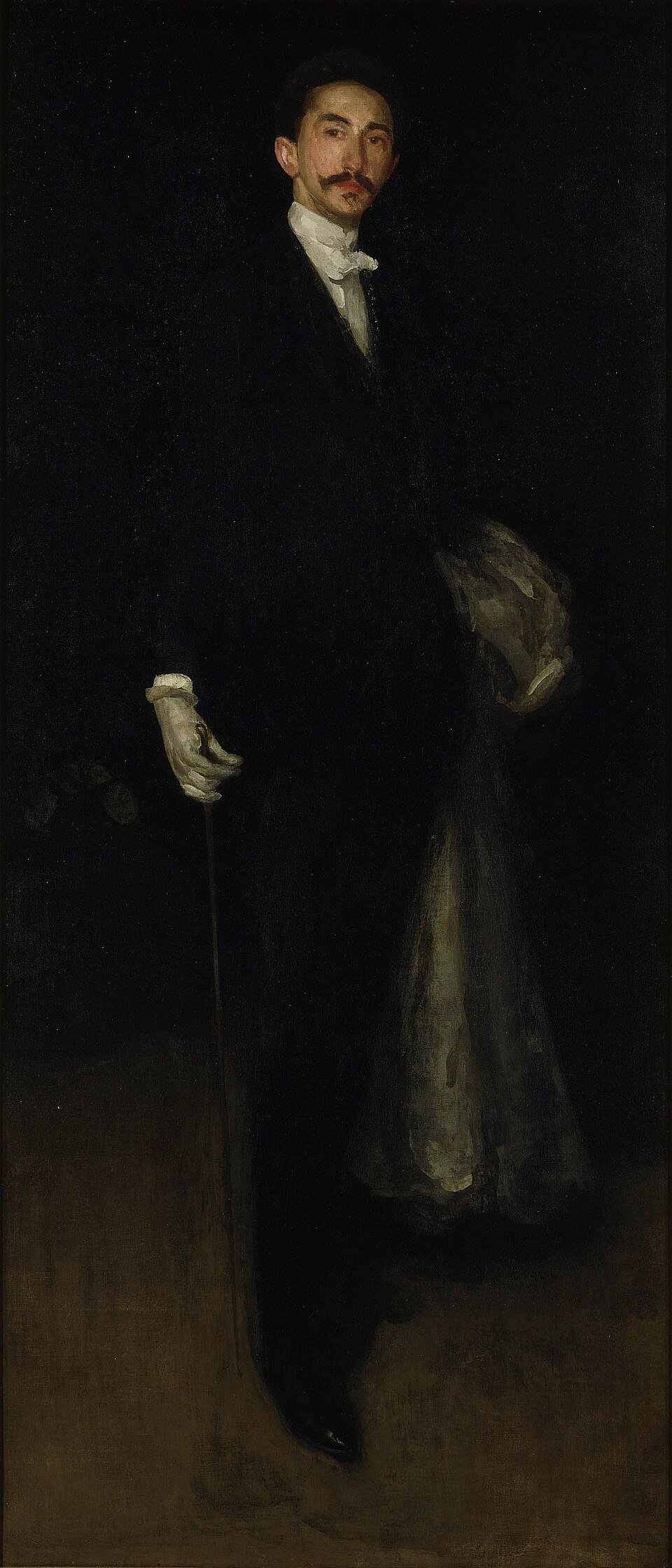
A tall, thin man in black evening dress almost dissolves into a dark ground, only his face, collar, glove and a golden fur catching the light. Whistler painted the most theatrical dandy of Belle Epoque Paris as a living work of art.
The story behind the painting
Whistler and Robert de Montesquiou met on 3 July 1885 at the Reform Club in London, introduced by Henry James. Soon after, Montesquiou asked to be painted. Whistler agreed, but the sittings only began in the spring of 1891 in his Paris studio. The portrait was finished the following summer, then stayed in the studio for two more years. It was first shown in 1894 at the Salon du Champ-de-Mars, where it drew lively interest from the public and the press.
What to look for
The canvas is very narrow and tall, about 208.6 by 91.8 cm. Montesquiou, around 35, stands in a black evening suit and patent shoes, barely separated from a deep, hazy background that lightens toward the floor into a blackish grey brown. Light from the upper left falls on his face, his white stand collar and cravat, and on his right hand in a fine grey glove. That hand holds a thin cane loosely. Over his left forearm hangs the chinchilla cape of his cousin Elisabeth Greffulhe, shimmering gold. At his side stands a faint vase of large white blooms, probably the hydrangeas he loved.
Meaning and intent
Montesquiou came from an old Gascon noble family whose ancestors included d'Artagnan. He styled himself as a dandy and staged his appearances among aristocrats, financiers and artists as a living work of art. Whistler's title, an arrangement in black and gold, treats the man as a harmony of tones, and the two colours of the title are exactly the black suit and the golden fur. To thank the painter, Montesquiou wrote a long poem called Moth, printed in 1892, a nod to the butterfly Whistler had used as his signature since 1869.
Legacy
Montesquiou kept the portrait until 1902, when, probably for money reasons, he sold it through the dealer Arnold Seligman to the American collector Richard Albert Canfield, who had met Whistler in 1899. Canfield later sold his Whistler collection to the dealer Roland F. Knoedler, who sold it on to the Frick Collection in 1914. In 1995 and 1996 the Frick devoted an exhibition to it, Whistler and Montesquiou: The Butterfly and the Bat. Montesquiou himself lives on in fiction, in Huysmans' Des Esseintes and in Proust's Baron de Charlus.
Schon gewusst?
- Sittings began in Whistler's Paris studio in spring 1891.
- First shown at the Salon du Champ-de-Mars in 1894.
- Montesquiou thanked Whistler with a poem called Moth.
- In the Frick Collection since 1914.
Über den Künstler
James McNeill Whistler (1834-1903)
Porträt · The Frick Collection
Mehr von James McNeill Whistler
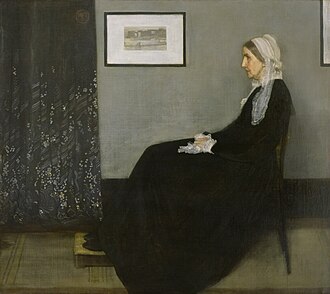 Arrangement in Grau und Schwarz: Porträt der Mutter des Künstlers - James McNeill Whistler (1871)
%201862.jpg) Symphony in weiss, No. 1: Mädchen in weiss - James McNeill Whistler (1860s)
Symphony in weiss, No. 1: Mädchen in weiss - James McNeill Whistler (1860s)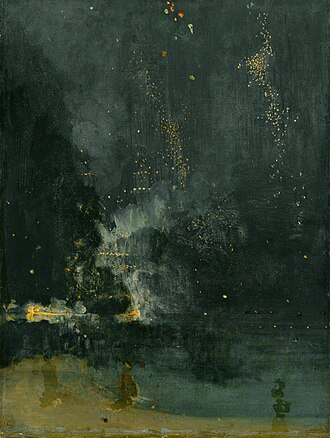 Nocturne in Schwarz und Gold: Die fallende Rakete - James McNeill Whistler (1875)
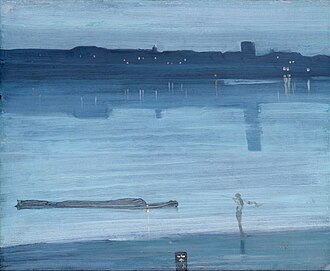 Nocturne: Blau und Silber – Chelsea - James McNeill Whistler (1871)
%201864.jpg) Symphonie in Weiß Nr. 2, Mädchen in Weiß - James McNeill Whistler (1864)
Symphonie in Weiß Nr. 2, Mädchen in Weiß - James McNeill Whistler (1864)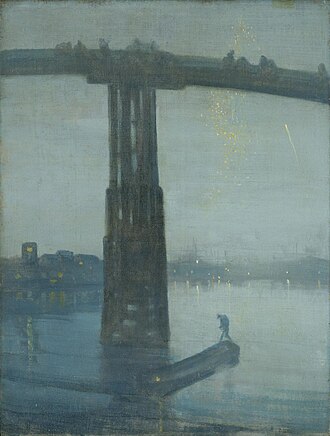 Die alte Battersea Brücke: Nocturne-Blau und Gold - James McNeill Whistler (1872)
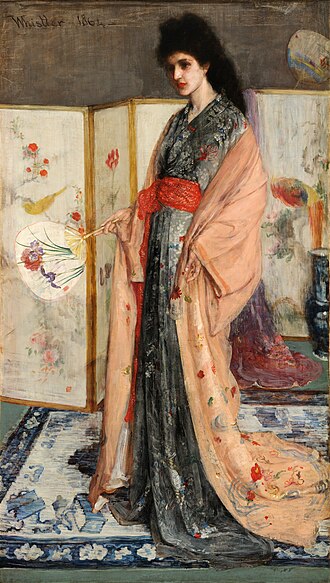 The Princess from the Land of Porcelain - James McNeill Whistler (1860s)
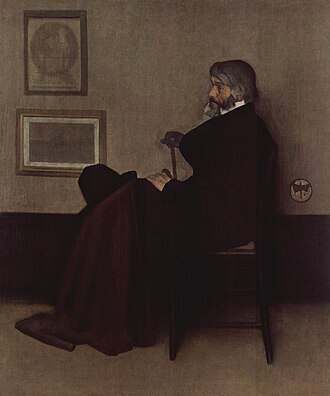 Arrangement in Grau und Schwarz, Porträt des Thomas Carlyle - James McNeill Whistler (1870s)