The Princess from the Land of Porcelain
James McNeill Whistler · 1860s
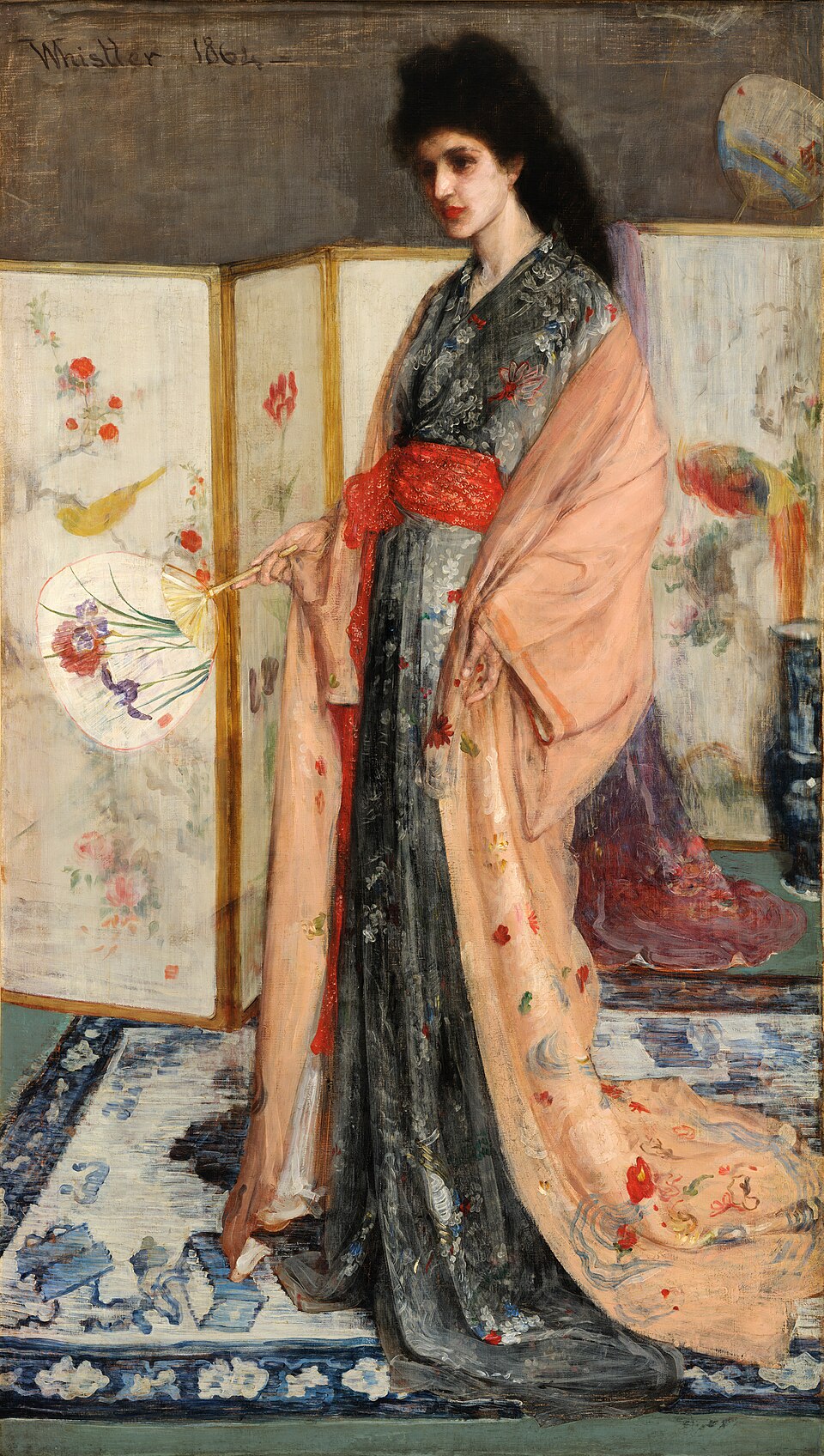
A young woman in a kimono stands among a folding screen, a rug and a great porcelain vase, fan in hand, looking ahead wistfully. Whistler's princess later became the reason for one of the most famous rooms in art, the Peacock Room.
The story behind the painting
Whistler painted the picture between 1863 and 1865, with Christine Spartali as his model. She was the sister of the Pre-Raphaelite artist Marie Spartali Stillman, and Smithsonian Magazine described her as an Anglo-Greek beauty whom all the artists of the day wanted to paint. Its full title is Rose and Silver: The Princess from the Land of Porcelain. When it was finished, Spartali's father refused to buy it, and another would-be buyer withdrew because of the large signature at the top, which may have led Whistler to develop his later butterfly signature.
What to look for
The woman wears a kimono in a Western manner and holds a hand fan, surrounded by Asian objects: a rug, a white Japanese folding screen that may have been Whistler's own, and a large decorative porcelain vase. The whole is painted loosely. Look at the frame too: it repeats motifs from the picture, interlocking circles and many rectangles. There is no gold in the painting itself, but its yellow and ochre tones were chosen to answer the gold and blue of the room it later hung in. A surviving sketch shows flowers that Whistler removed from the final work.
Meaning and intent
The painting is one of several from these years that place a Western woman in Asian costume and settings, reflecting the Anglo-Japanese taste of the time. Critics have seen the influence of the Japanese woodblock artist Kitagawa Utamaro and of 18th-century French chinoiserie. At the 1865 Paris Salon, Gustave Vattier wrote that the picture was not ready, that a child's breath could blow it over, and that it was nothing but whim and fantasy. The scholar Caroline Doswell Older later argued that without its frame it looks like a carelessly cropped photograph, but framed it holds its own.
Legacy
After passing through several hands, the painting was bought by the shipping magnate Frederick Leyland, who hung it in a dining room full of Kangxi porcelain. Whistler, asked to adjust the room's colours to suit it, transformed the whole interior into The Peacock Room, going further than Leyland wished and causing a quarrel between them. Charles Lang Freer acquired the painting in 1903 and the room the next year, and gave both to the Smithsonian in 1906. Today the princess hangs above the fireplace of the Peacock Room in the Freer Gallery of Art in Washington.
Schon gewusst?
- Painted 1863 to 1865 with Christine Spartali as the model.
- Shown at the Paris Salon of 1865.
- The Peacock Room was designed around it for Frederick Leyland.
- Hangs above the fireplace of the Peacock Room in the Freer Gallery.
Über den Künstler
James McNeill Whistler (1834-1903)
Frau · Porträt · Fächer · Vase · Talar · Schärpe · Orientteppich
Mehr von James McNeill Whistler
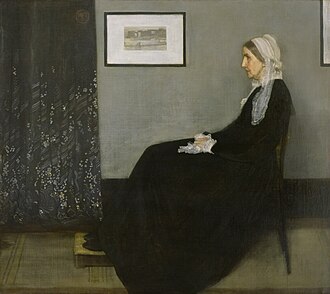 Arrangement in Grau und Schwarz: Porträt der Mutter des Künstlers - James McNeill Whistler (1871)
%201862.jpg) Symphony in weiss, No. 1: Mädchen in weiss - James McNeill Whistler (1860s)
Symphony in weiss, No. 1: Mädchen in weiss - James McNeill Whistler (1860s)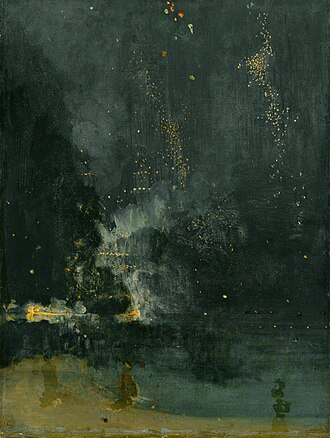 Nocturne in Schwarz und Gold: Die fallende Rakete - James McNeill Whistler (1875)
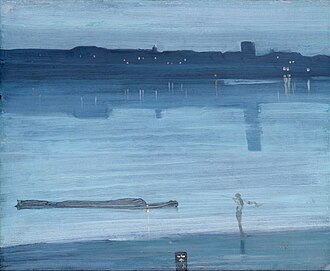 Nocturne: Blau und Silber – Chelsea - James McNeill Whistler (1871)
%201864.jpg) Symphonie in Weiß Nr. 2, Mädchen in Weiß - James McNeill Whistler (1864)
Symphonie in Weiß Nr. 2, Mädchen in Weiß - James McNeill Whistler (1864)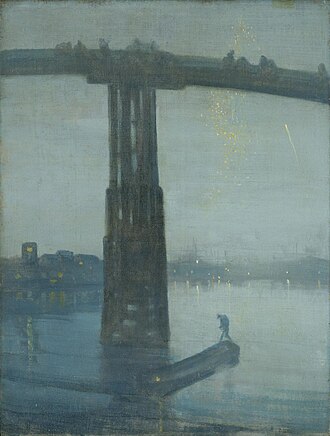 Die alte Battersea Brücke: Nocturne-Blau und Gold - James McNeill Whistler (1872)
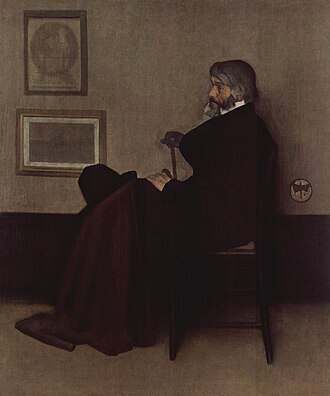 Arrangement in Grau und Schwarz, Porträt des Thomas Carlyle - James McNeill Whistler (1870s)
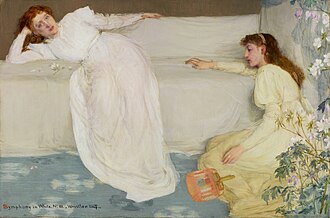 Symphonie in Weiß Nr. 3 - James McNeill Whistler (1860s)