Die Anbetung der Hirten
El Greco · 1570s
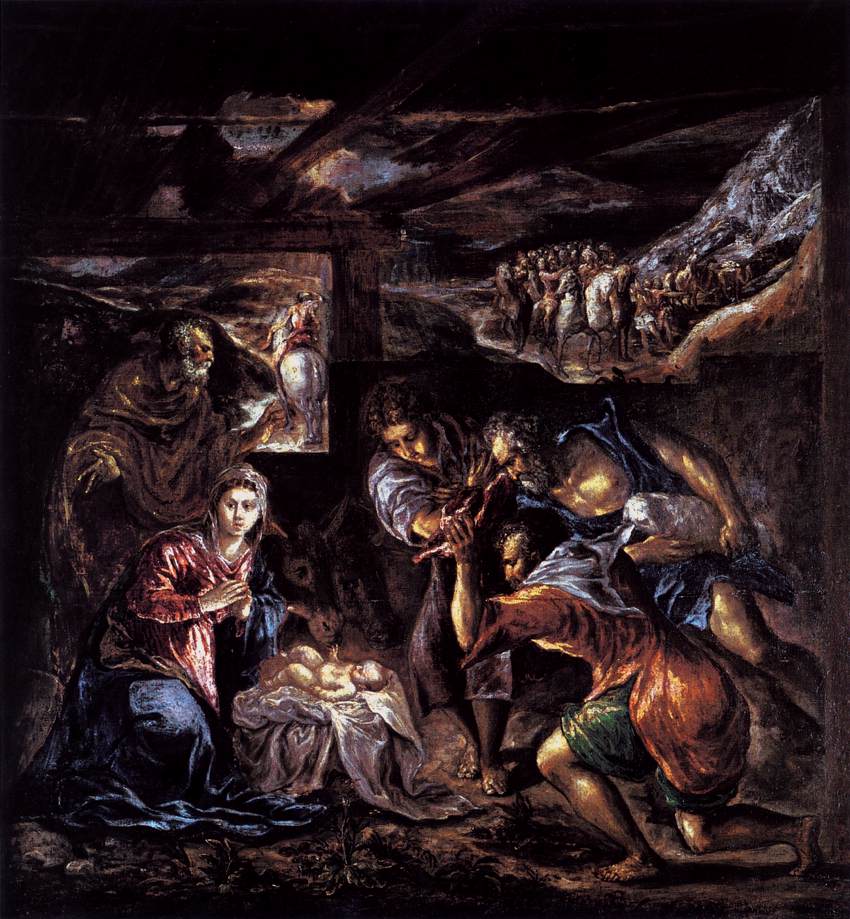
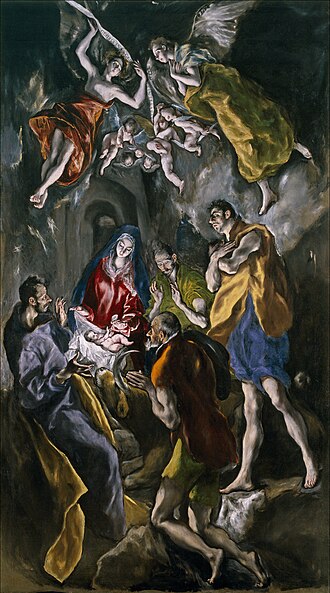
A shepherd takes off his hat, another offers a lamb, and the naked Child is the source of all the light. For two centuries nobody knew this was an El Greco: it was given to Lanfranco, then to Bassano.
The story behind the painting
El Greco painted the Adoration of the Shepherds many times across his life. The art historian Harold Wethey considered this canvas the first securely autograph version, since he doubted that the Modena Triptych is by El Greco. Its attribution took a long road. In the eighteenth century it was given to Giovanni Lanfranco, and from 1820 it was thought to be by Jacopo Bassano or his circle. In 1951 Wethey attributed it to El Greco, because some figures closely match the old man and youth in his Healing of the Blind Man in Dresden. Most specialists agreed.
What to look for
Inside the stable, a kneeling shepherd removes his hat and another offers a lamb to the Child. On the left the Virgin kneels toward the naked Child, looking out at the viewer. The Child is the source of light in the scene, as in all El Greco's later versions. An ox and a donkey lean toward him, a lone rider appears behind the wall at left, and on the right turbaned horsemen approach with a retinue on horses and camels. Notice the colour: the Virgin's pink tunic and blue mantle, Joseph's yellow-brown cloak, the kneeling shepherd in yellow with green breeches and a pink hat.
Meaning and intent
The subject comes from the Gospel of Luke, the only Gospel that tells how shepherds came after the birth of Jesus and the angel's announcement. The horsemen on the right look ahead to the next episode, the Adoration of the Magi, so one picture holds the poor and the kings arriving at the same child. The lighting and modelling show the influence of Titian and Tintoretto, and lively brushstrokes create a solemn atmosphere. The faces are expressive and idealised, above all Mary's, while a grey landscape and dark brown architecture set off the rich colours.
Legacy
The dating differs among authors: Wethey placed it around 1565, while others suggest around 1570, and Wikidata puts it in the 1570s. The canvas, about 114 by 104 cm according to José Gudiol, belongs to the collection of the Duke of Buccleuch at Boughton House, Kettering, in England. It carries number 24 in Wethey's catalogue raisonné. Its story shows how a painting can wait a long time for its real name, and how one composition already holds the light-filled Child that El Greco would paint again and again.
Schon gewusst?
- Long attributed to Lanfranco and then to Bassano.
- Attributed to El Greco by Harold Wethey in 1951.
- Dated around 1565 by Wethey, around 1570 by others.
- In the Duke of Buccleuch's collection at Boughton House.
Über den Künstler
El Greco (1541-1614)
Mehr von El Greco
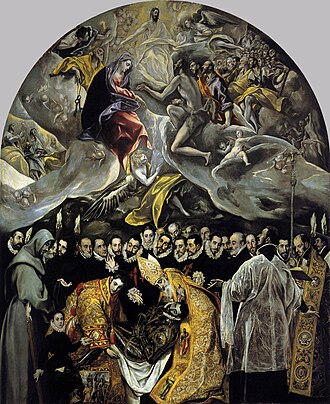 Begräbnis des Grafen von Orgaz - El Greco (1586)
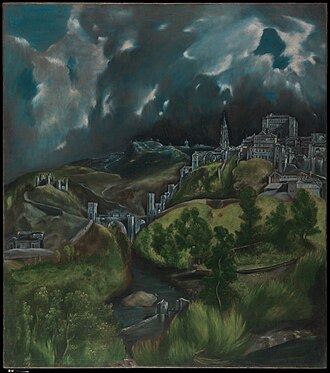 Ansicht von Toledo - El Greco (1596)
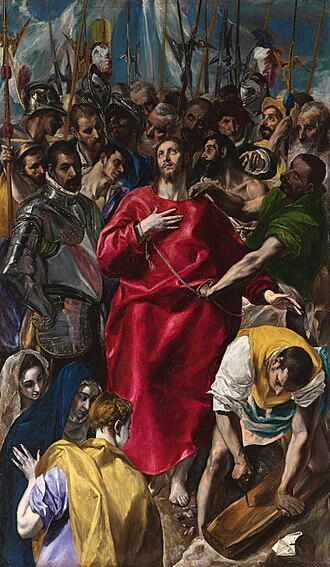 Die Entkleidung Christi - El Greco (1570s)
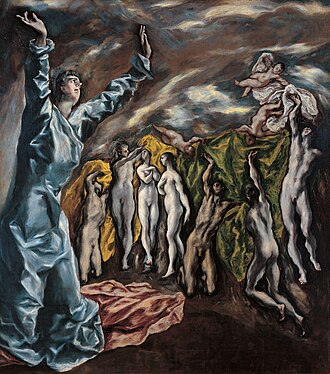 Die Öffnung des fünften Siegels - El Greco (1610)
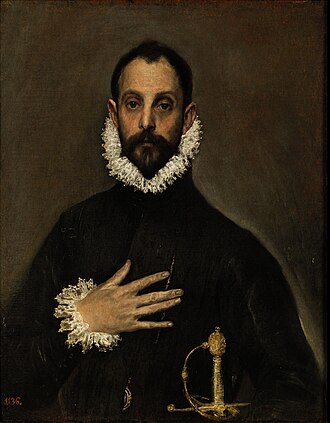 Bildnis eines Edelmanns mit der Hand auf der Brust - El Greco (1580)
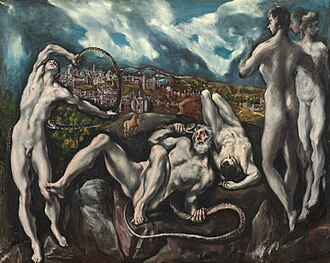 Laokoon - El Greco (1610s)
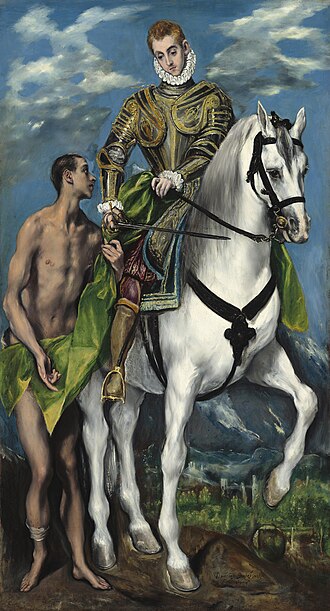 Der hl. Martin und der Bettler - El Greco (1597)
 Anbetung der Hirten - El Greco (1612)
Werke verwandter Künstler
 Die Hochzeit zu Kana - Paolo Veronese (1560s)
 Das Gastmahl im Hause des Levi - Paolo Veronese (1573)
 Das letzte Abendmahl - Jacopo Tintoretto (1563)
 Der heilige Markus befreit den gefesselten Sklaven - Jacopo Tintoretto (1540s)
 Venus von Urbino - Titian (1538)
 Mariä Himmelfahrt - Titian (1510s)
 Das Abendmahl in Emmaus - Caravaggio (1601)
 Die Berufung des Hl. Matthäus - Caravaggio (1609)
 Die Gesandten - Hans Holbein the Younger (1533)
 Der Leichnam Christi im Grabe - Hans Holbein the Younger (1520s)