Anbetung der Könige
Peter Paul Rubens · 1616
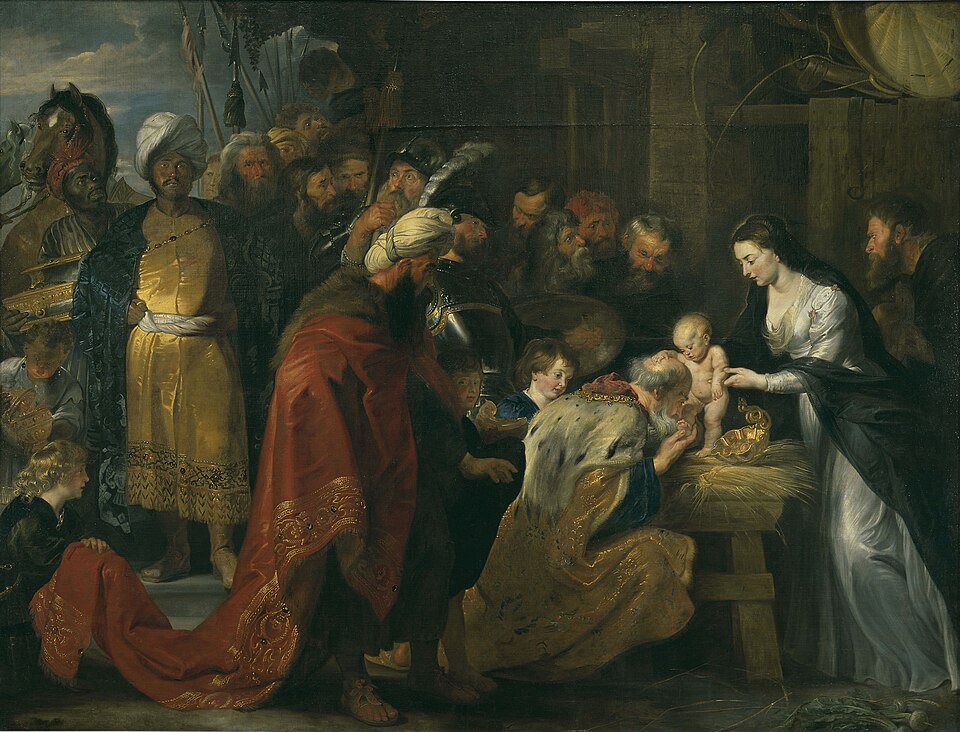
The oldest king kneels and kisses the Child's foot, and the Child lays a small hand on his bald head. For centuries this wide Rubens canvas was dismissed as a mere copy, until an exhibition in Paris gave it back its name.
The story behind the painting
Rubens painted the Adoration of the Magi many times, but most versions are tall altarpieces for churches. This one is wide, about 245 by 325 cm, and the art historian Peter C. Sutton suggested that the horizontal format points to a private, secular commission, like the Adoration Rubens painted for Antwerp's town hall around 1608 to 1609. Wikipedia dates the canvas c. 1617 to 1618, while Wikidata gives 1616. Rubens also earned considerable sums from reproductions of the composition in engravings and tapestries.
What to look for
Full-length figures stretch across the canvas, backed by a crowd arranged like a frieze: twelve mature men of different types, soldiers, onlookers, even horses filling every gap. The Virgin presents the Child, who stands on a table strewn with straw. The oldest magus kneels and kisses one of his feet with great tenderness, and the Child rests his hand on the man's bald head in blessing. The magi wear bright garments whose folds curl into arabesques, and servants hold up their gifts. A shaft of light from the left cuts through the dim stable.
Meaning and intent
The source calls the scene a desacralised version of the Adoration: there are no halos or heavenly signs, only people pressing close in a dark barn. The holiness lies in one small exchange, an old man's kiss and a child's touch, set against a noisy crowd. That contrast between the vast frieze of faces and the quiet centre is what makes the picture feel both grand and intimate, in the Baroque manner of movement and light.
Legacy
In September 1698 Maximilian II Emanuel, Elector of Bavaria, bought the painting in Antwerp from Gijsbert van Ceulen, in a spectacular group that included twelve other Rubens paintings now in the Alte Pinakothek in Munich. Yet this canvas languished for a long time as a copy. Only when Jacques Fouquart showed it in the exhibition Le siècle de Rubens in Paris in 1977 to 1978 was it recognised as a major work by Rubens. Today it is in the Musée des Beaux-Arts de Lyon; Wikidata also lists the Louvre's department of paintings.
Schon gewusst?
- A horizontal Adoration, probably for a private patron.
- Bought in Antwerp in 1698 by the Elector of Bavaria.
- Long considered a copy, recognised as Rubens in Paris in 1977 to 1978.
- Now in the Musée des Beaux-Arts de Lyon.
Über den Künstler
Peter Paul Rubens (1577-1640)
religiöse Kunst · Maria · Jesuskind · Gemäldeabteilung des Louvre · Anbetung der Könige · Heilige Drei Könige · Soldat · Anbetung · Musée des Beaux-Arts de Lyon
Mehr von Peter Paul Rubens
.jpg) Die Aufrichtung des Kreuzes - Peter Paul Rubens (1609)
Die Aufrichtung des Kreuzes - Peter Paul Rubens (1609)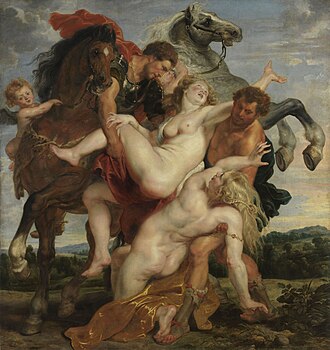 Der Raub der Töchter des Leukippos - Peter Paul Rubens (1618)
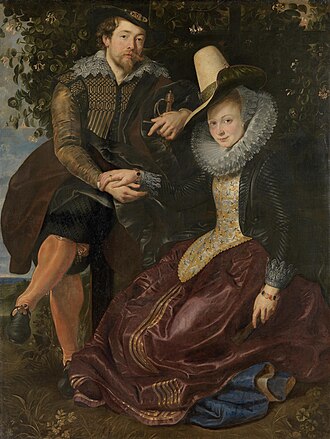 Rubens und Isabella Brant in der Geißblattlaube - Peter Paul Rubens (1600s)
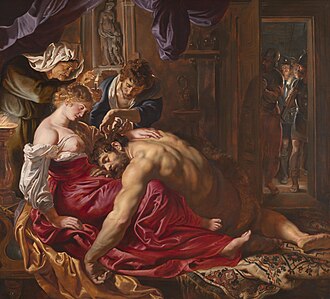 Samson und Delilah - Peter Paul Rubens (1600s)
 Kreuzabnahme - Peter Paul Rubens (1611)
 Haupt der Medusa - Peter Paul Rubens (1618)
 Helena Fourment - Peter Paul Rubens (1638)
.jpg) Der Liebesgarten - Peter Paul Rubens (1632)
Der Liebesgarten - Peter Paul Rubens (1632)
Werke verwandter Künstler
 Die Sternennacht - Vincent van Gogh (1889)
.jpg) Caféterrasse am Abend - Vincent van Gogh (1888)
Caféterrasse am Abend - Vincent van Gogh (1888) Das Abendmahl in Emmaus - Caravaggio (1601)
 Die Berufung des Hl. Matthäus - Caravaggio (1609)
 Las Meninas - Diego Velázquez (1656)
 Die Übergabe von Breda - Diego Velázquez (1635)
%20-%20Google%20Art%20Project.jpg) Dreifachporträt von Karl I. - Anthony van Dyck (1635)
Dreifachporträt von Karl I. - Anthony van Dyck (1635)%20with%20M.%20de%20St%20Antoine%20-%20Google%20Art%20Project.jpg) Karl I mit M. de St. Antoine - Anthony van Dyck (1636)
Karl I mit M. de St. Antoine - Anthony van Dyck (1636) Die Nachtwache - Rembrandt van Rijn (1642)
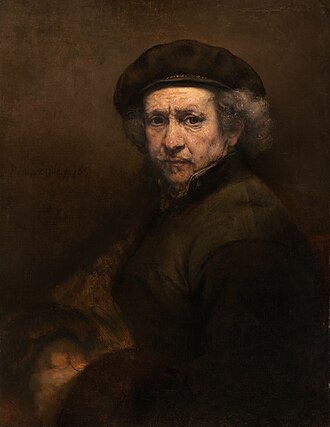 Selbstbildnis - Rembrandt van Rijn (1659)
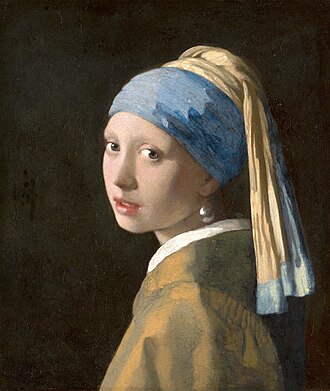 Das Mädchen mit dem Perlenohrgehänge - Johannes Vermeer (1665)
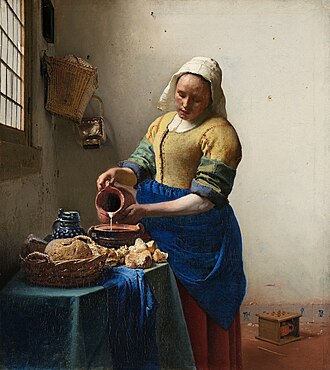 Dienstmagd mit Milchkrug - Johannes Vermeer (c. 1658)