荒れ模様の空の麦畑
Vincent van Gogh · 1890
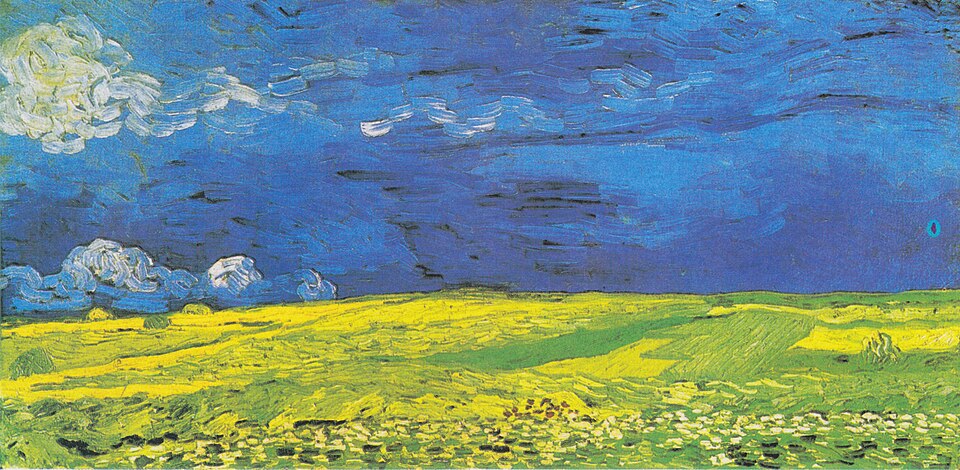
Green wheat stretches under a dark, heavy sky. Van Gogh painted it a few weeks before his death and wrote that such canvases would say what he could not put into words.
The story behind the painting
This very late work was painted in early July 1890 in Auvers-sur-Oise, just a few weeks before Van Gogh's death. In a letter of around 10 July to his brother Theo and his sister-in-law Jo, written after visiting them in Paris on 6 July, he said he had already painted three large canvases. One was Daubigny's Garden. The other two he described as immense stretches of wheatfields under turbulent skies, probably this painting and Wheatfield with Crows. He hoped to bring them to Paris as soon as possible, so that the paintings could speak for him.
What to look for
The canvas measures 50.4 by 101.3 cm, an unusually elongated double-square format that Van Gogh used for several wheatfield paintings at Auvers, including Wheatfield with Crows and Landscape at Auvers in the Rain. It shows a relatively flat, featureless landscape with fields of green wheat under a foreboding dark blue sky with a few heavy white clouds. The horizon divides the picture almost in two: shades of green and yellow below, shades of blue and white above. There are no figures, no paths, only the field and the weather pressing down on it.
Meaning and intent
In the same letter Van Gogh wrote that in these wheatfields he was trying to express sadness and extreme loneliness. Yet he added that the canvases would tell Theo and Jo what he could not say in words, what he saw as healthy and fortifying about the countryside. The painting holds both feelings at once: the weight of the darkening sky and the steady, living green of the young wheat. Reading his words beside the picture, one can feel how he hoped the land itself might carry comfort, even in a time of deep unease.
Legacy
Van Gogh shot himself on 27 July and died in Auvers on 29 July 1890; by then the three paintings were already with Theo in Paris. After Theo's death in January 1891 they passed to his widow Johanna van Gogh-Bonger, who lent this painting to the Rijksmuseum in Amsterdam from 1917 to 1919. After her death in 1925 it went to their son Vincent Willem van Gogh. It was transferred to the Vincent van Gogh Foundation in 1962, shown at the Stedelijk Museum until 1973, and since then has been on permanent loan to the Van Gogh Museum in Amsterdam.
豆知識
- Painted in early July 1890 in Auvers-sur-Oise.
- Uses an elongated double-square format, 50.4 x 101.3 cm.
- Van Gogh wrote he was trying to express sadness and extreme loneliness.
- On permanent loan to the Van Gogh Museum since 1973.
画家について
Vincent van Gogh (1853-1890)
風景画 · ファン・ゴッホ美術館 · 雲 · 畑 · コムギ属
同じ画家の作品: Vincent van Gogh
 星月夜 - Vincent van Gogh (1889)
 夜のカフェテラス - Vincent van Gogh (1888)
 ひまわり - Vincent van Gogh (1888)
 花咲くアーモンドの木の枝 - Vincent van Gogh (1890)
 カラスのいる麦畑 - Vincent van Gogh (1890)
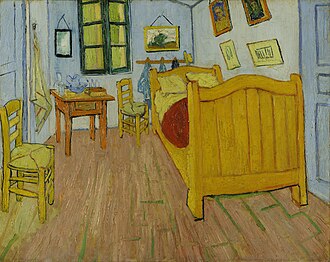 アルルの寝室 - Vincent van Gogh (1888)
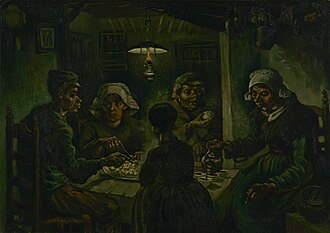 ジャガイモを食べる人々 - Vincent van Gogh (1885)
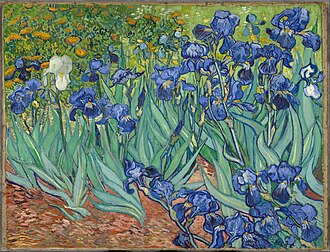 アイリス - Vincent van Gogh (1889)
関連する画家の作品
 大水浴図 - Paul Cézanne (1900s)
 赤いチョッキの少年 - Paul Cézanne
 我々はどこから来たのか 我々は何者か 我々はどこへ行くのか - Paul Gauguin (1897-1898)
 黄色いキリスト - Paul Gauguin (1889)
 キリスト昇架 - Peter Paul Rubens (1609)
 レウキッポスの娘たちの略奪 - Peter Paul Rubens (1618)
 Walk on the mountain - Joaquín Sorolla (1909)
 Sad Inheritance - Joaquín Sorolla (1898)
 ムーラン・ド・ラ・ギャレットの舞踏会 - Pierre-Auguste Renoir (1876)
 舟遊びの昼食 - Pierre-Auguste Renoir (1881)
 ムーラン・ルージュ - Henri de Toulouse-Lautrec (1892)
 La Toilette - Henri de Toulouse-Lautrec (1896)